Blog
Get Pay Right on ADP Workforce Now® Next Gen™
Bringing trusted compensation intelligence and seamless planning to even more ADP users.
Written by Salary.com Staff
June 12, 2026

Commissions are compensation given to sales employees when they hit sales targets. There are a lot of commission structures used by companies, and one of these is a tiered commission.
Find out what this compensation structure means and how to administer it within your sales team.
A tiered commission is a type of incentive compensation model where employees earn higher commission rates when they surpass the set sales targets. This design is for incentivizing overachievement while also controlling compensation costs.
To give you an idea on what a tiered commission looks like in practice, here is an example of the model:
| Tier | Quota attainment | Commission rate | Type |
|---|---|---|---|
| 1 | 75% and below | 4% | Base |
| 2 | 76% to 100% | 7% | Standard |
| 3 | 101% to 125% | 10% | Accelerator |
| 4 | 126% and above | 13% | High accelerator |
For you to design an effective tiered structure, you first need to know what are the elements that make up this commission strategy. Here are the important components you need to incorporate in your tiered incentives:
| Component | What it is | Impact on business |
|---|---|---|
| Sales quota | Baseline of performance target assigned to sales employees | Serves as the basis of all commission calculations |
| Tier thresholds | Established performance levels or breakpoints | Promotes employee motivation to achieve key milestones |
| Commission rate | Percentage earned by sales employees at each tier | Determines how much employees are paid based on sales |
| Accelerator rates | Higher commission rates are applied when employees exceed the quota | Rewards higher performers and encourages overachievement |
| Incentive compensation plan | Overall structure managing the design and payouts of incentives in a company | Makes sure the compensation is aligned with the business objectives and strategy |
Another crucial thing when establishing a tiered structure for commissions is to create clear, fair, and financially viable payouts. To do that, you need to remember these principles:
Maintain a simple tier system; 3 to 5 tiers are enough to make well-defined levels as too many tiers can lead to confusion.
Assign tiers with realistic performance in mind, making employees feel the incentive plan is achievable and motivating.
The progression of earnings must be obvious so that top performers can see higher performance reflecting higher pay.
Reward strong sales behavior without going over the budget, ensuring cost control while providing meaningful incentives.
Ensure these key principles are applied in your incentive program through CompXL®, where you can effectively plan your commissions, track your budget, and access approval workflow on a single, streamlined platform.
Here are steps on how you can implement a tiered structure for your commission strategy:
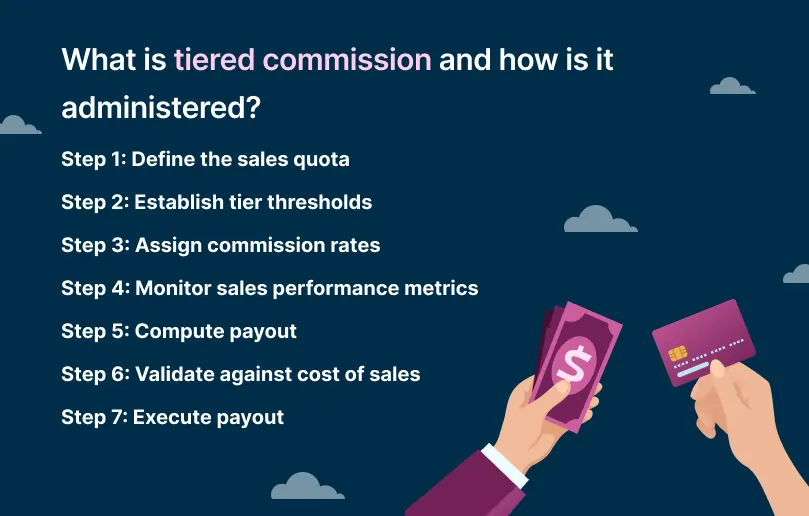
Establish the baseline for performance measurement by deciding what the target performance looks like for each role.
Once you decide on the quota, distribute performance into tiers such as 80%, 100%, and 120%. Each tier must represent a performance level.
Commission rates vary on which the performance belongs. Lower tiers get lower rates while higher tiers get higher rewards.
Compare the actual performance and the quota, feeding accurate data into your commission system.
Calculation of commissions include the following steps:
Measure total sales revenue against the assigned sales quota.
Map the employee's performance to the relevant tier thresholds.
Apply the commission rate based on the tier.
Add the tier payouts to determine the total commission earned by the employee.
Before making payout, evaluate whether the commission stayed within the budget by comparing the payout vs the generated revenue.
The approved commission is given to employees. Document these payouts and results for auditing and reporting purposes.
Automate commission calculations, simplify plan management, and provide clear and detailed payout statements to your sales reps through CompXL® Commission Management.
You also must ensure that your commission structure is aligned with the financial health of your organization. One way to do this is through a key financial metric, which is the cost of sales.
| Metric | Calculation | Target range | Why it matters |
|---|---|---|---|
| Cost of sales | Commission ÷ Revenue | 5% to 12% | This ensures commission are profitable and scalable |
In practice, this tells you whether:
Incentive payouts are negatively affecting the revenue
Commission plan is financially sustainable
Revenue is efficiently converted into profit
Since the tiered structure is part of your compensation system, you must maintain it in terms of cost control and pay fairness for employees. To do that, effective management must be practiced on a regular basis.
Here are some of the best practices:
Approval workflow must be in place, where any changes in tiers, rates, or quotas go through a structured process, ensuring consistent and well-planned pay decisions.
Payouts must be traced from its calculations for a transparent and audit-ready incentive system.
Incentive and tier rules must be written in a simple and structured manner to easily understand how payouts are determined.
Validation of payouts must be done regularly to ensure accurate calculations and alignment with the incentive plan design.
Here are frequently asked questions:
Flat commissions pay employees the same percentage regardless of sales.
Example: The rate never changes for a 5% flat commission rate, where the commission for $100,000 is $5,000, while $200,000 is $10,000.
Meanwhile, tiered commissions have escalating rates at defined performance thresholds.
Example: An employee earns 5% on the first $50,000, 10% on the next $50,000, and 12% on anything above that.
The common mistakes in tiered design include:
Setting unrealistic quotas
Creating a complex commission structure
No alignment between commissions and company objectives
Not considering the sales team dynamics
Not reviewing or adjusting the commission structure regularly
Yes, it can be based on profit, where the employee's earnings are directly linked to the profitability of each sale. Rather than receiving the percentage of the total price of sale, employees earn the percentage of the gross margin.

The latest research, expert advice, and compensation best practices all in one place.
Blog
Bringing trusted compensation intelligence and seamless planning to even more ADP users.

Blog
Learn how to train managers for effective pay conversations and build trust.

Blog
Total rewards package flexibility lets employees choose what matters - pay, perks, and benefits tailored to their needs.