Blog
Get Pay Right on ADP Workforce Now® Next Gen™
Bringing trusted compensation intelligence and seamless planning to even more ADP users.
Written by Salary.com Staff
June 20, 2025

Many organizations have adopted the practice of turning employee feedback into key insights.
These insights are gathered from the key moments of an entire employee lifecycle, starting from the onboarding process to exit interviews, encapsulating the employee journey. The feedback enables HR professionals to navigate workforce needs and talent management.
Auto-audit pay gaps. Eliminate bias before it strikes.
One way of organically collecting data from workers is by listening to them. With different listening tools, this strategy has proven its importance in understanding workers and building trust in the workplace.
To further understand this strategy, read on as we discuss what employee listening is, its examples and best practices, and how to build one in your organization.
Employee listening is an act of gathering thoughts and sentiments from employees to understand workforce needs, determine problems, and make data-driven decisions for positive employee experience and organizational success.
To do this, the company must establish an employee listening strategy.
Now, what is employee listening strategy? This system is built on continuous, regular, and real-time feedback from workers. It can be in various forms, such as pulse survey results or focus groups, promoting employee engagement and productivity.
What better way to show employees that you value them than openly communicating fair pay, performance, and opportunities. Through the Pay Equity tool, affirm the workforce that the company fosters salary that is externally competitive and transparently communicated.
Listening to the workers helps companies build an employee-centric system, where open employee communication, psychological safety, innovation, collaboration, and diversity are promoted. It gives importance to the people responsible for producing goods and services in the company.
Here are other reasons why listening to employees is important:
Helps understand employee needs
The perspective of business leaders on workforce conditions is limited if they do not consult with the employees. By listening and understanding the workers’ feedback, they can tailor strategies that will benefit both the employees and the company.
Builds strong relationship
The relationship between managers and staff is tighter since the employees feel valued. This bond leads to positive outcomes, such as good turnover and retention rates, better collaborative work, and more motivation to achieve team success.
Evaluates strategies
Employee feedback process enables the management to acknowledge blind spots and fresh ideas and improve talent strategies to better accommodate workforce needs. This continuous listening strategy builds organizational success step by step.
Boosts engagement
Employees are more engaged when they feel that their voice matters in the team. With this increased engagement come positive effects, such as productivity, profitability, customer satisfaction, innovation, and adaptability.
Speeds up conflict resolution
Unlike the traditional annual engagement surveys and performance reviews, regularly listening to employees brings an immediate action to real-time insights and issues, which leads to a more dynamic and proactive way of management.
Improves employee retention
The act of listening to employees is a step in understanding what your employee needs to stay in the company. Once the management learns this, they will be able to provide development opportunities for workers to remain in the same organization.
Establishing a listening strategy is not only about hearing your employees’ concerns. It must follow a process to make the listening productive, positive, and empathetic. Here are 6 steps on how to do that:
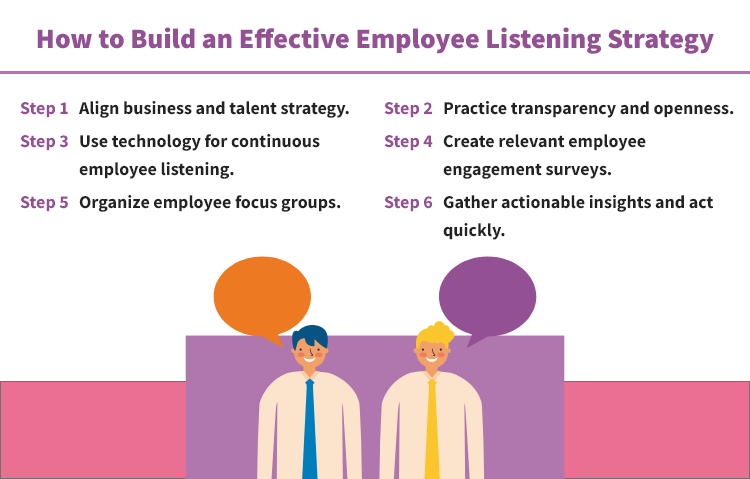
Ensure that your listening initiatives are aligned with the overall objectives of your company. Define the business priorities and assess how listening to employees can solidify and achieve them. Involve key stakeholders to make your listening strategy well-supported.
Good communication is key to listening and voicing out employee feedback. Of course, an open and transparent conversation must be earned. To have this, cultivate mutual respect, provide support, and implement meaningful actions to gain the trust of the workforce.
AI tools help achieve a successful employee listening programs can help HR department customize and send employee survey questions, reveal hidden patterns, forecast potential issues, promote ongoing dialogue, and respond effectively on immediate feedback using automation.
Employee engagement survey responses measure the motivation, productivity, and morale of workers. To avoid survey fatigue, questions must be specific to a company’s workforce to gain insightful survey data. When surveys are relevant to the daily work of employees, they are more involved in giving valuable feedback.
Focus groups help listening strategy by providing thorough qualitative insights to identify work trends, determine the strengths and weaknesses of the company, comprehend workforce sentiments, and give avenue for employees to voice out their feedback.
Having a timely response to the feedback is vital in upholding the listening strategy. The response rate demonstrates how much the management values the employee insights. If a concern cannot be acted upon, properly explain why and propose alternative solutions.
With the progressive environment nowadays, there are now a lot of innovative ways to listen to employees. Here are some of them:
Real-time feedback mechanisms
With a fast-paced work environment, some teams do not have the time to conduct meetings and one-on-one sessions with employees. So, having mechanisms like suggestion boxes, instant messaging platforms, and mobile apps helps the sharing of concerns more efficiently and responsively.
Employee listening sessions
These sessions are structured to encourage employees to share their sentiments and concerns. It is usually assisted by a third party for a transparent discussion. Here are some examples of questions asked in these sessions depending on various aspects:
A. Employee satisfaction
From 1 to 10, how satisfied are you in your current position?
Is your work recognized and appreciated by your leader?
What are the reasons for your satisfaction or dissatisfaction in the company?
B. Workplace culture
How would you describe your company culture?
Does the management value an inclusive, equitable, and diverse culture?
Do you feel a sense of community and recognition in the company?
C. Compensation and benefits
Does your company practice pay transparency? In what aspect?
How competitive are your benefits compared to the market?
Do all employees understand the pay structure of the company?
When it comes to compensation and benefits, ensure that the company culture promotes pay transparency by Assessing Pay Gaps. Salary.com’s pay gap assessment uses demographic distribution and pay levels to evaluate disparities in compensation practices and help promote equitable salary, encouraging employee engagement and satisfaction.
Employee listening strategy is an ongoing process, and it will get more effective once the organization learns to live by the best practices to maintain its purpose. Here are some of the approaches you can use for your company:
Establish privacy and confidentiality
For a successful employee listening strategy, assure your employees that the gathered feedback and concern are secure and protected. This will help alleviate their fear of retaliation and promote an open and ongoing dialogue.
Offer multi-channel feedback
Each employee has their own communication style, so it is best to not only stick to annual surveys and reviews. There are virtual channels like email surveys and mobile platforms, in-person discussions like focus groups and one-on-one conversations, and employee resource groups.
Provide competitive pay
A livable and competitive salary is one of the most priorities for every employee. Ensure that they get a fair pay that matches their job roles and the current market. This gives the impression that the company values their employees’ voice and worth.
One-click compliance reports for state pay equity laws.
A huge step in listening to employees' needs is to give them an equitable pay structure for Comparable Work. With automatic synching of HR data, you can price jobs according to similar responsibilities and provide market-competitive salaries through factors like skills, qualifications, and knowledge.

The latest research, expert advice, and compensation best practices all in one place.
Blog
Bringing trusted compensation intelligence and seamless planning to even more ADP users.

Blog
Learn how to train managers for effective pay conversations and build trust.

Blog
Total rewards package flexibility lets employees choose what matters - pay, perks, and benefits tailored to their needs.