Blog
Get Pay Right on ADP Workforce Now® Next Gen™
Bringing trusted compensation intelligence and seamless planning to even more ADP users.
Written by Salary.com Staff
May 16, 2025

Developing talent is more than just a company necessity, it’s a proven and tested business strategy that can turn your top talents into precious assets. And as we all know, these top talents can serve as the engine of your company’s success.
For HR professionals and business leaders, an effective talent development strategy not only drives top-notch organizational performance—but it also offers sustainable growth, employee engagement, and a competitive edge in the industry’s competitive landscape.
Today, we’ll discuss everything you need to know about talent development strategies. What does it mean? Why is it important? What actionable steps can you take? And what are the real-world examples of these talent development strategies? Let’s find out!
Talent development refers to HR’s systematic approach in identifying, nurturing, and advancing employees’ skills, knowledge, and capabilities to meet current and future organizational needs. The primary goal is to align employee growth with business objectives, ensuring that your workforce remains agile, innovative, and prepared for evolving challenges.
A talent strategy encompasses a wide range of activities, including the following:
On-the-job training
Leadership development
Mentorship programs
Continuous learning
Skills assessment
Career planning
Succession planning
Performance management
As you can see, talent development isn’t just about upskilling; it’s about creating an environment where employees feel valued, engaged, and motivated to contribute to organizational growth. Utilizing the Skills Library can boost your organization’s talent management and learning development efforts through comprehensive AI technology.
A well-crafted talent development program brings a lot of positive benefits to the workplace. In fact, 59% of US employees believe that training has a direct and positive impact on their performance.
Therefore, talent development strategies are vital for several reasons:
Foster employee engagement and retention: Employees who feel valued and clearly see development opportunities are more likely to stay and perform at their highest level for a company.
Bridge skills gaps: Targeted and strategic talent development efforts address existing and emerging skills gaps, ensuring the organization is future-ready.
Drives positive organizational performance: By aligning the talent development strategy with your business goals, companies have greater potential to achieve innovation, productivity, and adaptability.
Supports succession planning: Effective talent development strategies can create future leaders from within; It secures business continuity and reduces the risks associated with talent shortages even in the long term.
Strengthens company culture: A culture of continuous learning and growth promotes a healthy and thriving workplace culture that makes employees feel valued and motivated.
Salary.com’s Skills Library helps a company like yours to hire with confidence and effectively attract top talents with the right skill sets, attitude, and credentials. It also fosters a culture of continuous growth and development by closing capability gaps.
Before proceeding to the actionable steps, you can take to create effective talent development strategies, let us first discuss the key differences between talent development and talent management. While often used interchangeably, these two HR terminologies have their own distinctions:
| Aspect | Talent Development | Talent Management |
|---|---|---|
| Focus | To develop, enhance, and improve employee skills. | To attract, retain, and manage talent. |
| Scope | Only has specific coverage such as learning, growth, and upskilling. | Has broad coverage including recruitment, performance evaluation, employee retention, and succession. |
| Objective | Prepare and train employees for future roles in the company and close skill gaps. | Optimize human capital or manpower to achieve business goals. |
| Activities | Training programs, mentorships, internships, coaching, and on-the-job learning. | Recruitment process, onboarding, performance management, and succession planning. |
Simply put, talent management focuses on the entire employee lifecycle, while talent development emphasizes growing and advancing existing employees’ skills to meet organizational objectives.
Creating an effective talent development strategy requires adequate preparation and careful analysis to ensure success. Here are four actionable steps you can take to get started:
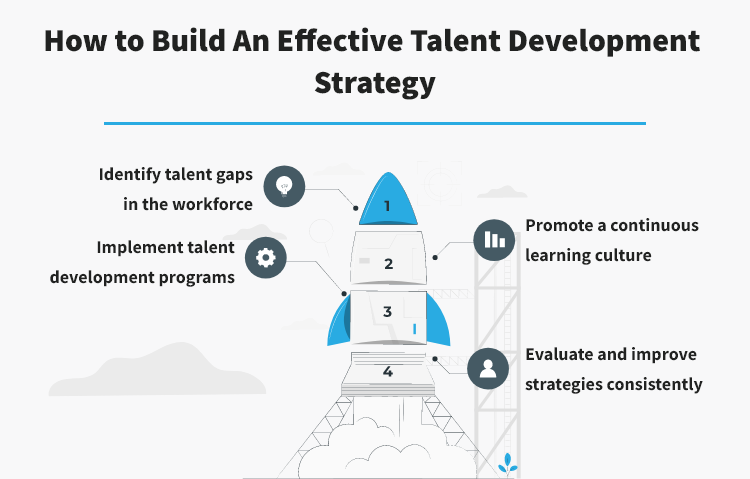
You can begin with a thorough analysis of your current workforce to pinpoint skills gaps and development needs. This ensures your development strategy is data-driven and aligned with business performance.
Make sure to utilize tools such as Salary.com’s Skills Library, which is the industry’s most comprehensive AI-powered software for data collection of basic skills and competencies. Moreover, talent development interviews provided by talent managers may also reveal valuable insights along the process.
A culture of continuous learning is definitely crucial and essential for organizational growth. Do your best to encourage employees to pursue learning and development opportunities through formal training, online courses, and on-the-job training opportunities.
Leadership should serve as role models in learning behaviors, and HR should be able to provide resources such as workshops, e-learning platforms, and mentorship programs to foster ongoing development.
The next step would be to design and roll out talent development initiatives that cater to diverse learning styles and business needs. Some of these examples are the following:
Leadership development courses for future leaders
Mentorship and coaching to transfer knowledge and support career advancement
On-the-job learning through stretch assignments and cross-functional projects
Formal training and certification courses to build new skills and competencies
Performance coaching to provide real-time feedback and guidance
Make sure that you tailor these initiatives to align with organizational objectives and employee aspirations, ensuring everyone has access to meaningful growth opportunities.
Finally, continuous feedback and evaluation are critical for the success of any talent development strategy. It allows you to spot areas for improvement, solve arising problems, and tailor-fit your strategies according to the needs of your workforce.
Moreover, you can use employee performance management systems, regular check-ins, and talent development interviews to assess progress and gather input from employees and team managers. Adjust your programs based on outcomes and feedback to ensure they remain relevant and effective.
Effective talent development strategies can take many forms. After all, every employee has their own preferred learning style and habits. Here are a few real-world examples you can follow:
Onboarding and buddy programs: This is a program where new hires are typically paired with experienced employees to accelerate on-the-job learning, cultural integration, and even promote performance coaching.
Leadership development training: Companies invite and engage employees with high potential to participate in rotational assignments, special projects, and leadership workshops for the purpose of developing employees for future leadership roles.
Mentorship programs: This is when junior staff employees are matched with senior mentors to give support for career planning, skill-building, and succession planning. This is also one of the reasons why companies deem talent development important, because it's motivating employees to perform like their role models or mentors.
Continuous learning courses: Companies offer access to on-demand online learning, certification courses, and industry conferences to keep employees' skills updated.
Performance coaching: This includes regular one-on-one coaching sessions to help current employees set development goals, receive feedback, and guide career paths.
Cross-departmental projects: This program involves encouraging employees to join task forces or committees outside their usual roles and in other company departments to broaden their experience and discover hidden talents.
These talent development initiatives not only support individual employee growth but also help organizations achieve their strategic objectives and maintain a competitive edge. Combine these proven employee development strategies with a reliable Skills Library, and you’re already on the right track.
Investing in a comprehensive talent development strategy is essential for achieving organizational goals, meeting business objectives, and building a resilient, future-ready workforce.
By identifying talent gaps, promoting a corporate culture of continuous learning, implementing targeted development initiatives, and consistently evaluating progress, HR professionals and company leaders can ensure that their most valuable asset—their employees—are well-equipped and ready to meet the demands of tomorrow’s even more challenging times.

The latest research, expert advice, and compensation best practices all in one place.
Blog
Bringing trusted compensation intelligence and seamless planning to even more ADP users.

Blog
Learn how to train managers for effective pay conversations and build trust.

Blog
Total rewards package flexibility lets employees choose what matters - pay, perks, and benefits tailored to their needs.