Blog
Get Pay Right on ADP Workforce Now® Next Gen™
Bringing trusted compensation intelligence and seamless planning to even more ADP users.
Written by Salary.com Staff
June 26, 2026

Compensation budget is a crucial financial plan that helps companies allocate funds for paying their employees. The HR department uses this budget to strike a balance between offering employees what they require financially while also maintaining the company's financial limits. This budget allows companies to achieve their goals while ensuring that their employees are paid fairly and competitively.
This guide is geared towards HR and compensation professionals looking to create a compensation budget for their organizations. The steps included will enable readers to create an effective compensation budget for their organizations to help ensure their success.
The compensation budget is the total amount of money set aside to pay employees for their work within a specific timeframe, usually for a year. This payroll budget considers the base pay for each employee as well as any incentives and pay adjustments for employees. The payroll budget for a company aligns with the company's finances.
Professionals use it to plan merit increases and promotions. It prevents a company from overspending on employee salaries. The parameters can be reviewed regularly to ensure the company meets its business needs. Good management of the company ensures employee satisfaction and retention.
Many organizations use CompAnalyst® to design structured pay ranges that help ensure compensation remains aligned with both internal equity and market competitiveness.
A compensation budget includes several key parts that create a complete pay package.
Base salaries: This is the major component of total pay and applies to all positions. You can adjust this according to market changes and cost of living.
Merit increases and promotions: Use this to reward employees according to their performances and to aid their careers within the company.
Variable pay: This goes towards performance-based bonuses and rewards for employees.
Benefits and perks: The cost of providing health insurance, pension plans, and other benefits for employees.
Equity adjustments and other costs: This makes up any gap in employee pay and can be used for one-time payments to employees.
Building a payroll budget requires careful data review, planning, and alignment with business strategy. Follow these steps for a solid process.
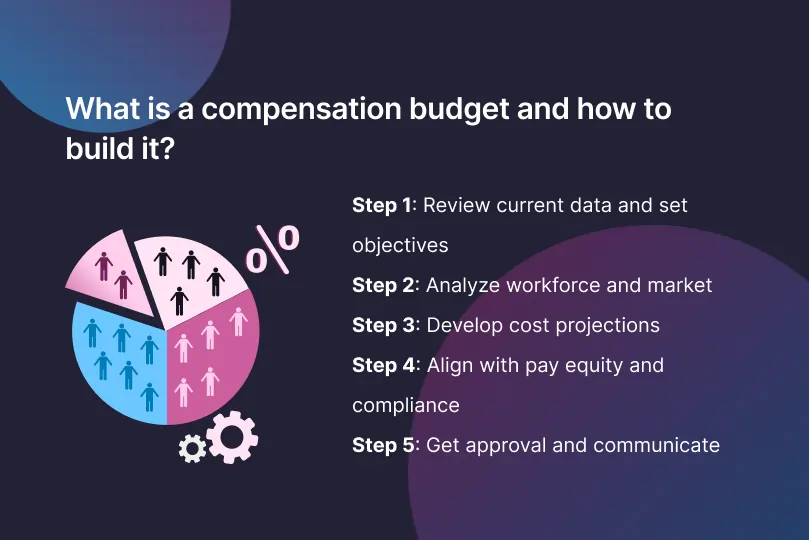
Step 1: Review current data and set objectives
Review the spending of last year. Ask the finance and the leadership team about their goals for the coming year. Use this as the foundation for your budget. Consider the economic factors and internal equity needs.
Step 2: Analyze workforce and market
Review headcounts, turnover, and skills requirements. Conduct market pays surveys. This will ensure that pay is competitive and within budget. Ask the department heads for their input on headcount estimations.
Step 3: Develop cost projections
Calculate increases in base pay, merit pools, and variable pay. Model different scenarios to calculate the potential increase in each category. Factor in benefits, costs and promotions. Establish a budget based upon these calculations.
Step 4: Align with pay equity and compliance
Review for fairness across groups. Adjust as needed within the budget. Ensure compliance with all legal requirements regarding non-discrimination and transparency. This protects the organization.
Step 5: Get approval and communicate
Show the executives the data. Once approved, share the budget with the managers and employees. Plan for monitoring and possible adjustments. This will ensure that everyone is informed and aligned with the organization's budget.
Workforce planning connects headcount needs directly to compensation costs for better budget control.
Forecast staffing needs to plan for new hires and avoid unexpected salary expenses.
Hire based on budget constraints to ensure you do not spend too much on employee salaries.
Plan for staff turnover and growth when determining hiring needs to provide enough employees without overspending.
Determine staffing needs based on required skills and salary implications to hire the right people for the job.
Market pricing and pay benchmarking compare internal roles to external salary data for competitive positioning.
Select the jobs to be benchmarked. Choose jobs based on their key responsibilities and skills.
Gather the data. Use salary survey data from a variety of different sources.
Analyze the data and adjust compensation structures to ensure the organization remains competitive and attractive to job candidates.
Monitor the compensation structures regularly to ensure they remain competitive and current.
Pay equity ensures fair compensation regardless of protected characteristics like gender or race.
Conduct regular audits to find pay gaps after controlling legitimate factors. Address issues.
Allocate dedicated funds to address pay gaps within the budget.
Maintain documentation of the processes to ensure compliance with pay equity regulations.
Train managers on the pay equity regulations to encourage their implementation.
Organizations use CompAnalyst® Pay Equity Suite alongside compensation analytics to detect and correct pay disparities within the organization.
Companies forecast and control compensation costs through data-driven planning and ongoing monitoring. This keeps spending aligned with performance and finances.
Use scenario modeling. This will help you prepare for the unknown.
Track key metrics. Use this to adjust necessary.
Implement controls. This will help prevent expenditure from escalating.
Review the budget periodically. Update the estimates every quarter to reflect business results.
Common techniques include analyzing the cost associated with the company's drivers, creating rolling forecasts instead of fixed annual budgets, and zero-based budgeting by starting from scratch each year to find the most efficient expenditures for the company. These budgeting techniques help improve the accuracy of financial projections for the company.
Compensation analytics and data systems provide insights for better decision-making.
Centralize data: Bringing all information together in one place to reduce errors
Generate reports: Visuals into spend, equity and trends to share with leaders
Predict outcomes: Model out different scenarios for increasing pay for underrepresented groups
Ensure compliance: Automatically track audit trails and fairness metrics
Modern tools and systems streamline payroll budget management with automation and real-time insights.
Compensation management software: Platform like Salary.com can automate the compensation process.
HRIS integrations: Many HR software systems offer integrations with other software platforms.
Benchmarking tools: These tools will allow your company to access market data and continue to offer competitive pay for key positions.
Analytics dashboards: These can provide a visual representation of your compensation spend and variance from budget.
Organizations use HRIS or HCM integrations to connect compensation systems with HR platforms for real-time data synchronization.
Here are some FAQs for better understanding.
A compensation budget focuses on the specific dollar amounts allocated for pay and incentives in each period. A total rewards strategy is broader. It includes pay plus benefits, career development, recognition, and work-life elements to attract and engage talent holistically.
| Aspect | Compensation budget | Total rewards strategy |
|---|---|---|
| Focus | Financial allocation for salaries and bonuses | Overall employee value proposition |
| Timeframe | Usually annual | Long-term strategic |
| Scope | Direct pay costs | Pay + benefits + growth opportunities |
| Goal | Cost control and planning | Talent attraction, retention, and motivation |
Compensation directly impacts the money that goes into the payroll budget. More headcount plans require more money to pay employees. Accurate headcount planning will ensure companies do not spend too much money on employees. Aligning headcount planning with compensation will allow companies to manage tight labor and economic markets.
A compensation budget includes estimates of salary costs (base and merit pay), variable pay, benefits costs, and equity adjustments. Training and retention bonuses may also be included within the payroll budget.

The latest research, expert advice, and compensation best practices all in one place.
Blog
Bringing trusted compensation intelligence and seamless planning to even more ADP users.

Blog
Learn how to train managers for effective pay conversations and build trust.

Blog
Total rewards package flexibility lets employees choose what matters - pay, perks, and benefits tailored to their needs.