Blog
Get Pay Right on ADP Workforce Now® Next Gen™
Bringing trusted compensation intelligence and seamless planning to even more ADP users.
Written by Salary.com Staff
July 10, 2026

Companies use merit budgets to allocate funds for performance-based salary increases. Such budgets ensure that employees who contribute the most to a company earn the highest salary increases compared to their peers within the organization.
A merit budget is funds allocated to a company for performance based salary increases. Unlike cost of living adjustments, merit pay adjustments are permanent increases to an employee's base salary.
Companies typically establish merit budgets on an annual basis, taking into account the revenue that they earn and the economic conditions within the current year.
| Term | What It Means |
|---|---|
| Merit Budget | A fixed percentage of the company's payroll that is dedicated to performance based salary increases for employees. |
| Merit Increase | A permanent increase to an employee's base salary. |
| Merit Matrix | A grid that maps out salary increases based on employee performance ratings and salary range position within the company. |
| Merit Cycle | The period each year during which companies review employee salaries and provide performance based salary increases. |
While the salary increase budget for a company is a broader figure than the merit pay budget, it includes merit pay raises as well as raises for other reasons, such as market adjustments and promotions.
Overall, merit pay is focused upon rewarding employees for their individual performances, while the total salary increase budget covers a variety of different categories for salary adjustments.
Therefore, the total salary increase budget for a company includes merit pay raises, raises for promotions, and raises to account for market salary adjustments.
According to the Salary Budget Planning Report, the average salary increase budget for companies in the United States for 2026 will remain the same at 3.5% for both actual salaries and merit pay raises for employees. In addition to this percentage, a Salary Budget Survey indicates that 68% of companies in the United States will use the same budget for salary increases in 2026 as they did in 2025, and only 16% of those companies plan to increase their salary budget for employees compared to the previous year.
Performance ratings and salary range position are the two most important factors that impact the determination of merit budgets for companies.
Top performers who are earning less than the salary range midpoint for their position should receive merit pay increases of the highest percentage.
Employees whose performance ratings are even with the midpoint for their salary range should receive smaller merit pay raises.
Finally, employees who are underperforming should receive no merit pay raises.
In addition to performance ratings, companies are also required to run a pay equity review in conjunction with their merit pay cycles before granting final approval to merit pay raises for all employees.
One of the primary reasons that merit pay raises lose their impact within a company is due to performance ratings that are too high for most of the company's employees.
If most employees have performance ratings of "excellent" or "above expectations," then there is no way to provide merit pay raises for those high performing employees without decreasing the merit pay budget that may be provided to other employees.
Additionally, performance ratings that are not consistent throughout the company may lead to salary disparities between departments or roles within the same company. Performance ratings should be reviewed and established by the HR and management departments prior to the merit pay cycles for each year's employees.
Salary ranges for each job or position within a company impact merit pay raises because each employee's raise should be calculated according to their percentage of the salary range for that job.
If an employee is earning 80% of the salary range midpoint for their position, they may earn a higher percentage raise than an employee who is earning 90% of that salary range's midpoint. The compa-ratio for each employee's salary is reviewed as part of the merit pay cycle along with salary range data to establish merit pay raises for all employees.
Maintaining accurate salary ranges is critical when determining merit increases. CompAnalyst® allows organizations to benchmark jobs, build salary structures, and analyze compa ratios so companies can distribute raises more strategically and remain competitive in the market.
Companies allocate merit pay raises according to their goal of providing incentives to retain their top performing employees. Overall, top performers should be compensated with raises at a higher percentage than average performing employees in the company.
| Performance Rating | Suggested Merit Increase Range |
|---|---|
| Exceptional | 5.0% to 8.0% |
| Exceeds Expectations | 3.5% to 5.0% |
| Meets Expectations | 2.0% to 3.5% |
| Needs Improvement | 0% to 1.5% |
| Unsatisfactory | 0% |
The majority of companies allocate merit budgets to each department within the company based upon the number of employees within that department. Each department manager then uses the merit budget for their department and their knowledge of each employee's performance ratings and salary range to provide merit raises to individual employees within their department.
Some of the most common mistakes that company managers make with merit pay raises include distributing merit pay raises that are even for all employees (thus creating no incentive for the top performers to earn high ratings each year), not considering the risk of salary retention for key employees when allocating merit budgets, not providing an explanation for merit pay raises to the employees of the company, skipping pay equity reviews prior to merit pay cycles, and providing merit pay raises to all employees based upon the merit budget for the previous year without reviewing market and salary data for that company.
Calculating merit budgets for a company is a five step process. Each step for calculating merit pay raises will be explained below.
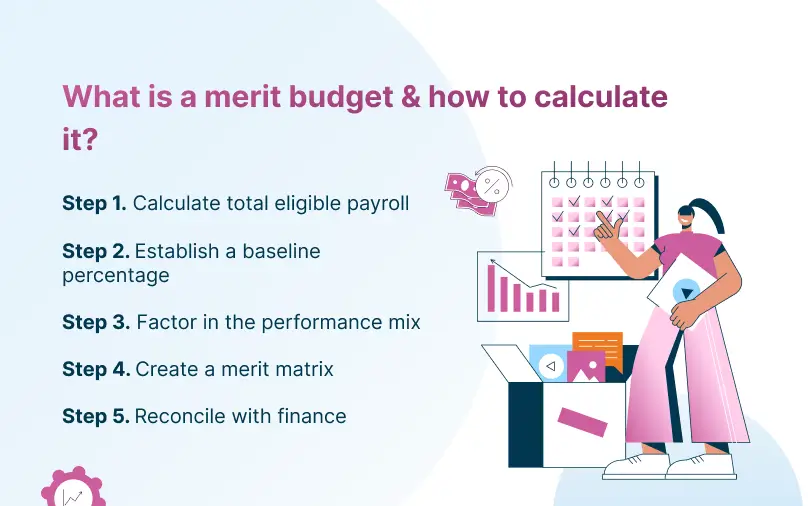
Step 1. Calculate total eligible payroll
Each company should determine the total base salary for each eligible employee within the company. This does not include employees that are on a performance improvement plan for the year.
Example: If you have 100 employees in your company and each earns an average base salary of $70,000 per year, the total eligible payroll will be $7,000,000.
Step 2. Establish a baseline percentage
Companies can use salary surveys to determine the percentage raise that should be offered to each employee each year. For instance, if the baseline percentage for merit raises is 4%, and each eligible employee earns $80,000 per year, each employee's salary will be increased to $83,200. Multiply the total eligible payroll by the percentage to calculate the total cost of merit raises for the company.
Before setting up a merit percentage, companies should review current market trends. CompAnalyst® Market Data provides compensation benchmarks across industries and locations, helping organizations establish budgets that align with prevailing market conditions.
Step 3. Factor in the performance mix
Determine the percentage of each salary raise that should be distributed according to the performance ratings for each employee. For instance, if 20% of company employees earn an exceptional performance rating, they will earn merit raises at a higher percentage than employees whose performance was "exceeds expectations" or "meets expectations."
Step 4. Create a merit matrix
A merit matrix is a table that companies create that maps percentage raises for employees according to their performance and salary range. Companies use merit matrices to distribute merit pay budget funds for the company to each manager and each department.
Step 5. Reconcile with finance
Before merit raises are approved for each employee, the compensation and HR department should reconcile merit pay raises with the finance department for the company to ensure that merit raises will not impact the company's revenue projections for that year.
Organizations with larger workforces often use compensation planning software to simplify this process. CompXL® helps HR and finance teams automate merit cycles, model multiple raise scenarios, manage approvals, and ensure total salary increases remain within approved budgets.
Here are the common questions about the topic:
Merit pay raises should only be frozen by a company if the company experiences a drop in its revenue for that year. If a company decides to skip implementing merit pay raises for the year, it can have a long term negative impact upon the company's retention of its top performing employees.
As merit raises are permanent increases to each employee's salary, the longer the company does not provide merit pay raises to high performing employees, the more likely that those employees will seek opportunities outside of that organization.
Managers should reference the performance ratings and the salary range position for each employee when communicating with that employee. By clearly explaining the reasons for merit pay raises, managers can establish trust with their employees.
Also, managers should make clear in these communications the requirements for employees to earn merit pay raises during the upcoming merit pay cycle.
Smaller companies may implement merit pay raises without compensation software. Instead, they may utilize spreadsheet based merit matrices to allocate merit raises to employees.
However, because this process is more prone to human error, most growing companies implement a compensation software system that can automate the merit pay raise cycle.

The latest research, expert advice, and compensation best practices all in one place.
Blog
Bringing trusted compensation intelligence and seamless planning to even more ADP users.

Blog
Learn how to train managers for effective pay conversations and build trust.

Blog
Total rewards package flexibility lets employees choose what matters - pay, perks, and benefits tailored to their needs.