Blog
Get Pay Right on ADP Workforce Now® Next Gen™
Bringing trusted compensation intelligence and seamless planning to even more ADP users.
Written by Salary.com Staff
August 16, 2024

The business world is rapidly advancing due to technological changes. Organizations can only keep up and adapt to these changes by developing their employees' skills and knowledge.
Having a skills inventory makes it easier for your organization to progress as it helps identify skill gaps and equip your workforce with competencies that matter. With Salary.com's Skills Library, you can access a comprehensive collection of skills and competency frameworks that help you create a skills database in your company and enable your HR team to hire, manage, and develop top talent.
Our Skills Library helps with skills-based pay by quickly grouping similar jobs with the same skills.
A skills inventory is a compilation of employees' experiences, skills, and educational backgrounds. It provides a bird's eye view of the organization's workforce capabilities that helps HR professionals identify skills gaps and make informed decisions about talent management and strategic planning.
Organizations can enhance recruitment, succession planning, and employee development by regularly updating their skills portfolio. This practice supports HR planning and provides a competitive advantage through human capital improvement and targeted development initiatives.
Thanks to Salary.com's Skills Library, you can help your organization's HR teams to hire, evaluate, and develop top talent with the industry's most comprehensive Al-powered software and data collection of skills.
Here are three essential components that companies must consider when creating a skills inventory:
Skills database
Serves as a comprehensive inventory that compiles the technical and soft skills of current employees.
Skill assessment
Assess employees' proficiency levels to identify strengths and areas for development.
Gap analysis
Identifies skill gaps between current skills and future needs to help employers address them by implementing formal training programs.
Here are the 7 in demand skills that should be included in your skill inventory:
Communication
Enhances team collaboration and clarity through effective information exchange and understanding within the workplace.
Data literacy
Enables employees to examine and interpret data efficiently that helps employers make informed decisions based on strategic planning and organizational objectives.
Emotional intelligence
Improves workplace relationships by helping employees and employers manage their own emotions and understand each other.
Time management
Reduces time-consuming processes and improves overall performance by helping your employees prioritize tasks and manage their time efficiently.
Leadership skills
Enables effective guidance and motivation of teams that help develop future leaders within the organization through succession planning.
Collaboration
Promotes teamwork and cooperation across departments in discussing complex projects and achieving common business goals.
Creativity
Encourages innovation and problem-solving among employees as they think outside the box and develop new solutions for business growth.
A skills inventory helps HR leaders align employees' skills and competencies with company needs for better talent acquisition, employee retention, and workforce planning. It creates a positive work environment and better outcomes especially for skills-based organizations that prioritize employees' skill enhancement.
Salary.com's Competency Library provides talent management, learning and development, and HR with a common language and set of expectations for success.
Companies that create a skills inventory can expect the following benefits:
Helps companies identify and address skills gaps among current employees to ensure that they have the competencies needed for future roles.
Enables HR executives to assess the technical skills and educational qualifications of their workforce for effective strategic planning.
Encourages employees to engage in development activities like skills training that align with their career goals and the needs of the organization.
Supports succession planning as skills database promotes talent and potential leaders within the organization.
Ensures that job skills are updated regularly to keep up with developing technologies and business processes.
With Job Skills Model, your organization can acquire a competency framework to guide their job architecture, career pathing, and skill-based hiring initiatives so you can hire with confidence.
Many organizations face challenges in managing skills inventories. Here are 5 challenges your organization might encounter:
Aligning talent: Identifying where to focus talent development efforts can be challenging when organizations lack clear business goals. This results in a misalignment between employee development initiatives and the actual needs of the organization.
Updating Skills: Unable to keep an up-to-date record of their employees' skills leads companies to rely on outdated information. Outdated skill records can prevent effective talent management that makes companies difficult to assign the right people to the right tasks or projects.
Evaluating relevance: Determining how long skills remain relevant is challenging due to rapid technological advances and market shifts that can quickly alter their value. Organizations that neglect skill development risk falling behind competitors that leads to decreased productivity within the workforce.
Developing continuous learning: Lack of investment in continuous learning and training can widen skill gaps. This leaves employees unprepared for future job demands, individual growth, and career advancement.
Predicting needs: Recruiting becomes a complicated task when organizations lack clarity on future skill requirements. This can lead to job mismatches when new employees may not possess the skills needed for upcoming projects.
Creating skills inventories helps you maximize human capital by identifying the strengths and areas for development within your organization. Here are the 7 simple steps on how to create a competencies inventory in your company:
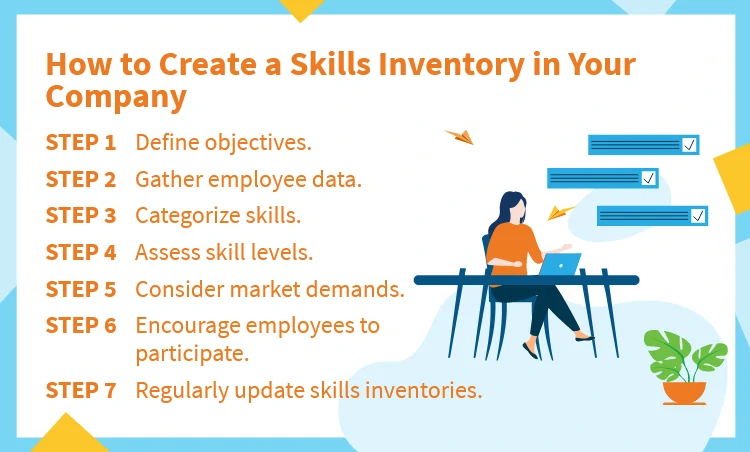
Determine the purpose of creating a skills database; it can be for training, recruiting, or planning future projects. This will guide you in creating a skills inventory that meets the specific needs of your organization.
With Job Competency Model, organizations can acquire up-to-date skills and competency data for hiring, assessing, and developing top talent to fill the skills gap.
Collect information on your current employees' skills, education, and job experiences. Use surveys, interviews, and performance reviews to understand their capabilities.
Process the collected data into categories such as technical skills, soft skills, and leadership skills. This will help you easily identify and assess the different competencies that each employee lacks for their personal and professional growth.
Evaluate the proficiency of each skill among your employees based on the previous steps taken. This will provide you with a foundation for addressing training needs and creating career development opportunities for each of them.
Consider the demands of the market by comparing the skills currently available in your organization to the skills needed to remain competitive. This helps you identify any gaps in knowledge or expertise among different roles and departments across the industry and allows you to upgrade your training and recruitment strategies.
Utilize skills inventories to guide decisions on training, recruitment, and project assignments, and encourage employees to participate in it. This promotes personal and career growth that benefits both your employees and your organization.
Regularly review and update these inventories by adapting to organizational and market changes. This helps your organization remain competitive and avoids future problems in the modern market.
Add skills and competency data from our Skills Library to attract the right candidates.
A skills inventory is a compilation of the skills, knowledge, and abilities of your employees. This process helps leaders assess human capital, identify learning needs, and ensure proficient future growth and recruitment. Thanks to Salary.com's Skills Library, you can now create a comprehensive skills inventory using the industry's most comprehensive Al-powered software and data collection of skills and competency frameworks.

The latest research, expert advice, and compensation best practices all in one place.
Blog
Bringing trusted compensation intelligence and seamless planning to even more ADP users.

Blog
Learn how to train managers for effective pay conversations and build trust.

Blog
Total rewards package flexibility lets employees choose what matters - pay, perks, and benefits tailored to their needs.