Blog
Get Pay Right on ADP Workforce Now® Next Gen™
Bringing trusted compensation intelligence and seamless planning to even more ADP users.
Written by Salary.com Staff
June 06, 2025

The saying “teamwork makes the dream work” has become one of the pillars that most U.S. companies have implemented since its conception way back in 2002. But if done right, it will do so much more than making the dream work – it can straight up turn a company on its feet.
That’s where team effectiveness models swing into the action. It’s essentially a framework that allows companies to create better teams and allows for better team development in the long run as well. But there’s more to this practice than most companies believe, and the right conditions can easily help a company go from 0 to 100.
Continue reading to learn more about the team effectiveness model, the positive impact that it can have on your company, and most importantly, how to create one for companies who want to try it out for themselves to ensure organizational success.
A team effectiveness model is a framework that companies use to understand how their preexisting teams gel with each other and create effective teams in the process. This can then help companies create viable plans that can help the team function at a more efficient pace and help them accomplish their goals, which can lead to better team performance in the long run.
The model can also help with setting clearer goals within the team. Additionally, if done right, the model can even help them gain valuable insights on which teams perform better under certain metrics as well, which can help create plans that can help companies dedicate teams with a more dedicated skill set to a specific task – therefore creating an effective teamwork model.
This makes creating a model more difficult compared to others, companies can get around this problem by using a dedicated skills library. This ensures that organizations can properly monitor their team’s effectiveness, help them address their skills gap, and enhance team effectiveness as well.
The 7 c’s of team effectiveness that can help create a strong team culture are as follows:
Communication
Collaboration
Coordination
Cooperation
Commitment
Creativity
Celebration
The main goal for these seven stages is to create an effective teamwork strategy where growth is greatly encouraged. Although mostly used in team building activities, it also provides team leaders with a better image of what they might need to improve upon to help their team function to their best capacity, creating high-performing teams in the process.
Implementing these 7 c’s within a team setting can also help team leadership create a better working environment. This, in turn, can help boost employee morale and productivity while keeping retention rates relatively high.
Listed below are some examples of team effectiveness models that companies can utilize to create a better team atmosphere and can help positively impact team effectiveness.
Created by Patrick Lencioni, the self-named Lencioni Model is mostly designed to help teams struggling with conflict or dysfunction. This particular model aims to overcome five causes of dysfunctions and do the exact opposite to overcome them, which can help with effective teamwork and boost team performance in the long run. Below is the Lencioni Model in practice.
Trust to overcome the absence of trust, which can cause conflict
Conflict resolution to help with team members who might be too afraid to speak up
Commitment to help when teammates lack the drive to follow through to their commitments
Accountability to help team members understand the standards that are set upon them and lastly
Attention to results to help them focus on the team’s performance
One of the more common examples of team effectiveness models, the GRPI, which stands for Goals, Roles, Procedures, and Interpersonal Relationships aims to provide teams with clearer goals moving forward. This, in turn, can provide teams with a better idea for effective teamwork.
Keep in mind that the GRPI model only covers the team in the long run and requires the team to be structured properly first before it becomes a viable option. Extending the model can be a good solution for the team in the long run for the former, and a good skills library tool is the solution for the latter.
The LaFasto and Larson Model is one of the more innovative solutions to the team effectiveness model by focusing on the team’s overall dynamic rather than how they function to create an effective process.
Although the model does take the individual’s skills and expertise into account, the LaFasto and Larson Model mainly tackles how individuals can work together as a team. Think of this model as a way for companies to learn more about the dynamics of teamwork and how it can impact team performance as a whole.
The LaFasto and Larson’s Model has five key factors, which is listed below:
Team member: Identify the team member’s individual skills to make sure that they can fit within the team composition
Team relationships: Identify how team members interact with each other and see whether they fit within the company's culture
Problem-solving skills: Know the team's ability to solve problems together by using team skills that they have gathered by working together
Leadership: Getting the right leader can strongly help the team reach their goals faster
Organizational environment: The company culture can help create a better working environment for everyone involved
First coined by psychologist Richard Hackman, the Hackman Model mainly deals with the conditions that a team has. The better the conditions, the higher the chances of success. The five factors that are involved in this model are listed below:
Real team members: To be a real, cohesive team, they should rely on each other and how other team members work as an organized unit. They should also share responsibilities and, ideally, share a common goal as well having specific task skills, which can help with effective teamwork.
Compelling direction: They should also have a clear idea of the team's mission. A team with a compelling direction is a team that’s engaged and oriented towards their common goal.
Enabling structure: Make sure that the team’s overall structure properly their objectives and support their goals, which promotes team growth in the long run.
Supportive context: The company should support the team’s goals by providing them with all the tools, resources, training, and team orientations that they may need to succeed to help with overall team productivity and team performance.
Expert coaching: Lastly, providing the team with adequate coaching and feedback can aid them with their overall team performance while ensuring professional and personal growth at the same time.
Clocking in with the least amount of framework at 3, the Katzenbach and Smith Model is a type of team effectiveness model that aims to provide a meaningful approach to team management. Its main goal is to help teams communicate effectively to their stakeholders about their purpose, empowering team members further and allowing for mutual respect from both parties.
The framework for the Katzenbach and Smith model can be seen below:
Personal growth
Collective work products
Accountability
Although it can be difficult to identify which model works for specific teams, most companies can jumpstart the process by creating a team effectiveness model which can help positively influence team effectiveness by following the steps below.
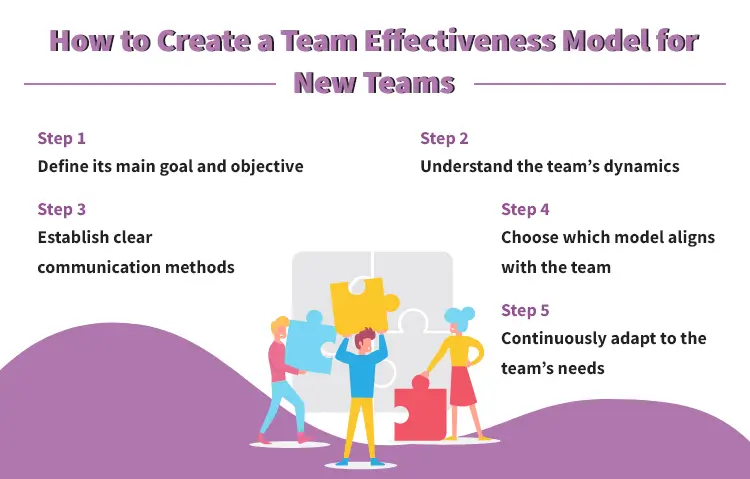
Effective models vary in their main goals and functions. For instance, the Hackerman Model mainly deals with a team’s conditions, whereas the Katzenbach and Smith model focuses on how the team can communicate with their higher-ups.
It’s recommended for companies to already have their main goal in mind to ensure that they can pick the right model to go with their teams to ensure better team cohesion. Mutual performance monitoring may be used by some companies to help define their main goals better as well.
What works for one team does not necessarily work for the other – it may be due to internal factors or other factors that vary from one team to another. Thus, it’s important to understand how the team functions first before choosing which model suits them the best to secure the team's success. It's also important to consider that the team supports each other as well to create positive group dynamics before the model has been chosen.
Properly communicating the model to the team can help them understand the process better along with helping them properly adapt to the changes that will be made within their teams, as long as it's properly communicated to individual team members. It's also important to encourage team members to openly communicate their opinions and whether or not the model works for their team and can boost overall team performance.
Next, companies should choose which model will be used for their teams. The models specified above are only some of the more prominent, easy-to-use examples of team efficiency models – it's important to delve into more research to ensure that the right model is chosen for specific teams. Consider how the teams work and the overall team's process before choosing the right team effectiveness model for the team.
After the right team effectiveness model has been chosen and team members begin following it, it's important to consider that the model is not a one-size-fits-all solution to create an effective teamwork process. Keep in mind that companies can change their models as often as they like since it depends on the specific circumstances like the company’s, the team’s needs, how effective the specific model is, along with the internal and external factors like effective teamwork or issues with leadership.
For the most part, using a handy skills library can help companies properly navigate through which model to use to boost team performance and how often it should be changed depending on the company’s needs. It can also help gauge the team’s performance as well.
With the team effectiveness model, always consider three things: psychological safety, knowledge of how the team operates, and the overall group dynamics.
Most of the time, the model should just be treated as a guide to promote psychological safety and on how employees function as a project team and to solve the problems that may arise with overall team performance.
Always consider the team's work and how they fit within the company's culture. Think of it as a way to gauge the team's work and allows companies to create a model team out of newly formed teams.

The latest research, expert advice, and compensation best practices all in one place.
Blog
Bringing trusted compensation intelligence and seamless planning to even more ADP users.

Blog
Learn how to train managers for effective pay conversations and build trust.

Blog
Total rewards package flexibility lets employees choose what matters - pay, perks, and benefits tailored to their needs.