Blog
Get Pay Right on ADP Workforce Now® Next Gen™
Bringing trusted compensation intelligence and seamless planning to even more ADP users.
Written by Salary.com Staff
June 12, 2026

When offering benefits to employees, it is not enough that compensation and perks exist. They must also be relevant and efficient in terms of cost, employee satisfaction, and returns. This is called better benefits.
In this article, we will discuss a better employee benefits strategy.
Better benefits are improved compensation and perks for employees to be more motivated and to maximize the value of the amount spent on the workforce. This means that better benefits aim to:
Improve the overall total rewards strategy so everything works together
Avoid overspending by maintaining the benefit cost ratio under control
Invest on benefits that actually drives impact
Make sure benefits are aligned with the company's compensation strategy
Streamline your total compensation strategy with CompXL®, where you can plan and manage benefits, track your budget, and automate approval workflow.
A stronger benefits design means that there are important parts working together to balance the workforce cost, employee needs, and your business objectives. Knowing these elements helps you achieve a more efficient benefits design.
Here the crucial components you need to keep in mind:
| Component | What it means | Importance in business |
|---|---|---|
| Total rewards strategy | Ensuring the benefits, pay, and incentives work as one in a structured system | Aligns rewards with the overall business goals and talent strategy |
| Workforce segmentation | Acknowledging that different employee groups require different types of benefits | Avoids wasting money on benefits that are not applicable to every employee |
| Financial modeling | Forecasting the impact of benefits on the company's future cost and budget | Helps in planning the spendings ahead of time |
| Benefits utilization rate | Monitoring how many employees actually use the offered benefits | Determines what benefits are valuable and what are only driving costs |
| Employee value perception | Identifying how employees feel after receiving the benefits | Shows employee engagement, satisfaction, and retention |
| Compliance management | Ensuring all the benefits are compliant to legal and regulatory requirements | Protects the company from legal and financial risks |
| Vendor management | Managing external providers to ensure cost and service are fair and reliable | Boosts quality while remaining on budget with the spendings |
Designing a better program for employee benefits is not a one-time thing. It must follow a structured process to ensure that it keeps company costs under control and engages the workforce effectively.
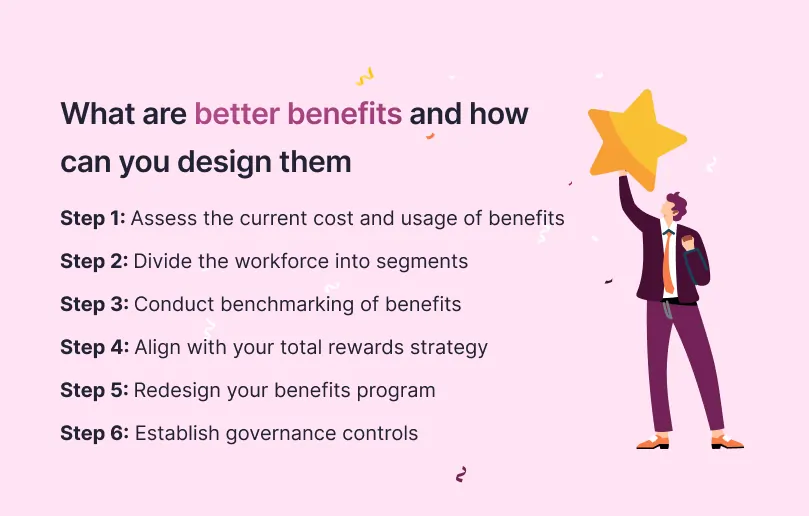
Here steps to do that:
Before changing your benefits program, understand first what you are dealing with and determine what works, what doesn't, and what's being put to waste. Here are metrics you can use:
| Metric | What it tells you | What you should do |
|---|---|---|
| Benefits utilization rate | What benefits are actually used by the employees | Remove or redesign benefits with low use |
| Employee value perception | How employees feel about the benefits received | Improve communication with employees or redesign offers |
| ROI on benefits | Whether the benefits are generating value | Focus investment on benefits with high impacts |
Watch out for these risks when evaluating your existing benefits program:
High cost but low usage
High cost but low employee engagement and satisfaction
Benefits that are not aligned with the workforce needs
Consider that different employee groups value different perks. Workforce segmentation, or diving employees into distinct groups based on characteristics, is important in this step because:
It reduces wasted spendings on benefits irrelevant to some employees.
It improves the usage of benefits.
It promotes employee satisfaction and engagement.
It aligns benefits and the actual needs of the workforce.
Here is an example of workforce segmentation:
| Type of segments | Example | Changes in benefits design |
|---|---|---|
| Job level | Executive level vs entry-level | Different benefit tiers or packages |
| Workforce type | Critical vs non-critical job roles | Focus retention benefits where they matter most |
| Career stage | Early career vs late career | Age-based or lifecycle-based support |
Compare your benefits program to know where you can improve. Here are common approached when it comes to benchmarking:
| Type of benchmark | Purpose | Outcome |
|---|---|---|
| Industry benchmarking | Compare with similar companies | Ensures competitiveness |
| Talent market benchmarking | Align with hiring expectations | Improves attraction |
| Positioning strategy | Decide whether you lead, match, or lag the market | Balances cost and competitiveness |
Your benefits must fit into your overall compensation philosophy. A good alignment of benefits and the total rewards strategy look like this:
Benefits support your compensation philosophy
Total rewards are balanced and meaningful
Costs are distributed with control
In redesigning your benefits portfolio, apply flexibility where employees have a level of choice. With cost control, this makes employees feel that they're getting more value and benefits represent diverse needs.
This is what a flexible benefits structure looks like:
| Features | What it means | Why it works |
|---|---|---|
| Benefit credits | Fixed amount provided by company | Maintains a predictable overall cost |
| Employee choice | Employees choose benefits that matters to them | Boosts employee satisfaction |
| Modular plans | Benefits are offered in building blocks | Promotes personalization |
Controls help your benefit program become more robust and reliable. Here are important governance areas you need to look at:
| Area | What it ensures | Risk if ignored |
|---|---|---|
| Regulatory compliance | Follows labor laws and tax implications | Legal and financial penalties |
| Approval controls | Creates structure in decision-making | Biased or inconsistent changes |
| Documentation | Provides clear rules and policies | Issues in audits and confusion |
Monitor progress, track actual spend and budget, enforce eligibility and guideline rules, and ensure compliant and audit-ready benefits program with CompXL®.
Here are frequently asked questions about better benefits:
They improve employee retention by boosting job satisfaction, loyalty, and financial security. This makes employees feel that their work is important, and they're less likely to seek opportunities from other companies.
Benefits are better when they highlight effectiveness, relevance, and ROI. This also means that the quality, personalization, and holistic support of the benefits are focused on the compensation package.
The ROI of better employee benefits are:
Lower employee turnover
Increased productivity
Decreased absenteeism
Improved talent attraction

The latest research, expert advice, and compensation best practices all in one place.
Blog
Bringing trusted compensation intelligence and seamless planning to even more ADP users.

Blog
Learn how to train managers for effective pay conversations and build trust.

Blog
Total rewards package flexibility lets employees choose what matters - pay, perks, and benefits tailored to their needs.