Blog
Get Pay Right on ADP Workforce Now® Next Gen™
Bringing trusted compensation intelligence and seamless planning to even more ADP users.
Written by Salary.com Staff
April 10, 2026

“Teamwork makes the dream work,” a common statement that emphasizes the importance of collaboration and unified vision in a company. To promote this in the workplace, an incentive is established for individuals who collectively work towards the same goals.
With this, let’s discuss team incentives in this article, including examples, key components, and how to effectively establish an incentive design in your organization that drives strong team performance.
Team incentives are rewards given to employees and teams who deliver exceptional performances at work. Its focus is on collective outcomes instead of individual achievements.
Implementing an incentive program for exemplary teams help companies:
Acknowledge above-average contributions
Promote team performance
Encourage collaboration
Improve employee and team morale
Increase productivity
Attract and retain talent
For the team incentive to work, HR must ensure fairness and alignment while Finance ensures affordability and measurable impact. To centralize this incentive workflow, view and control budget, and produce payroll-ready outputs, Compensation Planning Software is the tool to use.
Incentives can be in the form of monetary and non-monetary rewards. Here are some of them:
This type of incentive is based on compensation or added payment.
Bonuses and raises
Additional paid time off
Profit-sharing programs
Tuition reimbursement
Travel incentives
Commission programs
These incentives come in the form of events or experiences within or outside of the workplace.
Professional development opportunities
Health and wellness programs
Volunteering opportunities
Social recognition programs
Family-oriented perks
Team retreats
This can be through physical rewards or privileges that improve an employee's daily work experience.
Flexible work arrangement
Gift cards
Subscriptions and entertainment
In-house services
Catered meals
Company merchandise
When designing an incentive program, you must know the important components that create a strong foundation for rewarding good outcomes and performance in your teams. Here are things to include in your design:
| Component | What it means | What it does |
|---|---|---|
| Team incentive plan | A structured program that rewards a group of employees for achieving goals | Promotes shared accountability and aligns pay with measurable outcomes |
| Variable pay | A compensation that fluctuates based on performance instead of a fixed salary | Encourages focus on better performance and maintains flexibility in labor costs |
| Pay-for-performance philosophy | A company’s approach to aligning employee rewards with team results instead of tenure or position | Strengthens pay fairness and controls efficiency of rewards |
| Performance-based compensation | A pay tied to measurable performance metrics such as productivity, revenue, or profitability | Supports a merit-driven work environment and improves ROI on labor costs |
In designing an incentive plan, rewards must be focused on team performance, which encourages teamwork and collaboration. To do that, a compensation structure must be in place to ensure outcomes are aligned with the business objectives.
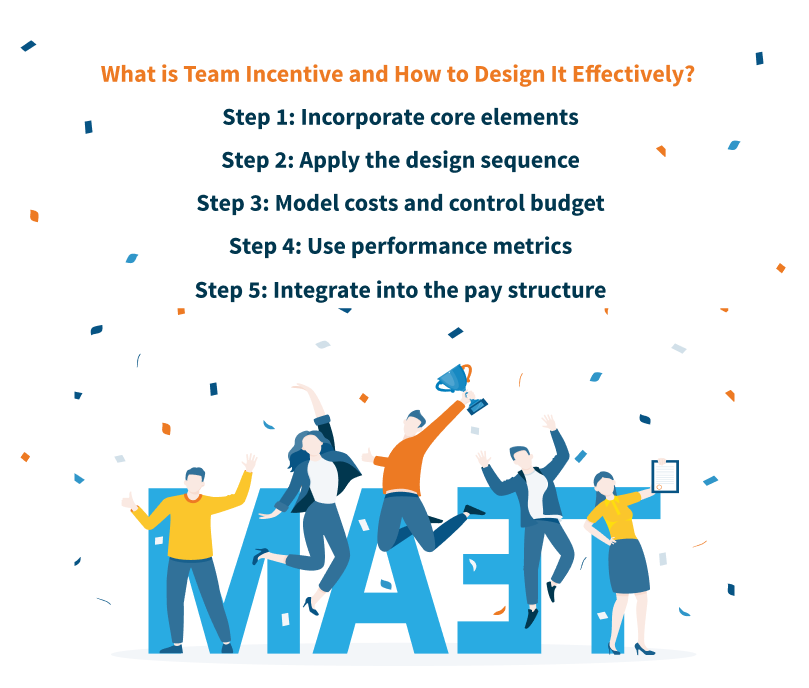
Here are steps on how to effectively design a team incentive program:
For the incentive plan to work at the get-go, include its building blocks that ensure its fairness, motivation, and financial predictability. These key elements include:
| Element | What it does | How to do it |
|---|---|---|
| Incentive eligibility rules | Defines which teams are eligible for the incentives | Determine which employees or teams are included |
| Incentive formula design | Translates team performance into compensation payouts | Decide how to calculate results and turn them into pay |
| Threshold-target-maximum model | Sets performance levels that produce different payout amounts | Determine minimum, expected, and maximum reward levels |
| Payout curve | Controls how payouts increase when performance improves | Choose if payout grows steadily, accelerates, or capped |
| Team performance metric | Measures the outcomes that drive incentive payouts | Select metrics that reflect real results from team performance |
Simplify commission planning and calculation through Compensation Planning Software. Through familiar spreadsheets and smart cloud features, integrate incentives and total reward management into a unified system for a more efficient incentive compensation strategy.
After knowing the key elements on an incentive program, it must follow a logical workflow. Here is the approach:
Define team boundaries and eligibility.
Choose measurable team performance metrics.
Establish the formula for incentives.
Set threshold, target, and maximum payout levels.
Incorporate payout levels aligned with budget limits.
To prevent financial risk in your incentive plan, cost modelling and budget controls must be part of your incentive design. Here are key financial controls to take note of:
| Financial control | Purpose | Outcome |
|---|---|---|
| Incentive cost modelling | Estimates and optimizes cost of payout based on performance scenarios | Makes budgeting predictable and better control on costs |
| Variable compensation budget | Establishes limits for incentive spending annually | Allows governance and accountability in finances |
| Payout scenarios | Assesses different performance outcomes | Helps visualize potential risks and costs |
| Plan affordability testing | Evaluates if incentive plan is sustainable over time | Ensures incentive program is achievable |
Model merit matrices based on performance, forecast accurate cost using historical data or expected distributions, and discover new insights linking employee performance and market competitiveness through Merit Modeling.
Choosing the right performance metrics ensures that incentives reward impactful results. Your metrics must be:
Measurable and editable: They are clear, defensible, and can be monitored.
Within the control of the team: The team can influence the results.
Balanced measurement: They are a combination of output, profitability, and quality.
Now that you know the key principles of performance metrics, here are different metrics you can use in your incentive program:
| Type of metric | What it measures | Why it is used |
|---|---|---|
| KPI-based incentive metrics | Outcomes linked to business objectives | Ensures team efforts are aligned with company targets |
| Revenue performance | Revenue growth in sales or income | Connects incentives to business expansion and sales results |
| Profit margin metrics | Profit generated from operations | Controls costs and ensures payouts reward actual business value |
| Productivity metrics | Efficiency of operation | Measures output in relation to pay |
| Quality performance metrics | Service quality, defects, and risks | Protects standards against metric shortcuts |
Incentives don’t operate alone. It must be part of your organization’s compensation structure so that the incentive program is fair and motivating for employees while being financially sustainable for the company.
Here are key elements that support incentive design in your overall pay structure:
| Element | Role in team incentive design |
|---|---|
| Pay mix strategy | Defines the mix of fixed salary and variable incentives, helping in the making of the overall compensation |
| Base pay vs variable pay ratio | Controls compensation risk by defining the guaranteed pay versus the performance-based pay |
| Target total cash | Sets expected total earnings if teams achieve 100% of the expected results |
| Salary band integration | Maintains consistency of internal pay and ensures incentives fit within the pay ranges and equity rules |
Here are key points you need to consider when it comes to integrating incentive programs in your overall pay structure:
Higher job levels usually have larger variable components.
Incentives must align with salary band structure.
Variable pay complements base pay instead of replacing it.
Streamline your salary and incentive program through Total Compensation Management. With this tool, you can:
Plan and manage the compensation process
Get data, software, HR integration, and consulting
Access clear and consistent information on compensation
Streamline pay and benefits compensation
Now that we know the key components of incentives and how to effectively design the program, this section explains how you can manage and maintain its design through clear rules, consistent supervision, and proper documentation.
To build effective governance and compliance in your incentives, take note of these of these key areas and their purpose:
| Governance area | Purpose |
|---|---|
| Incentive governance framework | Determines who approves incentives, how decisions are made, and overall supervisory responsibilities |
| Performance validation process | Ensures the accuracy and reliability of metrics used in calculating incentives |
| Plan documentation | Standardization rules and processes so everyone knows how the incentives work |
| Auditability of incentives | Supports compliance and provides a clear record for internal and external audits |
Here are some of the ways you can ensure effective governance of your company’s team incentives:
Document calculations and formulas before implementing the plan.
Validate performance results before you make payouts.
Keep traceable records of calculations for every plan cycle.
Conduct periodic audits to maintain consistency and compliance.
Of course, after establishing an incentives program, you must know whether it drives your desired business outcomes or not. Only then will you know if the program is effective or not, then apply necessary adjustments.
Here are metrics to use:
| Evaluation metric | What it answers |
|---|---|
| Incentive ROI analysis | Did incentive payouts generate real business value? |
| Performance lift measurement | Did team output improve after implementing the plan? |
| Cost-to-performance ratio | Was the reward efficient in terms of cost vs results? |
Here are frequently asked questions about employee incentives for teams:
Some incentive plans fail due to:
Outdated designs
Misalignment with company objectives and KPIs
Poor communication and lack of transparency
Complex structures that are confusing instead of inspiring
Unethical behavior because of aggressive targets
Incentives should not be part of a base salary. Base salary is a fixed compensation, which is a guaranteed pay regardless of performance outcomes. Meanwhile, incentives are part of variable compensation, which are tied to performance and fluctuates based on business outcomes.
Incentive plans should be reviewed at least annually. Ideally, it should be done quarterly due to changing business needs and team dynamics. Regular check-ins help maintain fairness and effectiveness of incentives.

The latest research, expert advice, and compensation best practices all in one place.
Blog
Bringing trusted compensation intelligence and seamless planning to even more ADP users.

Blog
Learn how to train managers for effective pay conversations and build trust.

Blog
Total rewards package flexibility lets employees choose what matters - pay, perks, and benefits tailored to their needs.