Blog
Get Pay Right on ADP Workforce Now® Next Gen™
Bringing trusted compensation intelligence and seamless planning to even more ADP users.
Written by Salary.com Staff
August 29, 2025

In a 2022 report, 65% of employees think that the competencies required for their jobs have changed in the last two years. With the ever-changing demands of the job market, business strategies must be packed with employee skills insights.
These strategies include creating skills taxonomies. This structure helps companies in determining skill gaps in the workforce, developing career paths, improving recruitment process, streamlining resource allocation, and many more.
Here is a comprehensive guide to skills taxonomy, its key role in skills and job architecture, its benefits, how to use it in company processes, and how to build one for organizational skills success.
Skills taxonomy is an inventory of skills relevant to a company organized into categories based on classification and hierarchy. This is commonly used in performance management, training and development programs, succession planning, and recruitment.
This skill category framework is empowered nowadays with comprehensive AI-powered software like Skills Library for most effective competencies and skills data collection, giving HR professionals the edge in making robust taxonomy and enhanced talent management.
Skills taxonomy helps in categorizing, defining, and organizing skills in an organization. This allows companies to match their talent management with the business goals.
Here are the key roles of skills taxonomy:
Defines core competencies: It is easier to track crucial and specific skills for roles, helping talent growth.
Promotes career development: There is a clearer direction for upskilling of employees based on the skill category and hierarchy.
Aids skills-based management: It helps HR to align hiring and workforce planning with a skills-based approach.
Standardizes skills: Talent acquisition and job evaluation are more objective and consistent by using a systematic and common language.
Helps define job roles: The job descriptions are more aligned with the business goal since they are more outlined and organized, leading to a better job taxonomy.
There are terminologies that are confused with one another when talking about skills taxonomy, and these are skills ontology and skills framework. The differentiate these concepts, here is a table defining their structure, objectives, and key features:
| Skills Taxonomy | Skills Ontology | Skills Framework | |
|---|---|---|---|
| Structure | Hierarchical; details the categories of skills | Relational; mapping the interconnectedness of skills | Standardized; defines competency levels, indicators, and standards |
| Objectives | Helps in the structure of skills; aids in the identification and assessment of talent management | Helps in analyzing the interaction of skills to job match different roles and functions | Helps in performance evaluation, employee development opportunities, and skills assessment |
| Key Features | Categories and subcategories | Relationships between skills | Mastery level of skills |
| Proficiency levels | Evolution of new skills and relationships alongside changing organizational needs | Behavioral indicators | |
| Classification of individual skills | Benchmarking of skills |
Skills taxonomy has wide application in various aspects of HR and business processes. Here are ways that you can utilize it:
Recruitment: Maximize acquisition of potential candidates using a skills-based hiring process and having a comprehensive hierarchical structure of skills related to a job role through the taxonomy.
Performance management: Let employees have a deeper understanding of how to advance their proficiency and allow business leaders to guide them through relevant feedback and assistance.
Workforce planning: Anticipate employee needs, adapt to the changing global workforce demands, and establish effective planning through insights on the emerging skills and competencies of talents.
Career development: Make smarter decisions on employee upskilling and reskilling with a clear path on the required competencies, learning, and development to achieve professional growth.
DEI strategy: Promote equity and inclusion for marginalized sectors in the industry by requiring more skills instead of employee background and diversity.
To address your company’s crucial needs in a skills-based system, use the Job Skills Model. This skills intelligence tool has customizable solutions for your skills framework and will guide you with job architecture, career pathing, and competitive skills-based initiatives.
Having a skill category and structural framework gives value to a skills-based organization. Here is how a company benefits from establishing a taxonomy:
Clear focus on skills
With a skills-based organization, capabilities are prioritized. This translates to a more focused talent matching and hiring process, minimized skill gaps, and aimed upskilling and reskilling for employees.
Enhanced internal mobility
Employees who have a better view of skills required for specific roles can develop their competencies, pursue career path advancements, and lead a more satisfying work experience.
Promotes interdisciplinary collaboration
Collaboration is better when employees have various skill sets contributing to teams and projects. Skill categories help build a diverse and versatile workforce by leveraging job matching and clear role definitions.
Skills taxonomy is not only a structure or an inventory of skills. It must also reflect the business goals, the company’s relevant roles and functions, and the integration in the HR processes. Here are steps to build one:
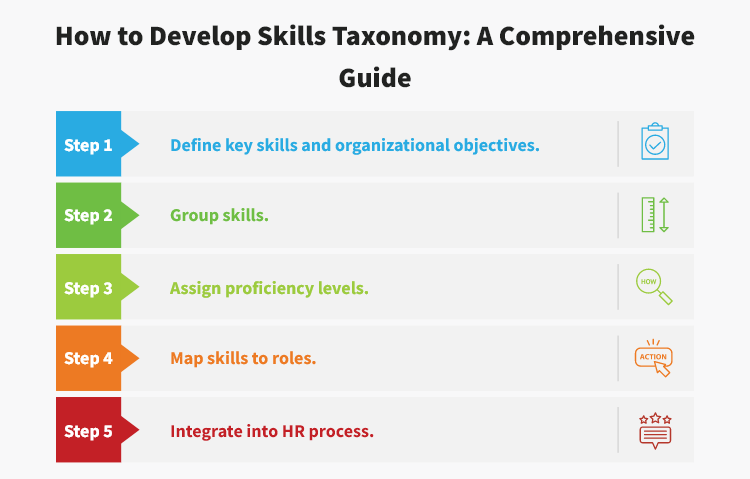
Identify the organizational objectives and determine core skills needed for reaching these goals. Make a comprehensive summary of the key competencies or refine existing organizational skill lists in collaboration with department heads and employees. Include both the hard and soft skills.
Classify the key skills into categories and sub-categories. For example, technical skills can be in the broad category with programming languages and machine learning as sub-categories. Another main category would be leadership skills with decision-making and delegation as sub-skills.
Define proficiency levels, such as beginner to expert. Some use levels 1 to 4 to distinguish rankings of expertise in job roles. For example, Level 1 is Manager, Level 2 is Senior Manager, Level 3 is Director of Marketing, and Level 4 is Head of Marketing.
Map the skills in their corresponding roles and functions. This helps in crafting job and skill descriptions, workforce management, employee assessments, and training needs. For example, skills like project planning and risk management are mapped with the Project Manager role.
Implement and integrate the right skills taxonomy in your organization. Include using platforms that help in managing the workforce's skills category and skills requirements using employee data and latest workforce trends.
These steps might be daunting when manually done so it is best to use an automated tool to maximize efficiency. Good thing Skills Library can help you build job profiles, skill mapping, match similar job, and support workforce mobility leveraging on technology and labor market trends.

The latest research, expert advice, and compensation best practices all in one place.
Blog
Bringing trusted compensation intelligence and seamless planning to even more ADP users.

Blog
Learn how to train managers for effective pay conversations and build trust.

Blog
Total rewards package flexibility lets employees choose what matters - pay, perks, and benefits tailored to their needs.