Blog
Get Pay Right on ADP Workforce Now® Next Gen™
Bringing trusted compensation intelligence and seamless planning to even more ADP users.
Written by Salary.com Staff
June 05, 2026

Unfair pay practices refer to situations where employees may receive different pay for the same work. As HR managers, it is essential for us to be able to prevent these scenarios and the issues they may cause within the company.
This article aims to help HR managers understand what constitutes unfair pay, and what steps can be taken to prevent it.
Unfair pay practices happen when employees receive different payments for doing the same amount of work. This typically happens due to factors such as gender, race, and market shifts in the job.
Some of the most common examples of this type of practice within the workplace are paying women or people of color less than others doing the same work.
Unfair pay gaps in early stages allow HR departments to take corrective measures that will prevent the development of serious issues.
As per professionals who review the pay structure of their organizations every quarter, the implementation of these steps brings higher levels of employee satisfaction and retention of employees within the company.
From legal stands, companies can find themselves in trouble when there is significant pay gaps based on gender or other protected characteristics.
The case of Disney settling for $43 million over gender pay discrimination shows that the company faces significant legal risks if it does not address such problems immediately. They also committed to conducting pay equity audits for three years.
On the cultural aspect, paying people unfairly will cause employees to lose motivation to work for the company and leave to find new challenges.
Internal inequity occurs when employees within the same company receive different pay. External inequity happens when the rate at which your employees are paid falls below the industry average.
| Type of Inequity | Key Signs | Impact on Team |
|---|---|---|
| Internal | Same title, different pay without clear reason | Resentment and lower collaboration |
| External | Your salaries fall below industry benchmarks | Higher turnover to competitors |
Look at performance reviews, job descriptions, and compensation history side by side. Red flags include unexplained pay bumps for new hires or slower raises for long-term staff. Run simple spreadsheets comparing base pay, bonuses, and total compensation within role families.
Organizations can use CompAnalyst®, a compensation management platform that helps HR teams benchmark salaries, build pay structures, analyze compensation data, and maintain internal pay equity using market data and analytics.
Salary compression occurs when the salary gap between new hires and experienced employees decreases.
How to fix it:
Conduct audits to see where salary inversions exist.
Use a dedicated budget to adjust the salaries of long-standing employees to current market rates.
Increase the spread between the minimum and maximum salary for a given position.
Use sign-on bonuses to lure in new employees without increasing the new employee’s salary.
Ensure that raises given internally are in line with market salary inflation.
High demand for certain positions and skills means that hiring managers may be forced to offer high pay to new hires. This means that the salaries of experienced employees will remain the same, leading to salary compression between these two groups of employees.
The rate at which jobs can be sourced and paid has changed significantly. According to a study, nearly one in three employees leaves their job due to unfair pay.
The first step is to adjust the pay structures and communicate with employees the reasons for such changes.
Conduct market and salary analysis
Adjust pay structure to account for salary compression
Communicate changes to all affected employees
Create a plan to adjust pay that will be completed over two budget cycles. Use external surveys to determine the correct salary for each position and create a plan to implement these changes throughout the team.
| Step | Action | Expected Outcome |
|---|---|---|
| 1 | Run market study | Identify exact compression gaps |
| 2 | Prioritize roles | Focus budget on highest-risk areas |
| 3 | Roll out increases | Improved morale and lower turnover |
To stop unfair pay using job evaluation, follow these four steps:
Create a standardized job description for each position in the organization.
Use a point-factor system to evaluate each job’s skill, effort, responsibility, and working conditions.
Place jobs into salary grades according to the evaluation to ensure that all jobs of equal value receive equal pay.
Compare salaries to job grades to identify any pay outliers that must be fixed.
Job leveling involves placing jobs into groups to make it easier to determine pay structures. This will allow for more accurate pay comparisons between employees.
Creating groups of jobs with similar levels of complexity and responsibilities ensures that employees get paid the same for doing the same work.
Level 1: Entry tasks with guidance
Level 2: Independent work with moderate impact
Level 3: Complex projects and team leadership
Complete the following checklist to ensure that your structure is fair.
| Checklist Item | Description | Why It Helps |
|---|---|---|
| Clear criteria | Document factors for each level | Removes bias |
| Cross-department review | Compare roles across teams | Ensures consistency |
| Annual refresh | Update with market data | Keeps pace with changes |
| Manager training | Teach how to use levels | Improves buy-in |
Ensure that the pay for each job reflects the complexity of the tasks required within that role. Review the job descriptions and adjust the pay scale as necessary.
To prevent unfair pay practices in your organization, take the following steps:
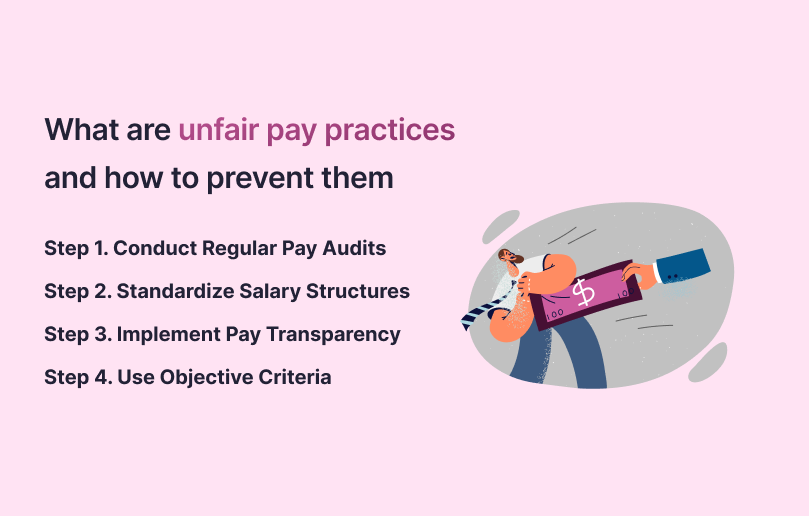
Conduct an annual audit of how much each group of employees is paid based on factors such as gender and race.
Organizations can also use CompAnalyst® Pay Equity Suite to help organizations identify pay gaps and ensure fair compensation practices. It helps HR teams identify pay gaps across gender, race, and other protected groups, and conduct pay equity audits.
It also analyzes internal pay structures, supports compliance with equal pay regulations, provides data-driven recommendations for pay adjustments, and monitors compensation fairness continuously.
Create a salary structure that every employee within your organization must follow. This will help prevent employees from receiving different pay structures.
Ensure that employees know how much they are to be paid by making this information available to them.
Ensure that objective criteria such as performance and experience are used to determine pay and bonuses. This will eliminate any bias from the decision.
Here are the common questions about unfair pay practices:
Employees can start with their manager or HR partner. If needed, they file with the Equal Employment Opportunity Commission or state labor department. Keep records of pay stubs and job descriptions to support the claim.
The top examples include gender or race-based pay gaps, salary compression from market hires, and bonuses awarded inconsistently. Each erodes trust when left unaddressed.
Yes. Courts focus on impact rather than intent. Recent settlements show companies pay millions even when no malice existed, simply because gaps appeared.
Half of employees say transparency ensures equal pay for equal work. Open ranges reduce negotiation bias and let workers see fairness in action.
Schedule a calm conversation with HR using facts and recent market data. Ask for a pay review and timeline. Document every step to protect yourself.

The latest research, expert advice, and compensation best practices all in one place.
Blog
Bringing trusted compensation intelligence and seamless planning to even more ADP users.

Blog
Learn how to train managers for effective pay conversations and build trust.

Blog
Total rewards package flexibility lets employees choose what matters - pay, perks, and benefits tailored to their needs.