Blog
Get Pay Right on ADP Workforce Now® Next Gen™
Bringing trusted compensation intelligence and seamless planning to even more ADP users.
Written by Salary.com Staff
July 25, 2025

With US companies facing triple recruitment growth from 2021 to 2024, utilizing everything within a company’s power to hire top talent is becoming more and more important. Although there are plenty of ways to do so, utilizing market salary data can not only boost recruitment rate, but also ensure that top talent will be the ones walking through your company doors.
The market salary data consists of information about market trends per location, salary ranges for specific job titles, and company size. This information then allows companies to create a competitive salary benchmark versus their competitors.
This guide can help you learn more about market salary, how companies can utilize the data it can provide, how it can help companies create a more effective recruitment model, and most importantly, how Salary.com’s Real-time Job Posting Salary Data can help you not just gather market data, but also provide you with a new way to hire talents.
Simply put, market salary data is external data that highlights information that’s pertinent to creating a competent and fair compensation model for companies. The data contains everything from publicly available data which includes pay and benefits within certain areas within a certain area.
This data can then be used to help provide a more competitive salary for new talent, since their compensation will be up to industry standards. This also leads to a better employee retention rate since they are getting paid similarly – if not better – than their peers in a similar field.
Complex as it may seem at first, only four factors need to be considered to create effective salary data.
Company location: Different states offer different minimum wages for every employee – for example, the minimum wage in California is $16.50, whereas the minimum wage in Wyoming is less than half of that at $7.25. This means that salary survey data can easily vary from state to state.
Industry: Industry should also be considered, as not every industry shares the same salary starting point. For instance, those in the medical industry make significantly more compared to more in-demand jobs like those in the service industry, which can heavily skew data.
Experience level and skill set: Skill and experience should also be considered to provide a better image of the data since there is a sizeable pay gap between employees with only a year’s work experience versus those with more than eight. For example, entry-level executive administrative assistants in the US make $73,236 versus $77,249 for specialist-level (8+ years of experience) executive administrative assistants.
Company size: Salary structure might also differ from one company to another, as bigger companies might have a more complex structure in place while smaller companies have a simpler structure in place.
The data is primarily used to compare and contrast a company’s current compensation package to other companies that offer the same job, within the same industry, and within the same general geographic area. This ensures fair pay for both prospective and existing employees at the same time.
Although there is no data backing up the correlation between market salary data and employee hires, 87.6% of medium-to-large sized companies use salary surveys to great success.
Salary surveys provide a solid vantage point for the current job market and give a company’s future employees a more competitive salary range. The data can also be used to find gaps in talent shortages, create a better employment structure, and even predict employee turnover as well.
Since the labor market statistics provide companies with an idea of what the current job market looks like, they can then adjust accordingly and utilize the data to do the following for their recruitment process:
Know where and how to source new employees.
Optimize their job postings board and provide a well-written, tailored job description to highlight the skills that the company needs the most.
Get informed about the skill gap – or which skill is valued more per company, how much competitors pay for them, and identify skill shortages within the industry.
Learn how much a certain skill is compensated by other companies and adjust their compensation plan accordingly.
Set a competitive base salary, which can then net the right talent to your company.
Although there are plenty of ways to utilize market salary data to further streamline a company’s overall recruitment process. Follow the steps below to make use of salary data to ensure that you’re acquiring top talent for your company.
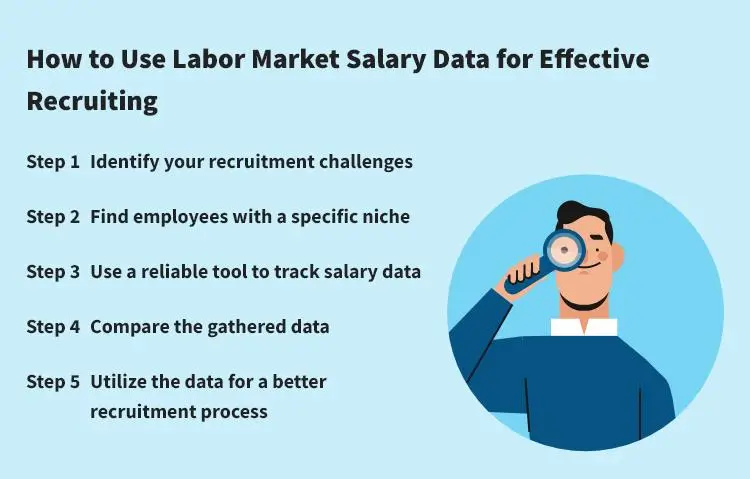
As mentioned above, a company’s location plays a pivotal role in the overall recruitment process. This is because the standard of living, minimum wage, hourly pay, and many others vary state by state – and in some cases, even city by city as well.
To start gathering market salary data, a company must pinpoint their exact location – or even just the broad location, to make sure that they can get the data they need to make a more accurate recruiting strategy. Identifying your company’s location also allows you to narrow down ideal applicants as well, making the recruitment process significantly easier.
Properly pinpointing your location not only increases your company’s odds of being discovered by tenfold but can also help you move on to step two.
After narrowing down your company’s location, the next step is finding the right set of employees for your company. The secret to that is to write job descriptions that specifically highlight the niche that your company is looking for at the moment.
When it comes to writing job descriptions, remember to K.I.S.S. - keep it short and simple. Although some studies recommend using 600 to 700 words, it’s ideal to keep it shorter and more concise at 300 to 500 words to ensure that it captures the applicants’ attention while retaining as much information as possible.
With the aforementioned steps finished, the next thing to do is to make use of reliable software that you can use to double-check the information that you’ve already gathered. Going with Salary.com’s AI-powered tool can help provide real-time salary data acquired from publicly available sources, which can then help provide you with the competitive edge that you need to smoothen and further streamline your hiring process.
Making use of a reliable tool that can track data in real-time provides you with accurate data that ensures a flexible hiring process in the long run, along with providing your employees with a more competitive payment structure as well.
Afterwards, the next step is to compare and contrast the data that you’ve gathered with the data that your company has at the moment. This ensures that you’re offering similar – or higher base pay for the roles that you’re offering at the moment.
Lastly, remember to utilize all the aforementioned steps to create a solid, flawless recruitment process for your company.
Rather, treat the practice of market salary data like advice - a way for your organization to get professionals among the sea of employees.

The latest research, expert advice, and compensation best practices all in one place.
Blog
Bringing trusted compensation intelligence and seamless planning to even more ADP users.

Blog
Learn how to train managers for effective pay conversations and build trust.

Blog
Total rewards package flexibility lets employees choose what matters - pay, perks, and benefits tailored to their needs.