Blog
Get Pay Right on ADP Workforce Now® Next Gen™
Bringing trusted compensation intelligence and seamless planning to even more ADP users.
Written by Salary.com Staff
June 26, 2026

Keeping your employees is among the top priorities for HR leaders and organizations. A solid retention plan will help your organization reduce the costs associated with high employee turnover and maintain high levels of productivity.
This article will discuss retention plans, why they are important, and how you can create an effective plan for your organization.
A retention plan is a plan that HR departments use to reduce the number of employees leaving an organization voluntarily. It takes a close look at the various factors contributing to high employee turnover and give each department a plan to improve the employee experience. With this plans, HR teams can proactively prevent turnover from occurring in the first place.
| Term | Definition |
|---|---|
| Retention Plan | A structured HR document with defined actions to reduce employee turnover |
| Retention Strategy | The broader organizational philosophy that guides how talent is retained |
| Retention Bonus | A financial incentive offered to keep a critical employee through a defined period |
| Employee Engagement | The level of emotional and professional investment an employee has in their work |
An example of a retention plan might target a department that is currently experiencing high levels of employee turnover. For instance, if a company finds that engineers leave at a high rate, the HR department can create a plan for engineering staff that includes incentives or training programs to increase their loyalty to the company.
Employee retention is the ability of an organization to keep its employees over time. High employee retention rates indicate that an organization has successfully built a healthy workplace and maintained a commitment to its staff.
A retention strategy is the underlying philosophy or framework for an organization regarding its employees and how they should be retained. A retention plan is the series of actions that are to be taken as part of a retention strategy.
For organizations that do not implement any plan to retain their employees, there are numerous costs associated with high employee turnover. According to the training and development organization SHRM, the cost to an organization to replace one employee is between 50 and 200 percent of that employee's annual salary. Retention will significantly reduce these costs for organizations.
Cuts recruiting and onboarding expenses across departments
Preserves institutional knowledge
Strengthens the company's employer brand
Improves the productivity of the current staff
Assists in long term HR and workforce planning
Employees leaving an organization voluntarily can create various problems for that organization. Not only can the departments suffer from a loss of their current employees, but the other departments may be forced to take on additional responsibilities. According to the U.S. Bureau of Labor Statistics, over 2 million employees voluntarily left their jobs in the United States in the last year alone.
According to the 2024 State of the Global Workplace report, companies with low levels of employee engagement cost the global economy $8.9 trillion per year. These engaged employees are less likely to leave their jobs in search of other opportunities.
There are several components that an organization must include within their plan. These components will vary from company to company but are essential to ensure that the company maintains a healthy employee turnover rate.
| Component | Purpose |
|---|---|
| Competitive Compensation | Attracts and retains talent by matching or exceeding current market rates |
| Total Rewards | Combines pay, benefits, flexibility, and recognition into a compelling offer |
| Career Development | Gives employees a clear path for internal growth and advancement |
| Retention Bonuses | Provides financial incentives to keep key employees through critical periods |
| Workplace Culture | Creates an environment where people feel valued and connected |
One of the top reasons why employees voluntarily leave their jobs is due to compensation. A salary and compensation strategy for a plan will include information regarding how salaries will be competitive with the area and how employees can earn merit based raises based on their contributions to the organization.
CompAnalyst® Market Data gives HR teams access to reliable salary benchmarks and market insights so they can build competitive compensation strategies that support employee retention.
Today's modern employees care about more than just their salary. Many want an organization to offer mental health benefits, flexible work schedules, and even opportunities for staff to take time off or attend training programs to improve their skills.
Employees who feel that they have a future within their organizations are less likely to look outside those organizations for their careers. According to 2024 Workplace Learning Report, 90 percent of organizations consider employee retention to be one of their top concerns, with providing learning opportunities for employees being their number one retention strategy.
Retention bonuses are typically given to employees during events that may otherwise lead to employee turnover, such as during mergers, during the hiring of new management, or the completion of a vital project. Providing a bonus for these specific periods encourages employees to remain within the company during these critical times.
Here are steps that HR teams can take to create a plan that works for their organization and employees.
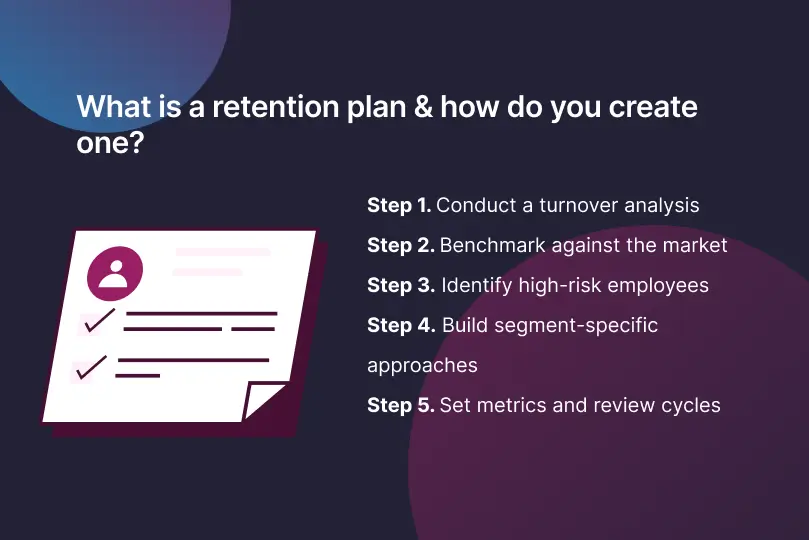
Step 1. Conduct a turnover analysis
An organization can review its departments and the reasons that employees leave to determine which departments or positions pose the biggest challenges for the company.
Step 2. Benchmark against the market
An organization can research the compensation packages that other companies in the same field offer to determine how close the company is to offering employees what they require to remain within the organization.
Compare your current compensation packages to market rates in your industry and location. CompAnalyst® makes this step fast and accurate by delivering access to over 800 million HR-reported data points, allowing you to build competitive salary structures with confidence.
Step 3. Identify high-risk employees
Based on the results of surveys and compensation packages, HR can determine which employees pose the highest risk for voluntarily leaving the organization.
Step 4. Build segment-specific approaches
Based on each department within the company, HR can create plans that address the specific needs of each group of employees.
Step 5. Set metrics and review cycles
An organization will have to establish specific metrics to evaluate the success of its retention plan. These metrics will also inform how often the HR department reviews the plan for effectiveness. Elevate® and the platform's built-in analytics help you track progress and refine your plan over time.
Here are the frequent questions about the topic:
Many retention strategies that go beyond pay, such as offering recognition programs for great department projects, offering mentorship between high-performing and newer employees, or creating employee career advancement programs, do not require additional spending on the payroll but can significantly increase employee loyalty.
SHRM has conducted research to show that each of these strategies will be effective without increasing an organization's payroll costs.
The biggest mistake that organizations make is ignoring the issue until they have a significant number of employees who leave the organization voluntarily. According to Gallup research, 42 percent of employees who voluntarily leave their organizations feel that their manager or the organization could have done something to prevent their voluntary departure from the company.
Retention plans should be reviewed at least once per year. However, each organization can create a schedule for updating that plan following major company events. Additionally, organizations should use surveys to monitor how employees feel about their company and could be leaving each quarter or each month.
Organizations can measure their retention plans based on the voluntary turnover rate within the company, the results of employee engagement surveys, offer acceptance rates for new hires, and internal promotion rates. The voluntary turnover rate and engagement survey results can be calculated for the company overall and each department within the organization.
Additionally, each department can track these metrics on a quarterly basis to determine any areas that may need improvement in their management of employees.

The latest research, expert advice, and compensation best practices all in one place.
Blog
Bringing trusted compensation intelligence and seamless planning to even more ADP users.

Blog
Learn how to train managers for effective pay conversations and build trust.

Blog
Total rewards package flexibility lets employees choose what matters - pay, perks, and benefits tailored to their needs.