Blog
Get Pay Right on ADP Workforce Now® Next Gen™
Bringing trusted compensation intelligence and seamless planning to even more ADP users.
Written by Salary.com Staff
June 05, 2026

An effective way to encourage employees in generating more sales is by giving them commissions, or the payment received after achieving a business target.
Find out how you can create an effective commission plan in this article, including examples and frequently asked questions.
A commission plan is a structured pay model that compensates sales employees based on performance to motivate sales, boost revenue, and attract high-performing workers. An effective commission structure plays different roles in an organization:
HR uses them to motivate and retain employees
Finance uses them to control costs and forecast payouts
Executives use them to align sales targets with pay strategy
When designing your commission structure, the first step is to know the important elements that make up an effective commission plan. These components have specific roles that shape how employees earn, and how companies pay. These are:
| Component | What it means |
|---|---|
| Pay mix | Balance between base salary and performance-based pay |
| Commission rate | Percentage employees earn from sales deals |
| Performance KPIs | Measurable results that generate payouts |
| Sales quota | Target employees are expected to hit for payouts |
| Commission revenue | Portion of the revenue that qualifies for commission |
| On-target earnings | Expected total earnings when the quota is reached |
There are numerous types of commission plans you can use depending on the context of your organization. Here are examples you can base on:
A fixed salary is paired with a variable sales commission, allowing a balance of financial predictability and performance-based rewards.
For example: Employee A has $80,000 fixed base salary and a 10% commission on all sales. This means that Employee A earns $8,000 on top of the $80,000 base pay. In total, Employee A earns $88,000.
Commission rates increase alongside higher sales targets, motivating sales representatives to sell past their quota.
For example: Employee B gets to earn 7% when $75,000 sales are achieved, 10% on the next $75,000, and 15% on any sales greater than $200,000.
Commission rates are based on the value of each offering. This structure motivates representatives to focus on high-priority services or products.
For example: Employee C earns a 6% commission on closed basic products and a 10% commission on closed premium products. In May, Employee C sold $10,000-worth of basic package and $45,000-worth of premium package, leading to a total commission of $5,100.
Automating commission calculations lets you focus on results and prevent manual errors. It also simplifies plan management and prepares detailed payout statements. Achieve all of these smart features through CompXL®.
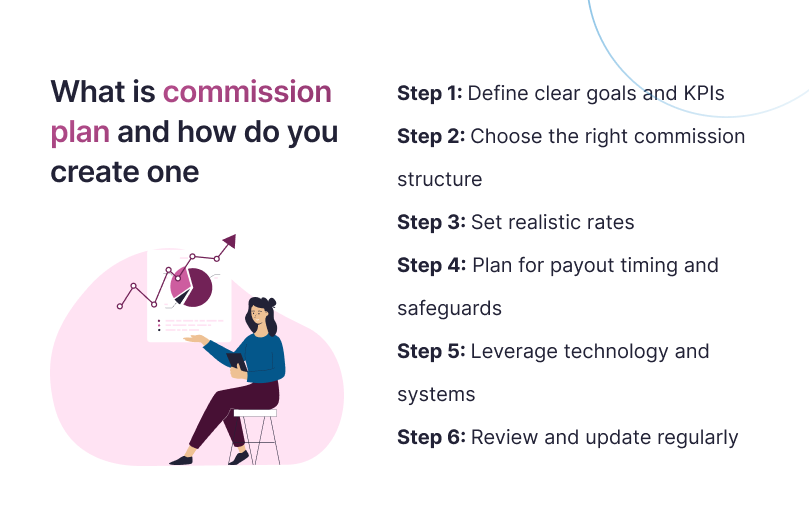
Here is a step-by-step guide on how to create a commission structure that align with your company strategy and objectives:
Every company differs in their sales targets and performance metrics. Identify the main priorities within your organization and make sure they are specific, measurable, attainable, relevant, and time bound.
For example: Increasing yearly revenue by 20% by modifying the sales pitch to each client.
There is no one-size-fits-all commission structure since it needs to be tailored to fit your company's goals and context. To make the right choice of commission framework, you need to consider these factors:
Length and complexity of sales cycle: Short sales cycles often go well with simple commission structures such as flat rates or small bonuses, while long sales cycles, flexible or tiered models can be a better fit.
Types of products or services: Profitable companies with subscription systems can use revenue and residual value, while organizations with lower profits can apply the gross margin model.
Financial capacity of your company: Consider your cash flow to avoid budget risks. Tighter budgets can use commission draws or a stronger base salary, while a larger financial capacity can apply uncapped commissions to attract top talents.
Experience and culture of the sales team: Entry-level sales reps often need incomes stability that comes with a heavier base pay, while expert-level sales reps might need more upside for their skills. Take note of the culture and competitiveness as well.
Ensure that your commissions really reflect the efforts and performance of employees. Payout mechanics can help with that, where performance is translated into actual earnings. The core elements of payout mechanics are:
| Element | What it means |
|---|---|
| Payout curve | How payouts increase when performance improves |
| Thresholds | Minimum level of performance required to receive commissions |
| Accelerators | Higher commission rates applied when quota is exceeded |
Here's how payout mechanics works:
When performance level is low, there are limited or zero payouts.
When performance reaches quota, payouts are based on budget expectations
When performance exceeds quota, accelerators increase earnings.
Always effectively communicate when and how payouts happen in your commission plan to avoid misconception and disputes. To further ensure that your commission structure is protected, use tools like caps and clawbacks.
Your commission plan works more effectively when you utilize the right technology and systems in your workflow, making sure that your data and payouts are accurate and credible to your employees. Here are some of them:
| System | What it does | Why it matters |
|---|---|---|
| Sales compensation system | Calculates commissions automatically based on rules | Reduces manual errors and makes scaling possible |
| CRM integration | Automates workflow to provide unified view of customer data | Ensures real-time and updated sales information and pay calculation |
| Data governance framework | Defines rules and roles on how organizational data is managed | Creates trust in payout accuracy and avoids disputes |
| Reporting and analytics | Monitors performance, payouts, and trends in costs | Helps in making data-driven decisions and adjust plan when necessary |
Break free from fragmented tools and switch to one platform that allows you to plan and manage commissions, track budgets, and streamline approval workflows through CompXL®.
As changes in business and market occur, your plan must also adapt. Make sure that your commission structure is still aligned with your company objectives. To further ensure this, your governance must be strong as well. Here are control areas you must maintain to achieve that:
| Control area | What to do | Why it matters |
|---|---|---|
| Plan documentation | Define all rules, formulas, and eligibility criteria clearly | Prevents confusion and misinterpretation of plans |
| Audit controls | Incorporate structured audit checkpoints before every payout cycle | Captures errors to prevent overpayments or disputes |
| Compliance | Make sure that plans adhere to legal and regulatory requirements | Provides protection to companies against legal and financial risks |
Keep your employee records current and pay decisions aligned through HRIS Integrations, a system where you can connect CompAnalyst® to simplify commission management.
Here are frequently asked questions about commission plans:
Commission rate is the percentage or amount paid to a salesperson while a payout curve is the overall structure that shows how rate changes based on performance thresholds.
Accrual accounting records commission expenses when they are earned, not when paid. This gives more accurate insights on the company's assets and liabilities in the balance sheet. It's the only method required in GAAP and is required by SEC for publicly traded companies.
The common risks in a commission plan include:
Errors in calculations
No transparency
Compliance and legal implications
Delays in payouts
Misaligned incentives
Vulnerability in data security

The latest research, expert advice, and compensation best practices all in one place.
Blog
Bringing trusted compensation intelligence and seamless planning to even more ADP users.

Blog
Learn how to train managers for effective pay conversations and build trust.

Blog
Total rewards package flexibility lets employees choose what matters - pay, perks, and benefits tailored to their needs.