Blog
Get Pay Right on ADP Workforce Now® Next Gen™
Bringing trusted compensation intelligence and seamless planning to even more ADP users.
Written by Salary.com Staff
July 10, 2026

Performance reviews are a standard practice in the U.S. Many organizations use these reviews to evaluate how employees are contributing to the company's success.
An annual performance review is an evaluation by a manager of an employee's contributions over a twelve month period. It results in a formal rating that influences compensation, promotions, and development plans.
Each performance review typically contains the following components:
| Component | Purpose |
|---|---|
| Goal assessment | Reviews an employee's accomplishments towards the goals they had at the start of the year |
| Competency evaluation | Rates core skills like communication and leadership |
| Self assessment | Gives the employee a chance to speak to their own contributions to the company that year |
| Manager narrative | The manager writes a narrative about the employee's contributions and skills |
| Overall rating | Assigns a final score used for compensation and talent decisions |
A performance review occurs once a year. Performance management is an ongoing process to evaluate and provide feedback to employees throughout that year. According to a 2025 report, 61% of managers and 72% of workers do not trust the performance management process within their organizations.
Setting goals for employees at the start of the year allows managers to evaluate how closely the employee achieved those goals during the performance review period. Using the SMART framework (specific, measurable, achievable, relevant, and time-bound) for these goals allows the managers to accurately evaluate the employees' accomplishments.
Effective goal setting also allows for a discussion about the challenges or obstacles that the employee may experience during the year.
A performance review is just the beginning of the process. What happens afterwards determines the success of the process of reviewing employees' contributions to the company.
Following a performance review, managers and employees may:
Update a development plan for the employee within two weeks of the performance review
Make decisions regarding an employee's compensation within 30 to 60 days of the performance review
Have a discussion with the employee regarding their long term career goals
Follow up with the employee during quarterly performance review meetings
A manager should start a performance review with a positive statement about an employee's accomplishments. The manager may also review the employee's areas for improvement and work together to create goals for the next year that the employee will work to accomplish.
Calibration is a process in which a manager reviews each employee's performance review ratings prior to finalizing those reviews.
An employee's rating is typically used to determine their compensation and any bonuses for that year. Employees with higher ratings are typically provided with larger merit increases or bonuses. According to research, companies that separate their performance reviews from compensation reviews for employees tend to achieve better outcomes.
Automating this step removes the manual spreadsheet process that slows teams down. CompXL® translates performance ratings directly into merit increases, bonuses, and equity awards - ensuring decisions are consistent and audit-ready.
A good performance review rating system should be easy to use by managers and provide differentiation between high performing and low performing employees. A good rating system should also be aligned with the company's values.
A five point rating scale is often used in performance reviews and contains the following labels and descriptions:
| Rating | Label | Description |
|---|---|---|
| 5 | Exceptional | Employees consistently exceed expectations of their role and act as a role model for others within the company that year |
| 4 | Exceeds Expectations | Employees often surpass the goals that were established for them that year |
| 3 | Meets Expectations | Employees have a solid performance for their role within the company during the review period |
| 2 | Needs Improvement | Employees have an insufficient contribution to the company that year |
| 1 | Unsatisfactory | Employees significantly underperform in comparison to the expectations of their role within the company |
Designing a rating system is only half the work - it also needs to connect to market-validated pay ranges. CompAnalyst® provides the benchmarking data to ensure each rating tier maps to compensation that is both competitive and internally fair.
Many companies use a five point scale to review employees' performances. Other companies use a four point scale to avoid what is known as the "central tendency bias." Companies that use a five point scale have more opportunities to differentiate between pay rates for employees based on their performances.
Managers can use bias rating scales that evaluate employees' performances according to specific behaviors and accomplishments. They can also use calibration meetings to review each other's performance reviews before they are finalized. According to a study, organizations that focus on continuous performance management outperform those that do not.
Here's the step by step on how to write an annual performance review of an employee:
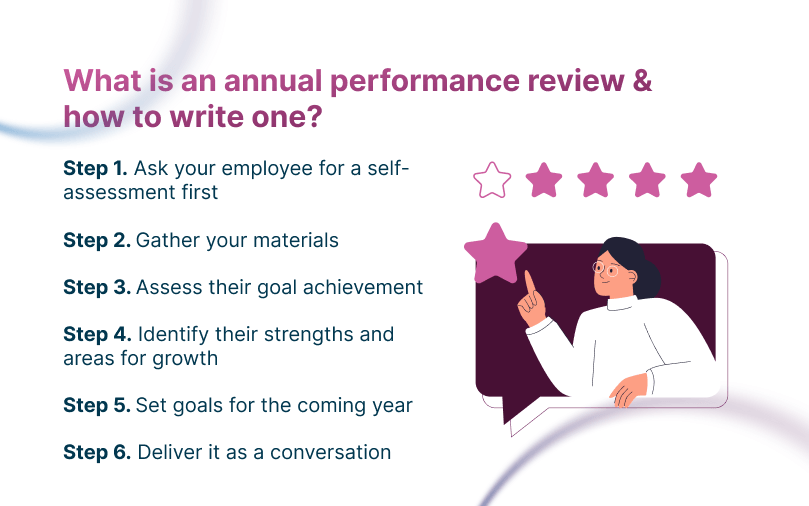
Ask your employee to reflect on their year and submit a self-assessment to you. This will give you an idea of their performance that you might have missed, and it will help them to feel a part of the performance review.
Collect your employee's goals for last year, their projects and their outcomes, and any feedback from their peers. Reflect on the entire year of your employee's performance. Try to avoid biases about their performance and only consider the highlights of their year.
Review each goal that you and your employee established last year. Assess whether they were met, nearly met, or not met at all. Consider providing examples of how you assessed whether these goals were met.
Provide feedback for your employee about their current skills and their areas for improvement. Avoid all praise or criticism in your feedback; it will make you appear insincere. Focus on the skills and areas for improvement rather than their personality.
Based on your employee's assessments and your knowledge of their career and role, establish goals for the coming year. These goals should be measurable and convey the direction you would like to take their career with the organization.
Give your employee a performance review in person. Allow them to react to your feedback and discuss their thoughts on the meeting. This will foster a better relationship between the two of you and make them feel like a part of the organization.
Organizations that want to align employee development with clearly defined roles often use tools such as JobArchitect®. The platform helps HR teams create standardized job descriptions, maintain job frameworks, and ensure employees' future goals align with the skills and responsibilities required for their positions.
Here are the frequent questions about annual performance review:
Use specific comments that relate to the employee's achievements. For example, instead of stating that an employee "contributed well to the company" a better comment is "Led the move of the corporate office to a new location which reduced commuting times for 25 employees".
Common mistakes include: relying on memory of that employee's contributions instead of documented reports, focusing only on the most recent contributions of that employee, avoiding difficult conversations with that employee, or writing feedback for employees that does not provide any clear next steps for the employee to improve their contributions to the company.
Employees can prepare for a performance review by compiling their achievements, focusing on goals that they have created for themselves, reviewing the goals that were created for them when they were hired, and preparing any questions that they may have regarding their career.
Yes, employees can typically submit written comments or requests for a reassessment of their rating. Employees should focus on providing factual comments about their performances rather than comments regarding any dissatisfaction of their rating.

The latest research, expert advice, and compensation best practices all in one place.
Blog
Bringing trusted compensation intelligence and seamless planning to even more ADP users.

Blog
Learn how to train managers for effective pay conversations and build trust.

Blog
Total rewards package flexibility lets employees choose what matters - pay, perks, and benefits tailored to their needs.