Blog
Get Pay Right on ADP Workforce Now® Next Gen™
Bringing trusted compensation intelligence and seamless planning to even more ADP users.
Written by Salary.com Staff
July 10, 2026

A well drafted commission agreement is the backbone of a high performing revenue team. It is a legally binding contract between the employer and the sales representative that defines how the sales representative will earn and receive their variable pay.
A strong and properly functioning commission agreement will prevent an organization from suffering legal lawsuits, disengaged sales representatives, and a lack of compliance with the law.
This article will break down the components of a robust and compliant commission agreement.
A commission agreement is a contract between the employer and a salesperson detailing the terms of how the salesperson will earn and receive their commission. Such agreements protect both the employer and the salesperson from any issues regarding the variable pay of the sales representative.
Most sales agreements will include the following elements:
The rate at which the sales representatives will earn their commission
The timing and method of the payment of the sales representative's earned commission
The conditions under which the sales representative will earn, hold, or forfeit their commission
The classification of the sales representative as an employee or an independent contractor
The sales territory and products for which they are responsible
Once the salesperson and the employer have agreed to the terms of the sales commission agreement, that agreement will guide the sales representative's compensation for the time period in which the sales are made.
The percentage of the product's sale that will be paid to the sales representative will be calculated according to the formula established in the agreement, and that sales representative will be paid according to the payment schedule established in the agreement.
The U.S. Department of Labor explains that commissions may be paid in addition to an employee's salary, or in place of a salary for some sales representatives.
A strong agreement leaves little room for interpretation. Beyond the commission rate, it should define payment timing, dispute steps, and what happens if employment ends mid period.
| Section | What It Covers |
|---|---|
| Parties and roles | Names and employment classification |
| Commission rate | Percentage, flat fee, or tiered formula |
| Payment timing | Pay period, draw, or payout date |
| Quotas and metrics | Sales targets and measurement method |
| Termination terms | Treatment of pending or unpaid commissions |
| Legal clauses | Confidentiality, dispute steps, governing law |
Performance metrics are the measurements of the sales representative that will determine how much commission they will earn for that time period. Sales quotas are the sales targets that a sales representative must meet in order for them to earn higher sales rates or bonuses.
The Department of Labor explains that outside sales employees, who are paid mostly through their sales commissions, must primarily be engaged in making sales away from the place of business of the employer.
The structure of the sales commissions is critically important in any sales agreement. Research shows that fifty one percent of organizations that use flat commission structures for their sales representatives end up overpaying their tenured top performers.
Also, forty six percent of those organizations found that their sales representatives were able to effectively set their own earning rates for themselves.
Sales commissions are important for the following reasons:
To ensure that the sales representatives' actions align with the revenue goals of the organization.
To ensure that the compensation cost for sales representatives is controlled to the amount of sales that they produce.
To ensure that sales representatives in different regions of the company earn the same rate because of the same opportunity for sales.
To decrease the turnover rate of the organization's top sales performers.
Organizations designing commission plans can use CompAnalyst® to benchmark sales positions against the market, build competitive compensation structures, and model various pay scenarios. This helps ensure commission programs support both business goals and employee retention.
A base salary plus commission model for sales representatives pays the sales representatives a base salary and a percentage of the sales that they make. This model is very common among organizations whose sales representatives perform mostly internal sales and account management functions.
A tiered commission structure for sales representatives awards them a higher percentage of the sales total for sales representatives who reach certain sales quotas, or "accelerators." Such structures are a means of rewarding the top performers among sales representatives for the sales that they produce.
A revenue based commission agreement pays the sales representative a percentage of the revenue that is made from the products that they sell. This structure for sales representatives is common when the sales representatives must sell a variety of products, as higher valued products will earn a greater percentage of the sales total for that sales representative.
Writing an effective commission agreement requires careful planning and collaboration between HR, legal, and sales teams. Follow these steps to write a document that supports your business goals.
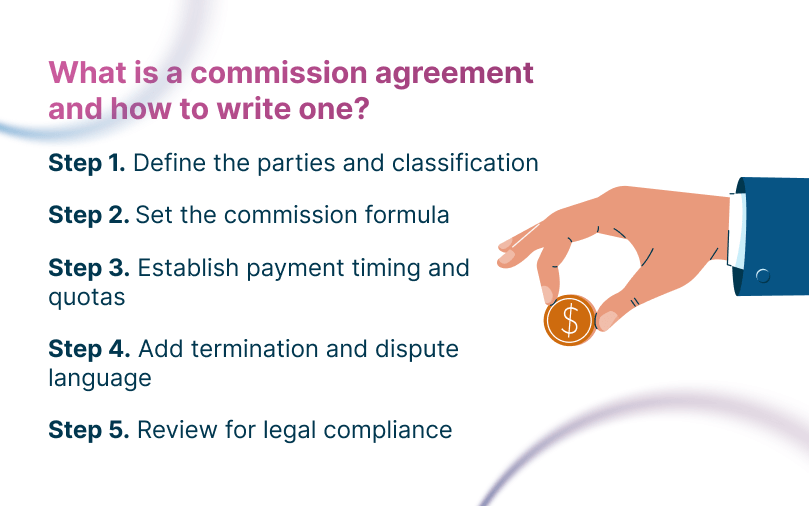
State the full legal names of employer and salesperson, and classify the role as employee or independent contractor, since this affects taxes and wage law coverage.
Clear job definitions are essential when drafting commission agreements. JobArchitect® helps orgnizations create standardized job descriptions, align responsibilities with compensation programs, and maintain consistent job documentation across the business.
Spell out the exact rate, whether flat, tiered, or revenue based, with a sample calculation so there is no ambiguity about the payout.
Specify in the agreement both when the sales representative will be paid for their sales, such as every two weeks, and state any sales quotas that they must reach in order to earn the sales commission that is set for them in the agreement.
Organizations managing complex commission programs can use CompXL® to automate commission calculations, bonuses, and incentive payouts. The platform helps HR and sales leaders apply compensation rules consistently while reducing manual work and spreadsheet errors.
Explain what happens to pending commissions if employment ends, and outline a simple process for resolving disputed sales so neither party is left guessing.
Have legal counsel confirm the agreement meets federal wage rules and pay transparency requirements in any state where the employee works, then have both parties sign and date it.
Here are the frequent questions about the topic:
Generally, agreements should not be backdated, since the Fair Labor Standards Act ties commission treatment to when wages are earned and paid, and retroactive changes can create wage and hour exposure if pay already earned is reduced.
Most agreements state that commission is only fully earned once a sale is finalized, often after a return or cancellation window closes, and the SHRM sample incentive policy recommends spelling out this earned versus paid distinction
When a structure is vague, the research highlighted shows pay outcomes become inconsistent and can create misalignment that erodes trust, which is why HR teams should document accelerator rates in writing before a performance period begins.
In states with pay transparency laws, employers must often disclose that a role is commission based and, in some cases, list the expected commission range in postings, so HR teams should review each state specific posting requirements before finalizing an agreement.

The latest research, expert advice, and compensation best practices all in one place.
Blog
Bringing trusted compensation intelligence and seamless planning to even more ADP users.

Blog
Learn how to train managers for effective pay conversations and build trust.

Blog
Total rewards package flexibility lets employees choose what matters - pay, perks, and benefits tailored to their needs.