I grew up in a small Kansas town and moved to the big city, San Francisco, after law school at the University of Kansas. I was a young lawyer in 1993, when a shooter, dressed in a suit, opened fire at another law firm a few blocks away and killed 36 people. It was terrifying.
A few years earlier, my legal assistant turned out to be sending threats of violence to another employee. When he was terminated for it, he came to me distraught and stated he was going to come back with a gun and kill several people involved in the decision. We evacuated the office and spent several hours in a cafeteria in a nearby building while law enforcement secured the area and investigated.
In the following days, we found strange occult symbols and figures in his desk, more threatening notes he hadn't sent yet, and a pile of correspondence several weeks old that had never gone out. (They really hadn't received my letter.)
One of the partners then brought in a psychic to put a "white light" around the office. Toto, I don't think we're in Kansas anymore. I left the firm shortly afterwards.
I wish I could say that I never encountered threats of violence again. For a long time, my sense was that it just came with the legal profession because, well, nobody who is involved in our legal system as a party is really okay. We don't talk enough about how traumatic litigation is.
In the years since, shootings have become common in the United States at work, stores, schools, movie theaters, night clubs, and pretty much any other place people gather. That's why California requires employers to create a workplace violence plan and to make sure everyone understands it and knows what to do.
We are in a time of uncertainty where people don't always act rationally, especially when they are scared, angry, or upset. This is a great resource for understanding and preparing for potential violence at work. I know it's not fun to think about. I hope you don't ever need it. But the problem is real and I want you to take care and be ready just in case.
April is Workplace Violence Prevention Awareness Month, and employers should use this as an opportunity to learn more about this critical safety issue and how to address it. We’ll cover the latest workplace violence data and developments – including key risk factors and compliance obligations – and equip you with 10 prevention strategies to help protect your employees (and your organization).
Workplace Violence Might Be More Common Than You Think
What’s considered workplace violence?
The Occupational Safety and Health Administration (OSHA) defines workplace violence as “any act of physical violence, harassment, intimidation, or other threatening behavior that occurs at the work site.” Acts of workplace violence can be carried out by:
criminals who have no legitimate business at the worksite;
customers, clients, patients, students, inmates, or visitors;
current or former employees, supervisors, or managers; or
individuals who have a personal relationship or history with an employee.
Who’s most at risk?
According to OSHA, workers who are at higher risk of becoming victims of workplace violence include:
workers who exchange money with the public;
delivery and taxi/ride share drivers;
healthcare professionals;
social assistants;
public service workers;
customer service agents;
law enforcement personnel; and
others who may work alone or in small groups.
What does the data say?
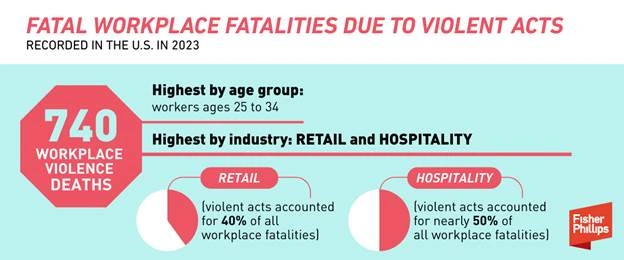
According to government data on fatal work injuries recorded in the U.S. in 2023 (the most recent reporting year), workplace fatalities due to violent acts:
totaled 740 (with more than 60% attributed to homicides);
were highest among workers ages 25 to 34 (totaling 179, including 121 homicides and 58 suicides) compared to any other age group;
were highest among retail and hospitality workers – violent acts accounted for 40% of all workplace fatalities in the retail industry and nearly 50% of all such deaths in the hospitality industry (for a more in-depth look at these numbers and how to address workplace dangers, click here (retail) and here (hospitality).
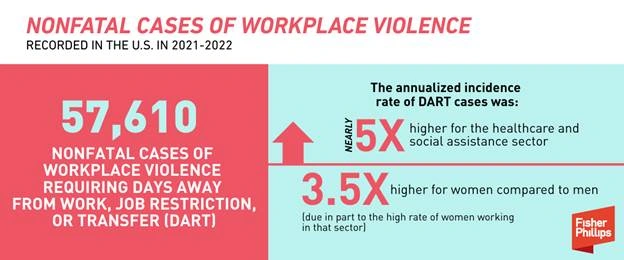
Remember, workplace violence can include a wide range of acts, including threats and verbal abuse, and is not limited to fatal incidents or even physical acts. According to this government fact sheet, over the most recent two-year reporting period (2021-2022), there were 57,610 nonfatal cases of workplace violence requiring days away from work, job restriction, or transfer (DART). In addition, the annualized incidence rate of DART cases was:
nearly five times higher for the healthcare and social assistance sector; and
5 times higher for women compared to men (due in part to the high rate of women working in that sector).
Note that the actual numbers could be much higher, due to the risk of underreporting.
Employers Must Take Workplace Violence Prevention Seriously
If the data summarized above is not alarming enough, there are many other compelling reasons why you should take workplace violence prevention seriously. Besides the most important reason – protecting the physical and emotional safety of your employees – implementing workplace violence measures could help you:
avoid compliance problems or regulatory fines (which we discuss further below);
reduce costs resulting from violent incidents, such as medical expenses, workers’ compensation claims, legal fees, property damage, and increased insurance premiums;
boost employee morale, productivity, and retention; and
protect your customers, clients, or patients (as applicable) – as well as your organization’s reputation.
Employer Obligations Under Federal and State Laws
Federal Law and OSHA Guidance
Federal OSHA has long taken the position that the Occupational Safety and Health (OSH) Act’s general duty clause requires employers to “take reasonable steps to prevent or abate a recognized violence hazard in the workplace.” And in 2019, the Occupational Safety and Health Review Commission – an independent federal agency that is not part of the Department of Labor or OSHA – ruled for the first time that the general duty clause requires employers to protect employees from incidents of workplace violence.
As a result, you may need to implement certain workplace violence prevention measures, depending on the specific circumstances at your worksite. This is especially true if members of your workforce are at higher risk of becoming victims of workplace violence.
Healthcare Employers. Last summer, OSHA unveiled its plans to release a proposed workplace violence prevention rule targeting healthcare employers by year-end. If the agency issues and ultimately finalizes the rule, healthcare employers would be required to implement a range of measures to protect their workers, utilizing a programmatic, performance-based approach to addressing workplace violence. To learn more, click here.
State Law
A growing number of states maintain their own workplace violence prevention laws that either span general industries or focus on specific workplaces (most commonly in the healthcare sector), including but not limited to California, Connecticut, Illinois, Louisiana, Maine, Maryland, Minnesota, New Jersey, New York, Ohio, Oregon, Texas, and Washington. Three of these laws were just enacted or took effect just within the past year, including two that are industry-specific and one that applies to nearly all employers in the state.
Most employers in California must establish a written Workplace Violence Prevention Plan, train employees and supervisors on workplace violence matters, maintain a violence incident log, and keep records of all training and violent workplace incidents that occur. Click here to read more about the California law, which took effect last year and is in addition to Cal/OSHA’s existing healthcare workplace violence prevention rule.
Ohio hospitals (and hospital systems) must establish a comprehensive security plan for preventing workplace violence, due to a new law (HB 452) that just took effect April 9. The security plan must be based on the results of a security risk assessment, and hospitals and hospital systems must review and evaluate the plan on an annual basis.
Retail employers in New York will soon be required to implement a written workplace violence prevention policy, conduct annual training and, for larger retailers, install panic buttons. The state’s Retail Worker Safety Act was originally set to roll out in March, but key amendments to the law pushed the effective date for most requirements to June 2 and eased other obligations (the effective date for the “silent response buttons” mandate for larger retailers remains January 1, 2027).
In addition, another wave of states this year are considering establishing or expanding workplace violence prevention laws. Many of the proposed bills (including in Massachusetts, Oregon, and Washington) would impose new compliance obligations on healthcare employers.
Virginia Bill Vetoed. While Virginia lawmakers passed legislation (HB 1919) that would have required any employer of 100 or more employees to maintain a workplace violence policy starting in 2027, Gov. Glenn Younkin vetoed the bill on April 2, claiming that it “misclassifies workplace violence as a regulatory issue rather than a criminal matter.”
10 Workplace Violence Strategies for Employers
Here are 10 steps you can take to help protect your employees from workplace violence. (For a deeper dive on the subject, check out OSHA’s specific resources.) Importantly, you should work with counsel when developing a workplace violence prevention policy, plan, or program, to ensure compliance with any applicable state or federal law.
Establish a Zero-Tolerance Workplace Violence Policy
Clearly communicate (in writing) and enforce a policy that prohibits any form of violence or threats. Train managers to recognize and address violations immediately.
Identify and Evaluate Workplace Violence Hazards
Are you in a higher-risk industry (such as healthcare, hospitality, or retail)? Regardless of your sector, are any factors present at your worksites that could potentially increase the risk for workplace violence? Certain workers could be more vulnerable, including those who work alone, at night, or where valued items are stored, or workers who perform in public safety or social welfare roles.
Implement Security Measures for High-Risk Workers
For example, hospital employers can equip front desk areas, cash handling locations, and entry points with surveillance cameras, panic buttons, and barriers to protect front-line employees in high-risk areas. They can also install panic buttons for housekeepers, room attendants, in-room dining servers, and others who need to enter guest rooms.
Train Employees on Violence Prevention and De-Escalation
Provide training on how to recognize warning signs, de-escalate conflicts, and safely exit dangerous situations. Ensure employees know when and how to seek help.
Control Access to Premises & Ensure Adequate Lighting in All Areas
Use keycards, guest logs, and secure entrances to limit unauthorized access to employee-only and sensitive areas. Restrict after-hours entry to prevent intrusions. Illuminate parking lots, hallways, kitchens, and back exits to deter criminal activity and make employees feel safer, particularly during night shifts.
Develop a Workplace Violence Prevention Program
Create a detailed plan that addresses potential scenarios, response protocols, and recovery support for affected employees. Make this a part of regular safety reviews.
Establish Safe Cash Handling Practices
Limit cash handling by encouraging credit or digital payments, and train employees never to resist during a robbery. Install safes and use automated cash management systems.
Hire or Partner with Security Professionals
Employ trained security staff or collaborate with local security firms to monitor entrances, patrol premises, and respond to threats, especially during peak hours or events.
Foster a Culture of Open Communication
Encourage employees to report suspicious behavior, escalating tensions, or security concerns without fear of retaliation. Act on reports swiftly and transparently.
Collaborate with Local Law Enforcement
Work with local police to conduct risk assessments, hold safety workshops, and ensure rapid response protocols. Consider hosting on-site law enforcement training sessions.
Share:
Subscribe for free: compensation & pay equity law review
LabelPlease enter a valid work email
You'll receive a weekly newsletter email with the most important legal news on compensation and pay equity. We handle your contact details in line with our
Privacy Policy
Thank you! You are now subscribed.
Are you concerned about pay gaps in your organization?
CompAnalyst® Pay Equity Suite can help you achieve and sustain pay equity