Free speech at work is one of the most confusing, complicated, and misunderstood areas of employment law. Well, besides "wrongful termination" and "hostile work environment."
There is no First Amendment right to free speech at work because the First Amendment only applies when the government tries to restrict someone's speech. Unless the employer is a government, there's no free speech at work. And even when the employer is the government, it can still restrict speech when there's an important reason. National security is a big one, but there are many others.
At the same time, how you approach political or other disputes at work matters because 1) work still needs to get done; 2) different laws can apply; 3) it's easy to make things worse instead of better; and 4) lots of people are concerned and upset about what's happening.
It's also important to know that especially right now, there can be a very thin line between "political" disputes and speech that reflects illegal discrimination such as racism and sexism.
Employers have to acknowledge that "unprecedented times" doesn't begin to cover it right now, at least for most people. In the meantime, here's an outstanding guide to political and other speech at work from Fisher Phillips.
As political tensions surge and employee expression spills into every corner of the modern workplace, employers are finding themselves caught in the crossfire. From off-hours protests to heated workplace debates and viral social media posts, the question for us isn’t just whether speech is free – but whether it’s job-protected. With laws, rights, and risks swirling around every conversation, T-shirt, post, and “like,” it’s time for a clear-eyed guide. Here’s what your business needs to know about navigating employee speech in various scenarios, both on and off the clock.
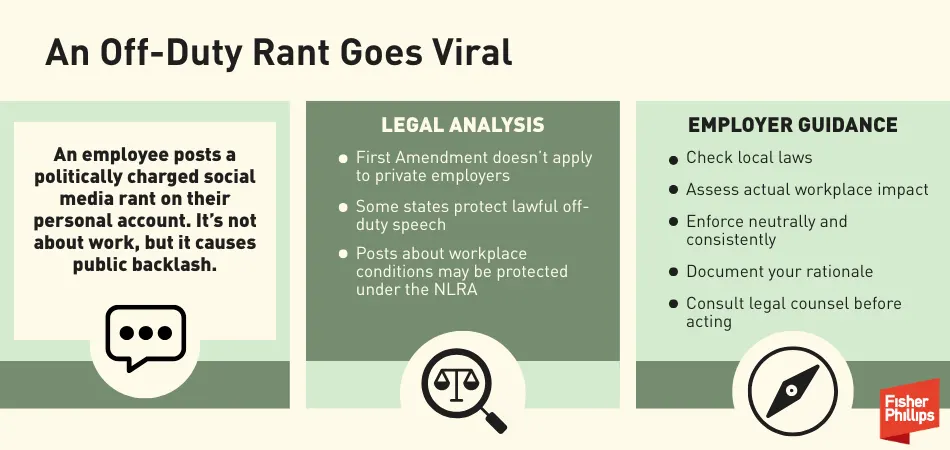
Scenario 1: An Off-Duty Rant Goes Viral
An employee posts a politically charged rant on their personal social media account over the weekend. It’s not about work, but it causes public backlash.
Legal Analysis:
Private-sector employers are not bound by the First Amendment’s free speech protections, which only restrict government action. That said, employers may not be able to discipline off-duty speech with total impunity. Several states – including California, New York, and Colorado – have statutes protecting employees from retaliation for lawful off-duty conduct, and Minnesota, Connecticut, Louisiana, South Carolina, and Wyoming are among the states that specifically protect off-duty political activity. These laws may prevent employers from firing or disciplining employees for expressing their personal views unless those views have a clear, material impact on the business.
Even without a directed state law at issue, the federal National Labor Relations Act (NLRA) could also provide your employees with protection. If the social media post relates, even indirectly, to the employee’s terms and conditions of employment, it may qualify as protected “concerted activity.” This is especially true if the post touches on workplace issues shared by coworkers (e.g., wages, scheduling, discrimination). The NLRB under recent interpretations has cast a wide net over what counts as protected speech, and this protection applies to non-union workplaces as well.
Employer Guidance:
Check local laws first. Understand whether your state limits employer action on off-duty political or personal speech. These laws may surprise you, as some prevent employers from terminating the employment of someone who posts even clearly offensive posts unless you can show the communication caused direct business harm.
Evaluate the workplace impact. Determine whether the post caused operational disruption, reputational damage, or significant internal strife. Absent that, discipline may not be legally or strategically justifiable.
Enforce policies neutrally. Whether the post supports or opposes a cause, the focus should be on the impact, not the ideology. Selective enforcement invites discrimination claims.
Document the decision-making. If you discipline, ensure documentation ties the action to the legitimate workplace impact you considered. Avoid using inflammatory or subjective language.
Consult legal counsel. These decisions often exist in legal gray areas and public scrutiny can escalate quickly. Getting a second opinion can help de-risk the response.
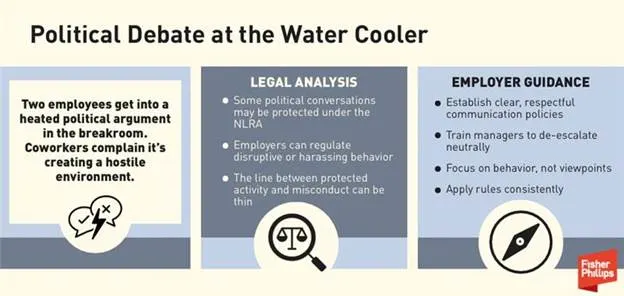
Scenario 2: Political Debate at the Water Cooler
Two employees get into a heated political argument in the breakroom. Other workers complain that it's creating a hostile or toxic environment.
Legal Analysis:
Political debates in the workplace are becoming more common – and more combustible. While the NLRA protects employees who engage in conversations about workplace conditions (regardless of whether the employees are members of a labor union), the law does not give employees free rein to disrupt the workplace. Employers may lawfully restrict political speech that creates a toxic atmosphere, distracts from productivity, or can be appropriately characterized into harassment or bullying.
That said, you must tread carefully. If employees are discussing matters that relate to shared working conditions, such as diversity policies, unionization, or workplace safety, their speech may be protected. Discipline in that context could trigger an unfair labor practice charge. The challenge is distinguishing between disruptive or discriminatory conduct (which may be regulated) and protected activity (which may not). If the discussions relate to other protected activity (complaining about discrimination or harassment), then fair employment laws might be triggered.
Employer Guidance:
Set clear boundaries in your code of conduct. Your policies should emphasize respect and civility in all workplace interactions, including political conversations. Make it clear that hostile or demeaning speech won’t be tolerated, regardless of the topic.
Train managers to intervene early and neutrally. You should teach supervisors to spot the line between a healthy discussion and a volatile one. They should not express political views themselves or allow situations to escalate.
Focus on conduct, not content. If you take action, make sure it’s about the behavior – disruption, intimidation, name-calling – not the opinion expressed.
Be consistent. If you address one type of political conflict but ignore another, you create risk of a discrimination or retaliation claim.
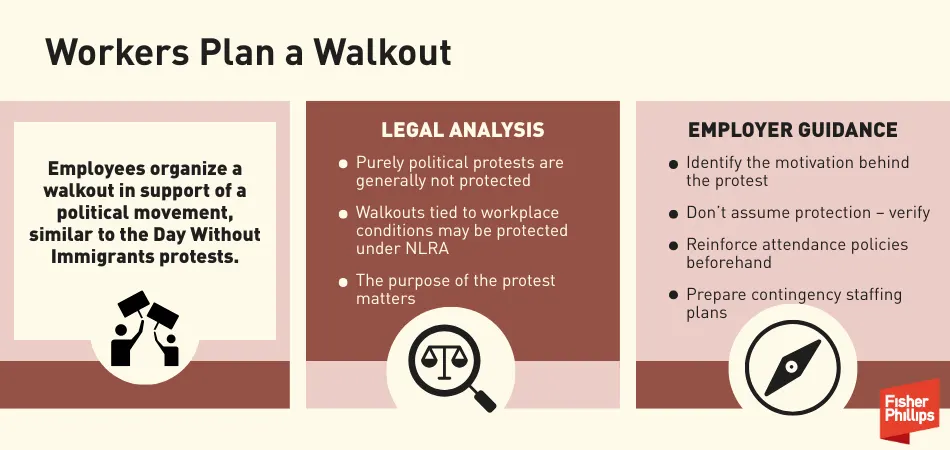
Scenario 3: Workers Plan a Walkout
Employees organize a walkout in support of a political movement – similar to the Day Without Immigrants or recent global protest days.
Legal Analysis:
The legality of employee walkouts hinges on the purpose behind the protest. If the protest is purely political and unrelated to workplace issues, such as a walkout opposing foreign policy or supporting a national election candidate, it likely falls outside the protection of the NLRA. In those cases, employers may treat the absence as unexcused and impose discipline under normal attendance policies.
However, if the walkout is tied to workplace issues or advocacy for better working conditions, it could be protected “concerted activity.” For example, employees walking out to protest workplace discrimination or to express solidarity with a national labor strike may fall under NLRA protection, even if your organization is not unionized. The NLRB under the Biden administration showed a growing willingness to connect national issues to local employment conditions, particularly under a broad reading of employee rights. We do not expect this trend to continue under the Trump Board once it regains a quorum.
Employer Guidance:
Determine the purpose of the protest. Ask whether this is political advocacy or workplace-related activism. If there’s a link to workplace terms, protection may apply.
Avoid snap discipline. Even if a walkout seems unprotected, consult counsel before issuing discipline. An inaccurate legal assumption can backfire.
Reinforce your attendance and conduct policies. Make sure employees understand how protest-related absences will be treated in advance. Apply policies consistently.
Prepare a contingency plan. If you anticipate workplace disruptions, line up backup coverage, communicate clearly, and debrief afterward to reset expectations.
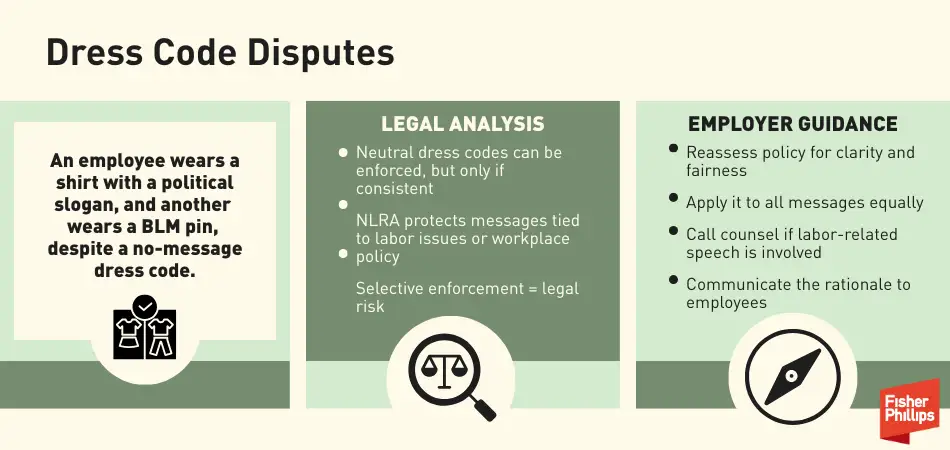
Scenario 4: Dress Code Disputes
An employee wears a shirt with a political slogan, and another wears a Black Lives Matter lapel pin. Your dress code prohibits all messaging.
Additionally, uneven enforcement of dress codes – allowing purportedly patriotic or humorous slogans but prohibiting political or social messages – can expose employers to legal risk. If messaging restrictions disproportionately impact one group of employees or one viewpoint, a discrimination claim could follow.
Employer Guidance:
Reassess your policy. If your dress code prohibits all messaging, make sure it’s uniformly enforced and tied to a legitimate reason, such as safety, customer expectations, or professionalism.
Apply it evenly. You can’t allow some messages and ban others based on subjective content. If you prohibit “BLM” attire, you should also prohibit “Back the Blue” messaging, for example.
Avoid knee-jerk enforcement. If the messaging relates to labor rights or workplace activism, call your lawyer before issuing discipline or sending someone home.
Communicate the rationale. When enforcing the policy, explain the focus is on maintaining a distraction-free, respectful environment – not silencing ideas.
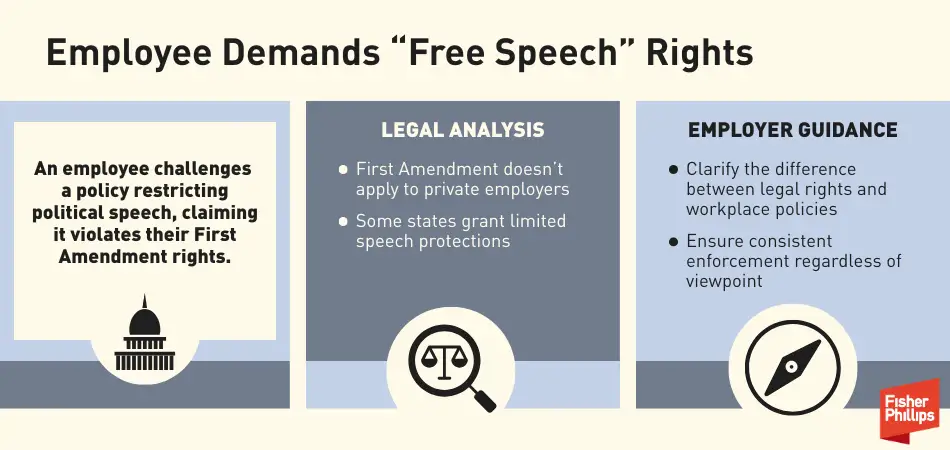
Scenario 5: Employee Demands “Free Speech” Rights
An employee challenges a policy restricting political speech, claiming it violates their First Amendment rights.
Legal Analysis:
One of the most common misunderstandings among employees is believing the First Amendment protects their speech at work. While that may apply in public-sector employment, it has no direct application in the private sector. However, some states provide narrow protections for off-duty political activity, especially when the speech has no connection to the workplace or employer.
Still, the law does not give employees carte blanche to say whatever they want in the workplace or on platforms where their employer may be impacted. You retain the right to impose reasonable restrictions on workplace speech to preserve productivity, safety, and a respectful environment. It’s a balancing act between creating space for diverse perspectives and maintaining order.
Employer Guidance:
Educate employees. Consider issuing FAQs or training to clarify that the First Amendment doesn’t apply to private workplaces, and explain how your policies balance expression with workplace cohesion.
Enforce policies neutrally. Don’t suppress one viewpoint more harshly than another. Fair and even application is your best legal defense.
Refine your messaging. When enforcing restrictions, emphasize business impact, not ideology. Reiterate that all employees must follow the same rules regardless of beliefs.
Respect protected off-duty conduct. If your employee’s speech occurred off-hours and in a jurisdiction with political activity protections, proceed with caution. Seek counsel before taking action.
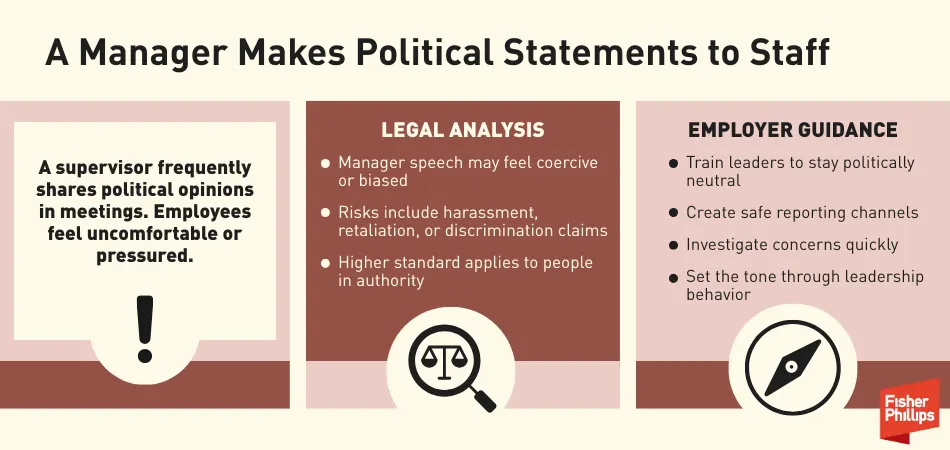
Scenario 6: A Manager Makes Political Statements to Staff
A supervisor frequently shares their personal political views in team meetings. Some employees feel pressured or uncomfortable.
Legal Analysis:
When a manager shares political views with those who report to them, legal risks multiply significantly. Even if the statements aren’t explicitly coercive, the power dynamic can create the perception of pressure – especially if employment decisions follow. Employees may feel silenced or retaliated against for not agreeing with their manager’s views.
From a legal perspective, such speech could open the door to claims of discrimination, retaliation, or hostile work environment, especially if the political commentary touches on race, religion, gender identity, or national origin. Managers are held to a higher standard because their words are presumed to carry the weight of the company.
Employer Guidance:
Train your leadership team. Make it clear that managers should avoid discussing personal politics with subordinates and must never appear to favor or disfavor anyone based on political alignment.
Create reporting channels. Ensure employees can safely raise concerns about inappropriate speech by supervisors without fear of retaliation.
Respond swiftly. If a complaint arises, investigate promptly and document the findings. Corrective coaching is often sufficient, but more serious consequences may be needed in egregious cases.
Model the right tone. Culture starts at the top. Your leadership team sets the example for respectful, inclusive communication across the company.
What Employers Should Do Now
The legal landscape surrounding employee speech is more complex than ever. While you have significant discretion to shape workplace norms, that discretion is bounded by state laws, federal protections, and public expectations. A one-size-fits-all approach won’t cut it.
Here’s what your business can do now to stay out of the crossfire:
✅ Audit your policies on political expression, conduct, social media, and dress code. Make sure they’re clear, enforceable, and compliant.
✅ Train managers to handle political tensions respectfully and neutrally – and avoid injecting their own views into the workplace.
✅ Monitor enforcement for bias. Whether it’s discipline, messaging, or investigations, make sure all actions are consistent across the board.
✅ Prepare for protest-related absences. Have a contingency plan for potential walkouts or disruptions linked to national events.
✅ Get legal support early. When in doubt, loop in your counsel, especially in high-visibility or legally gray situations.
Share:
Subscribe for free: compensation & pay equity law review
LabelPlease enter a valid work email
You'll receive a weekly newsletter email with the most important legal news on compensation and pay equity. We handle your contact details in line with our
Privacy Policy
Thank you! You are now subscribed.
Are you concerned about pay gaps in your organization?
CompAnalyst® Pay Equity Suite can help you achieve and sustain pay equity