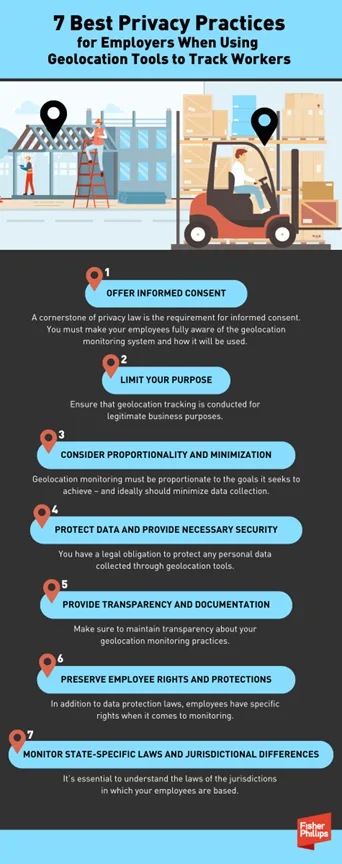
This is an excellent summary of the important general considerations when employers decide to track employee locations. But don't stop here. Check to see if your state has additional laws that apply.
California has several, starting with the state constitution that gives every California resident an express right to privacy. In addition, the California Consumer Privacy Act applies because location data is considered personal information under the CCPA. That means that employees must be notified that they are being tracked, are entitled to copies of the information collected, and can ask that it be deleted.
"An employer, or a person acting on behalf of the employer, shall not use an alternative device to monitor employees except during work hours, and only if strictly necessary for the performance of the employee’s duties. For purposes of this section, “monitor” includes, but is not limited to, locating, tracking, watching, listening to, or otherwise surveilling the employee."
The law requires that employers give employees notice that they are being monitored, explain the extent of the monitoring, what data is collected, how long it's stored, and whether the data will be used in any employment decisions.
The employer also has to tell the employee that they have the right to turn off or disable any monitoring devices or technology outside of work hours.
The initial penalty is $250 per employee for the initial violation then escalates to $1000 per employee, per day for subsequent violations.
Then Penal Code section 637.7 makes it illegal to use electronic tracking devices on any vehicle without the owner's consent. If the employer owns the vehicles, this provision may not apply, but you still have to give employees notice under the CCPA and Vehicle Code section 4854.
So before you start monitoring or tracking employees, make sure you understand the laws that apply in each location you are tracking.
Many employers have turned to geolocation tools like GPS devices to monitor employees’ whereabouts and movements – especially those working remotely or in field-based roles. While these tools provide an effective way to boost operational efficiency, improve safety, and optimize resources, you must ensure you respect workers’ privacy rights when deploying them. This Insight will explore the privacy obligations that come with monitoring your employees via geolocation tools and provide the seven best practices to guide your actions. You can also read about general employment guidance related to the use of wearable tech by clicking here.
1. Offer Informed Consent
A cornerstone of privacy law is the requirement for informed consent. You must make your employees fully aware of the geolocation monitoring system and how it will be used. This includes:
Clear Communication: Explicitly inform your employees that they will be monitored using geolocation tools, specifying the scope, purpose, and duration of the monitoring. This communication should ideally occur at the beginning of the employment relationship or before implementing geolocation tracking.
Voluntary Consent: While employees may be required to consent to geolocation tracking as a condition of their employment, it must be done in a transparent and voluntary manner. Coercion or the failure to fully disclose the nature of the tracking could mean there was no informed consent.
2. Limit Your Purpose
Ensure that geolocation tracking is conducted for legitimate business purposes. In many cases, this involves monitoring employees in roles that require travel, delivery, or site visits. Don’t use geolocation tracking for personal reasons or to monitor employees’ non-work activities. Legitimate business purposes can include, for example, protecting company property or customer property, ensuring there is no timecard fraud, checking whether employees are actually taking required meal or rest breaks (in some states), managing employee performance and efficiency, and optimizing travel or delivery routes.
Various states require consent if you monitor vehicles used for employment purposes. They vary from state to state and sometimes depend on such factors as whether the vehicle is company-owned or privately owned. Under many state laws, for example, employee tracking must be limited to specific and transparent purposes, such as ensuring productivity, protecting safety, or ensuring that business resources are being used efficiently. That said, while limiting the purposes for which geolocation data is used, your disclosure should comprehensively identify all the purposes for which you may use this day. Using geolocation data for purposes beyond the scope of the initial consent may violate anti-stalking laws.
3. Consider Proportionality and Minimization
Geolocation monitoring must be proportionate to the goals it seeks to achieve – and ideally should minimize data collection.
This means that you should only collect data that is necessary for the intended purpose, and the tracking should not be overly invasive. For example, monitoring an employee’s movement outside of working hours may be viewed as excessive and a violation of their right to privacy.
The Federal Trade Commission (FTC) has made it clear through various enforcement actions that it considers geolocation data to be sensitive location data. The agency emphasizes that employers should use geolocation monitoring tools in a manner that minimizes data collection and is not unduly burdensome on employees’ privacy. Similar data minimization requirements exist under the California Consumer Privacy Act (CCPA).
4. Protect Data and Provide Necessary Security
You have a legal obligation to protect any personal data collected through geolocation tools. This includes:
Data Security: You must securely store geolocation data, like any other personal information. You must also protect it from unauthorized access, alteration, or loss. Make sure to implement robust cybersecurity measures to ensure the data’s integrity. This includes proper due diligence over the security measures of vendors you engage to collect, process, or store this data.
Retention Period: Define and adhere to clear data retention policies. Geolocation data should only be stored for as long as necessary to fulfill its purpose. You should securely delete or anonymize the data when no longer needed.
5. Provide Transparency and Documentation
Make sure to maintain transparency about your geolocation monitoring practices. You should provide employees with clear documentation that explains:
How geolocation data is collected, through which devices and applications
What data is being tracked and for what purposes
How long the data will be stored
How the data will be used
Who will have access to the data
You should also make employees aware of their rights regarding access to their data. For example, California privacy law requires that covered businesses provide employees with a privacy notice that explains, among other requirements, data collection practices and retention policies. This is a best practice even if not required by applicable laws.
6. Preserve Employee Rights and Protections
In addition to data protection laws, employees have specific rights when it comes to monitoring. These rights vary by jurisdiction but generally include a right to privacy, particularly during non-work hours. You should avoid monitoring during personal time or in areas where employees would reasonably expect privacy (e.g., restrooms).
In California, the CCPA grants employees the “right to access” and the “right to correct,” allowing them to obtain copies of the data held about them and request any inaccuracies be corrected. The CCPA requires employers to provide information to employees about their rights in a privacy notice.
7. Monitor State-Specific Laws and Jurisdictional Differences
It’s essential to understand the laws of the jurisdictions in which your employees are based. For example, several states, including California, require that employers inform employees if they are being monitored electronically. In some cases, states allow geolocation tracking of company owned vehicles, but for personally owned vehicles written consent is required.
You should also be mindful of international differences. For instance, European data protection laws, such as the GDPR have stringent privacy regulations that may differ from those in the U.S. or other parts of the world.
Share:
Subscribe for free: compensation & pay equity law review
LabelPlease enter a valid work email
You'll receive a weekly newsletter email with the most important legal news on compensation and pay equity. We handle your contact details in line with our
Privacy Policy
Thank you! You are now subscribed.
Are you concerned about pay gaps in your organization?
CompAnalyst® Pay Equity Suite can help you achieve and sustain pay equity