I loved this article on diversity in tech and its tools and approaches to eliminate barriers, especially the parts about equal pay and auditing outcomes of employment decisions.
We also need to do a better job of understanding the decision makers and opportunity within organizations. For example, in pay equity analysis we look at whether people doing equal work are paid equally. This tells us a lot about the work and who and what we value. But it doesn't tell us about how and whether people move up in an organization.
I am not an expert on people analytics in the techy sense. But in the legal sense, I've been proving and disproving causation for several decades using all kinds of evidence, including demographic data and statistical analysis. (Correlation is not causation. If you don't know about the spurious correlations website, you're in for a treat.)
If I wanted to understand opportunity in an organization, here is some of the information I would like to know.
Demographic data on all employment decision makers by role and level of authority for hiring, firing, raises and promotions to show who has power for employment decisions and who are the deciders.
Tenure and time to promotion for all employees by manager, department, and division to show whether people stay in certain roles, how often they move, and how long it takes to move from one position to another. Where are the career cul-de-sacs? Where are the managerial roadblocks? What are the demographic patterns for both employees and deciders?
Opportunity maps that show different career paths by mapping data on where people start in the organization, where they go next, and where they stop or leave. I'd like to see a program that would allow me to see the typical career progression for a Black woman, a veteran, a disabled white man, and all the other demographic combinations.
Skills for opportunity—as we focus on skills and abilities instead of degrees and pedigrees, we need to understand demographics, skills, and opportunities. What skills are most useful for different career paths? Are there new career paths based on skills that we haven't tried?
Data and analytics are never going to give us final answers or tell us what to do. But they can show us things we couldn't see before and help us ask better questions like: why do we expect unconscious bias training to change the way our systems are built and work? Maybe we need to learn more about how our systems really work.
Tech industry employers may want to boost their anti-discrimination efforts as the federal government recently decided to shine a spotlight on low diversity in many high-tech occupations. Although tech employers have made progress in recent years, women and Black workers in particular are still significantly underrepresented, according to the Equal Employment Opportunity Commission (EEOC). The agency also noted low employment rates for Hispanic and older workers in high-tech jobs and said discrimination is likely a contributing factor. Here’s what you need to know about the EEOC’s recent report and 10 steps you can take to be proactive and eliminate potential barriers in your workforce.
Key Findings
The EEOC released a report on September 11 drawing attention to disparities in the tech industry – and for the high-tech workforce in general – for workers in 56 science, technology, engineering, and mathematics (STEM) occupations. Here are the key findings from the report:
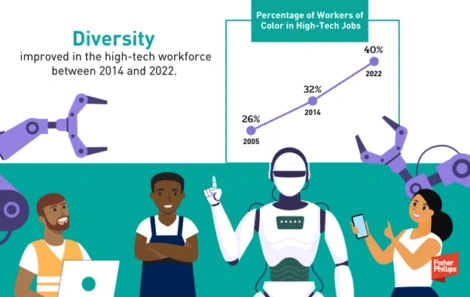
Progress Made. Diversity improved in the high-tech workforce between 2014 and 2022. By 2022, workers of color held about 40% of high-tech jobs (up from 26% in 2005 and about 32% in 2014). The current employment rate is close to the percentage of workers of color in the total U.S. workforce (nearly 42%).
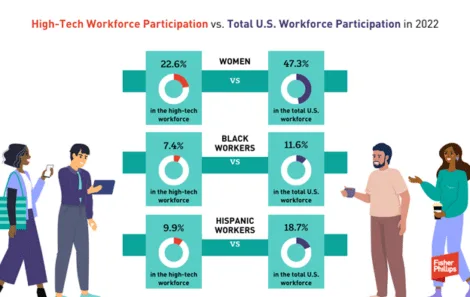
Barriers Remain. Female, Black, and Hispanic workers are still substantially underrepresented in the high-tech workforce. There was very little change between 2005 and 2022 for Black workers and almost no change for female workers.
Lower Diversity in Management Roles. Black, Hispanic, and Asian workers were underrepresented in managerial roles compared to their overall participation in the high-tech workforce.
Significant Gap for Women. Women represent almost half of the total U.S. workforce, but they were less than 23% of the high-tech workforce.
Age Disparities Found. The high-tech workforce is generally younger than the total U.S. workforce:
Nearly 41% of the high-tech workforce are ages 25 to 39, despite representing about 33% of the overall workforce.
The number of workers over age 40 in the high-tech workforce declined between 2014 and 2022 from almost 56% to about 52%.
Certain Claims Higher in Tech Sector. Charges of discrimination filed with the EEOC in the tech sector were more likely to involve discrimination based on age, pay, or genetic information than those filed in other sectors.
Based on these findings, the EEOC recommended that high-tech companies be proactive and review any barriers to employment, particularly for women, as well as Black, Hispanic, and older workers.
10 Ways to Eliminate Employment Barriers
Here are a few key steps you can take to reduce your risk of a discrimination claim, attract, and retain a diverse workforce, and create an inclusive environment for all workers:
1. Create, Communicate, and Follow Effective Policies
Be sure your workplace anti-discrimination and anti-harassment policies are up to date, communicated, and consistently followed. Additionally, you’ll want to ensure you have a robust internal system in place to investigate and resolve discrimination claims.
2. Develop Consistent and Neutral Hiring and Promotion Criteria
You should review your hiring and interviewing resources – including job descriptions, job ads, interview questions, employment tests, and selection criteria — to ensure they aren’t unintentionally screening out qualified candidates based on a protected characteristic. For example, be sure to use gender-neutral terms in job postings and ask job-related questions during interviews. By taking steps both internally and externally to expand the candidate pool, you can improve DEI efforts and reach a wider range of qualified candidates, which can have a positive impact on overall business.
3. Provide Training on Unconscious Bias
You’ll want to ensure your managers and human resources staff stay updated on the ever-changing legal landscape and best practices. Additionally, providing training on unconscious or implicit bias may help eliminate hiring decisions that are based on stereotypes or preconceived notions about job candidates.
4. Audit AI and Algorithms for Potential Bias
Employers often use software programs and AI resources to assist in the recruiting process. While these are excellent tools for streamlining the hiring process, federal agencies have warned that relying on such technology to make staffing decisions might unintentionally lead to discriminatory employment practices. Therefore, you should consider conducting an independent audit of your AI and algorithm-based tools to help eliminate any bias. You can read more about the Labor Department’s AI roadmap here.
5. Prioritize Equal Pay
To recruit and retain a diverse workforce, it is crucial that your organization prioritize pay equity and transparency, conduct regular pay audits, and address any disparities promptly. The concept of pay equity encompasses not only salary or wages, but also includes overtime pay, bonuses, and benefits. If you decide to conduct a pay audit, we recommend you work with counsel so that the results of the audit are protected by the attorney-client privilege.
6. Create and Support Affinity Groups
Affinity groups can provide a supportive network for employees to share professional experiences, receive valuable feedback from others, and experience a sense of community with coworkers. Additionally, affinity groups can promote an inclusive, non-discriminatory work environment, as these groups can help employers identify and fill potential gaps.
7. Establish Reward and Recognition Programs
Most employees enjoy receiving positive feedback or praise for above-average performance. It is important to establish recognition programs that celebrate all employee achievements within your business.
8. Offer Flexible Work Arrangements
Where at all possible, implement more progressive work policies, including long-term flexible work arrangements that will allow employees to work schedules that promote work-life balance. This may help you attract and retain women, for example, who often have greater caregiving responsibilities outside of work. You can consider permitting remote work, compressed workweeks, flexible hours, or job-sharing programs. Such policies improve work performance and job satisfaction and can improve retention.
9. Create Mentorship/Sponsorship Programs
You should be intentional in how you structure mentorship and sponsorship programs within your organization. Notably, sponsorship is more action-oriented than mentorship, whereby sponsors (leaders in the company) are matched with junior or mid-level employees with the express goals of advancing their careers and advocating for their professional opportunity. Facilitating these programs can ensure all employees reach their full potential.
10. Provide Leadership Training and Development
Implement programs and policies aimed at empowering all employees within your business to seek out and secure leadership roles. Ensure your workforce is aware of the existing pathways for career progression that are available to them — and that there are transparent and measurable ways for them to get there. Notably, employers that embrace diversity on their executive teams are more likely to attract and retain a diverse workforce overall.
Share:
Subscribe for free: compensation & pay equity law review
LabelPlease enter a valid work email
You'll receive a weekly newsletter email with the most important legal news on compensation and pay equity. We handle your contact details in line with our
Privacy Policy
Thank you! You are now subscribed.
Are you concerned about pay gaps in your organization?
CompAnalyst® Pay Equity Suite can help you achieve and sustain pay equity