Blog
Get Pay Right on ADP Workforce Now® Next Gen™
Bringing trusted compensation intelligence and seamless planning to even more ADP users.
Written by Salary.com Staff
September 19, 2025

The use of Artificial Intelligence in recruitment is leading a change in the way companies do their hiring strategy. Automating tasks and analyzing data helps HR teams improve efficiency and accuracy in recruiting. From creating stronger job descriptions to predicting future hiring needs, AI has become a practical tool for modern hiring.
Fine-tuned LLMs. Your 24/7 intelligent comp analyst.
In this article, we’ll walk through real-world examples of AI in recruitment that show how organizations can build smarter, faster, and more strategic hiring practices.
As an HR leader, you can use AI in your recruitment strategies to automate many of the tasks that slow down hiring. These tools scan applications, match candidates to job descriptions, and even identify qualified candidates online. By letting AI handle repetitive work, your team can focus on strategic decisions and stronger candidate engagement. This makes the process more efficient, consistent, and aligned with organizational goals.
With the overwhelming tasks that HR needs to do, using AI systems that streamline and simplify the hiring process is a huge advantage. From automating resume screening to using chatbots to follow up and answer frequently asked questions by applicants, AI is revolutionizing the recruiting process.
Organizations that are keeping up with the game are seeing actual benefits, which include the following:
Using AI in recruitment saves time: AI tools can quickly review large volumes of resumes, highlight qualified applicants, and schedule interviews automatically. This reduces the time spent on repetitive tasks and speeds up the overall hiring process.
Improves the candidate screening process: AI evaluates skills, experience, and qualifications against job requirements with more consistency. It helps reduce bias, ensures fairer assessments, and allows recruiters to focus on engaging with top candidates.
Removes bias in making decisions: AI tools analyze qualifications and skills based on objective data, limiting the impact of unconscious bias. This creates fairer opportunities for applicants while supporting diversity goals.
Promotes internal mobility: AI can match current employees to open roles that fit their skills and career paths. This improves retention and helps organizations fill vacancies with talent that already understands the company culture.
Enhances candidate experience: Chatbots and AI-powered assistants respond instantly to applicant questions, schedule interviews, and provide status updates. This transparency keeps candidates engaged and creates a smoother experience throughout the process.
Adopting AI in recruitment helps organizations gain speed, consistency, and insight across the entire hiring cycle. For recruiting teams seeking to streamline operations, Salary.com’s AI solutions provide practical tools that facilitate smarter decision-making and long-term workforce planning.
Artificial Intelligence is changing the way HR teams handle recruitment by automating time-consuming tasks and providing data-driven insights. With the right AI tools, you can focus less on manual administrative tasks and more on finding the best talent for your organization.
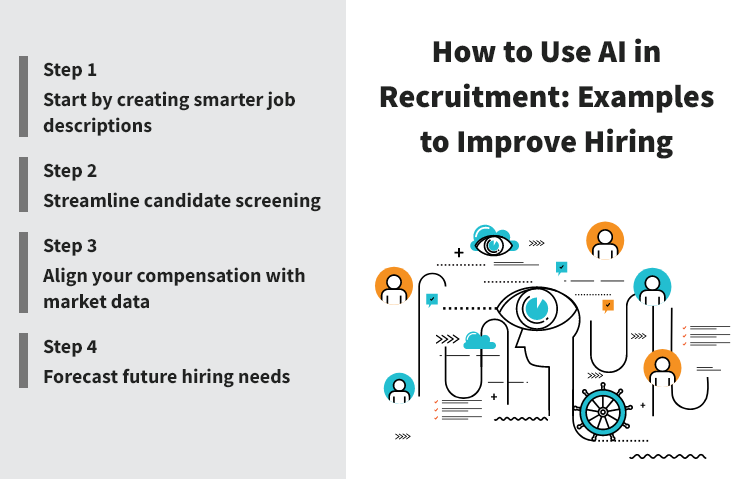
Attracting the right candidate starts with a well-crafted job description that highlights the right skills and competencies. With the help of Job Description Management Software, you can have access to over 5,000 prewritten templates and an AI-powered writing assistant that helps you create smarter job descriptions faster.
It also streamlines collaboration and approvals in one place, so you can focus on hiring, not formatting.
Screening hundreds of applications doesn’t have to drain your team’s time. With AI recruiting tools, you can automatically scan resumes, identify top candidates, and even predict candidate success based on skills and experience.
This allows your team to spend less energy on repetitive filtering and more time connecting with the right talent.
Salary discussions don’t have to slow down your hiring process. With AI-powered compensation tools, such as Compensation Management Software, you can access real-time market data to build offers that are both competitive and fair.
This helps your team maintain consistency, support pay transparency, and secure top candidates with confidence.
AI doesn’t just help with current vacancies; it also equips HR leaders to anticipate future workforce needs. Continuously scanning job boards, career sites, and market data allows AI to provide real-time insights into competitor activity and emerging trends.
These insights make it easier to align compensation strategies, keep job structures market-ready, and ensure your offers reflect what talent demands. With this kind of intelligence, your team can plan ahead, close talent gaps, and maintain an edge in competitive industries.
Now that we’ve covered how to implement AI recruitment tools in your hiring strategies, let’s look at how leading companies use them in real-world recruiting. Below are examples and the impact it has made on their processes.
Google: candidate matching
Google applies AI algorithms to match candidates with relevant job postings. Its AI technology uses natural language processing to analyze job titles, skills, and keywords. This helps recruiters find better matches faster and with more accuracy.
IBM: data-driven decision-making
IBM relies on AI technology to automate repetitive hiring tasks and analyze employee data. It also matches hundreds of candidates to jobs that fit their skills. This improves efficiency and supports more informed talent management decisions.
Amazon: resume screening
Amazon uses machine learning to streamline resume reviews and suggest roles based on skills and experience. Its AI tools provide targeted recommendations throughout the hiring process. This speeds up screening and supports diversity efforts.
Johnson Controls: conversational AI
Johnson Controls integrates AI chatbots to schedule interviews and screen candidates. The system reduces time-to-hire and improves candidate experience and engagement by answering questions 24/7.
These examples show how global companies improve hiring outcomes with Artificial Intelligence tools. The same benefits, better job descriptions, smarter screening, well-informed hiring decisions, fair pay alignment, and workforce forecasting, are available to HR professionals like you through solutions like Salary.com’s AI-powered platform.
Here are some of the frequently asked questions about the use of AI in recruitment processes:
The benefits of AI agents in recruitment interviews include the consistency and speed they bring to the process. They adapt questions in real time and help assess candidates more objectively using data-driven insights. AI also provides market-aligned data that supports fairer decisions during interviews and offers deeper insights for both recruiters and candidates.
The pros and cons of using AI in recruitment are the following:
Pros: AI boosts recruiting efficiency by automating resume screening, improving candidate matching, and reducing time-to-hire. Many organizations report measurable gains in quality and diversity.
Cons: AI systems risk perpetuating bias and lack transparency. Poor data or opaque decision-making can lead to unfair outcomes. Human insight remains essential.
Auto-generated trend reports. Predict market shifts.
AI cannot replace human recruiters. Artificial Intelligence is designed to improve recruiter effectiveness, not eliminate it. It handles early-stage tasks in talent acquisition like sourcing and screening, giving them more time to focus on relationship-building and strategic decisions.

The latest research, expert advice, and compensation best practices all in one place.
Blog
Bringing trusted compensation intelligence and seamless planning to even more ADP users.

Blog
Learn how to train managers for effective pay conversations and build trust.

Blog
Total rewards package flexibility lets employees choose what matters - pay, perks, and benefits tailored to their needs.