Blog
Get Pay Right on ADP Workforce Now® Next Gen™
Bringing trusted compensation intelligence and seamless planning to even more ADP users.
Written by Salary.com Staff
June 20, 2025

Sourcing candidates has emerged as a strategic priority as companies compete to acquire high quality candidates in a dynamic job market. The U.S. Department of Commerce encourages companies to assess the skills and competencies required in their workforce, actively pursue individuals with these qualifications, and foster continuous skills development among employees. This emphasizes the necessity of synchronizing recruiting strategy with the changing requirements of the job market.
This guide explores what candidate sourcing is, how it differs from recruiting, and outlines essential steps and creative methods to help recruiters build a sustainable and effective sourcing strategy.
Candidate sourcing is a proactive process within talent acquisition that aims to find, draw in, and engage with job seekers, whether or not they are actively searching for work. In contrast to conventional recruitment, which usually depends on candidates answering job vacancies, sourcing involves focused attempts to find qualified talent with the expertise required for open positions.
The U.S. Office of Personnel Management (OPM) noted that sourcing is a vital aspect of the candidate sourcing process, looking into the talent pool and involving bringing in promising talent capable of functioning effectively on the job, frequently with the goal of developing an inclusive and highly qualified talent workforce. This involves sourcing talent across platforms, building pipelines, and using inclusive policies to support both the hiring process and long-term diversity goals.
A few examples of sourcing candidates include:
Posting on job government boards: Using platforms to advertise federal positions and attract relevant candidates. This is considered a passive candidate sourcing process but remains a foundational strategy for public sector hiring.
Attending job fairs and recruitment events: Participating in in-person or virtual hiring process, including career fairs at universities or community organizations, to engage with active candidates face-to-face
Searching internal talent pools: Reviewing applicant tracking systems (ATS) or previous applicants for target candidates who meet the current job criteria—these speeds up hiring and leverage known talent
Professional networking platforms: Using sites like LinkedIn to directly search for and message target candidates with relevant skills, especially for hard-to-fill or specialized roles.
Partnering with educational institutions: Collaborating with universities, community colleges, and vocational training programs to identify promising talent and build future pipelines.
Employee referrals: Encouraging current employees to refer relevant candidates from their professional networks, often supported by formal employee referral programs to incentivize participation.
Companies need an effective candidate sourcing process to proactively attract top talent before competitors do. Leveraging our global real-time job posting solution enhances this effort by delivering continuous insights into market trends and competitor strategies, enabling smarter, faster talent acquisition decisions.
Sourcing and recruitment are related but distinct stages of talent acquisition. Sourcing is a proactive approach to finding and engaging prospective candidates, even those not actively job hunting. It uses various channels like networks, social media, and databases to build a talent pipeline for current and future positions. Sourcing is the proactive pursuit of eligible people for existing or future job openings, differentiating it from the reactive candidate sourcing process of evaluating applications submitted in response to job openings.
Recruiting, on the other hand, is the process of attracting, evaluating, and selecting candidates for specific job openings. It includes posting jobs, screening, interviewing, and making offers. While sourcing finds potential talent, recruitment engages with candidates to assess fit and make hiring decisions. The U.S. Office of Personnel Management (OPM) defines recruitment as supporting organizations in meeting staffing needs at various levels.
Sourcing is the initial step of identifying potential candidates, whereas recruiting encompasses the subsequent steps of engaging, evaluating, and selecting these candidates to fill job openings. Both functions are integral to a comprehensive talent acquisition strategy, working in tandem to ensure organizations attract and hire the most suitable candidates.
Here are some creating ways to source candidates:
Implement realistic job previews
The U.S. Office of Personnel Management (OPM) advocates that hiring managers utilize Realistic Job Previews to supply applicants with an equitable perspective on the job's duties and workplace atmosphere. This method enables candidates to evaluate their suitability for the position, potentially decreasing turnover and enhancing job satisfaction.
Engage in targeted outreach for diverse talent
To cultivate an inclusive workforce, it is essential to implement targeted outreach initiatives. This entails partnering with social organizations, disabilities organizations, advocates, and educational facilities to engage marginalized applicants. Accordingly, the significance of these collaborations in attracting competent applicants with disabilities.
Utilize employee referrals
Motivating existing employees to recommend prospects might be an effective hiring technique. Employee referrals frequently result in recruits that exhibit better cultural alignment and typically demonstrate elevated retention rates. This method also utilizes the networks of present employees to find candidates.
Establish educational partnerships
Establishing collaborations with educational organizations can generate a stream of best candidates. Interacting with students via internships, mentorship campaigns, and campus activities enables business to recognize and cultivate talent at an early stage. The U.S. Department of Commerce emphasizes the efficacy of these agreements in developing the workforce.
Leverage social media and online communities
Although conventional job boards are prevalent, leveraging various social networking platforms can access passive prospect pools. Platforms such as LinkedIn, Facebook, and Reddit provide avenues to engage with prospective applicants who might not be actively seeking employment. Compelling content and targeted advertisements can enhance visibility within these demographics.
Here is how to start sourcing candidates for a particular position:
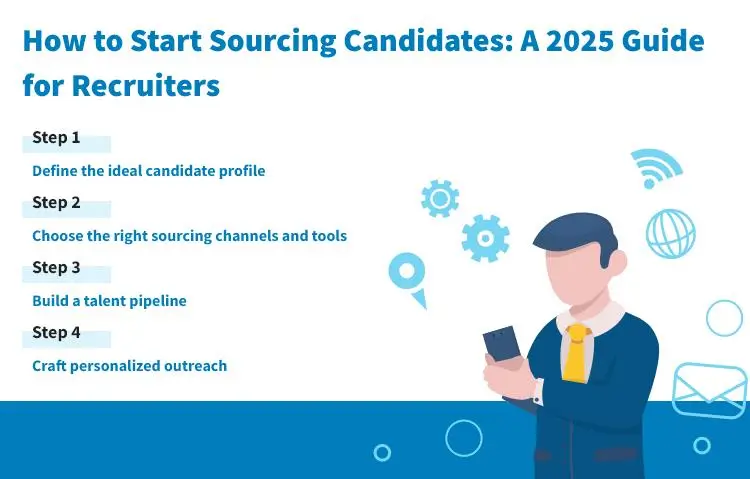
Effective talent sourcing is predicated on a clearly defined candidate profile. This profile must outline the essential tasks, credentials, and personal characteristics required for fulfillment in the position. It should also take into account cultural harmony, adaptability, and capacity for growth.
The U.S. Office of Personnel Management (OPM) advocates for the creation of systematic evaluations and position descriptions that explicitly delineate role requirements, competencies, and qualifications. This approach not only optimizes recruiting processes but also mitigates unconscious bias in candidate selection, hence enhancing the quality and fairness of candidates.
This phase entails identifying the most suitable sourcing channels and tools. These may encompass federal employment networks such as commercial job postings, social media platforms such LinkedIn, professional discussion boards like Reddit, and worker referral mechanisms.
Utilizing various channels, particularly those aimed at passive applicants, can greatly enhance the talent pool. The utilization of shared employment announcements among federal departments can improve outreach initiatives and optimize the applicant acquisition process.
As a sourcing tool, global real-time job posting solution empowers recruiters to identify where competitors are hiring and what they’re offering instantly. By integrating this intelligence into your sourcing strategy, you can target talent more precisely, adjust outreach in real time, and stay ahead in the race for in-demand skills.
Creating an efficient talent pipeline guarantees constant access to suitable candidates for both current and prospective recruiting requirements. Constructing this pipeline necessitates early collaboration with academic institutions, the establishment of internship programs, and the maintenance of a meticulously monitored database of prospective individuals.
It is important to emphasize the need for strategic pipeline development to guarantee equality, inclusion, and diversity in public service recruitment. Their ideas encompass new outreach initiatives and collaborations aimed at preparing applicants for sustained career advancement in public service.
Tailored communications exhibit a genuine interest in a candidate's distinct abilities and history, increasing the likelihood of a favorable response. Effective outreach must include the candidate's name, establish links between their professional background and the vacancy, and convey enthusiasm for their prospective contributions.
Although much on outreach personalization originates from advertisement and government organization, they have employed tools to develop customized recruitment communications, demonstrating the efficacy of personalized engagement in enhancing rates of response and candidate experience.
Comprehending the candidate sourcing process is crucial for recruiters seeking to establish an effective talent pipeline and obtain ideal hires. Through creativity and a planned approach, sourcing develops into an effective instrument for engaging top talent and fostering company success.

The latest research, expert advice, and compensation best practices all in one place.
Blog
Bringing trusted compensation intelligence and seamless planning to even more ADP users.

Blog
Learn how to train managers for effective pay conversations and build trust.

Blog
Total rewards package flexibility lets employees choose what matters - pay, perks, and benefits tailored to their needs.