Blog
Get Pay Right on ADP Workforce Now® Next Gen™
Bringing trusted compensation intelligence and seamless planning to even more ADP users.
Written by Salary.com Staff
September 04, 2026

A lack of career growth is one of the top reasons that employees leave their jobs. With the labor markets tighter than they've been in years, organizations need a career progression framework to help retain their employees and ultimately create a successful business.
Thousands of compliant templates. Save hours of work.
In this guide, we'll discuss what a career progression framework is, examples of good frameworks in action, the steps you can take to create one within your organization, and common mistakes that many organizations make when building such a framework.
A career progression framework helps to define the different levels, roles, and the possible career paths within an organization. Each employee can use the framework to understand where they are within the organization and how to grow their career within the company. HR teams can use the framework to plan employees' careers and create compensation structures that reflect those plans.
Organizations can create frameworks that allow employees to advance up the career ladder or to change departments or roles within the company. Some organizations create both management and specialist career tracks within the company to allow employees to focus on growing their careers in the area of interest to them.
| Component | What it covers |
|---|---|
| Job architecture | Organizing all roles into job families and functions across the company |
| Career leveling structure | Defining tiers or levels of employee seniority with clear job levels and titles |
| Competency model | Core competencies, technical skills, and soft skills required at each stage |
| Role based progression criteria | Measurable targets used to evaluate readiness for promotion |
| Compensation band alignment | Linking each level to a pay band for fair and transparent rewards |
A leveling matrix within the framework makes career pathing visible to not only your employees but also hiring managers and leadership.
A well-designed progression framework starts with clearly defined roles and job levels. JobArchitect® can help HR teams organize job content, standardize roles, and create a stronger foundation for career paths across the organization.
A typical career progression path might be linear, but many companies now support more complex career paths that include lateral and cross functional moves. Career pathing shows employees that growth opportunities extend beyond a single ladder.
Individual contributor track: Junior Analyst to Senior Analyst to Principal Analyst. This supports employee skill development without requiring management responsibilities.
Management track: Team Lead to Engineering Manager to Director to VP. This focuses on leadership and the ability to facilitate employee growth across teams.
Hybrid track: A Senior Customer Success Manager who moves laterally into Product Management before advancing to Director. Career development is not always a straight line.
Specialist track: Junior Designer to Senior Designer to Staff Designer. Organizations that prioritize career pathing offer this to retain top talent with niche skills.
Each path should include clear expectations for skills, qualifications, and measurable milestones demonstrating readiness for the next level.
Building a structured career pathing framework requires a deliberate, step by step approach that connects employee growth to business success.
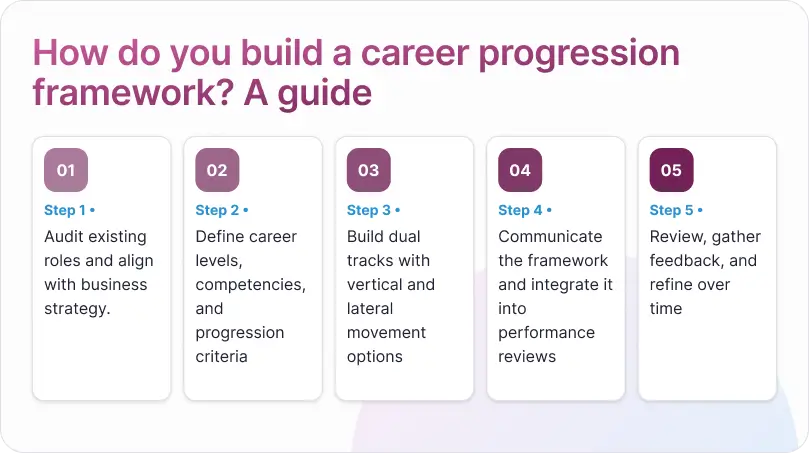
Framework implementation should begin with a clear understanding of business strategy. Organizations should audit existing roles to understand gaps or inconsistencies. Map every role to a job family, identify where job levels overlap, and conduct a skills gap analysis to assess how existing employee skills align with business objectives and where development opportunities exist.
Define career paths by establishing distinct career levels within each job family. At each level, specify the competencies needed, including both technical and soft skills. A strong competency model should outline what an employee must demonstrate before advancing, with measurable milestones so employees have clear expectations for progression.
To make career progression more actionable, HR teams need to clearly connect each level with the skills and competencies employees are expected to develop. Salary.com's Skills and Competencies resource can help organizations assess roles based on the skills people actually use, supporting talent development and career planning.
A good career progression framework includes multiple career paths such as individual contributor routes alongside the traditional management track. Career frameworks can include upward and lateral movement opportunities, so employees are not forced into management to grow. This encourages team members to align individual career paths with personal career goals.
A transparent framework enhances fairness in promotions by providing clear advancement criteria. Objective metrics help reduce workplace bias in promotions and pay raises. Roll out the framework with manager training so leaders can discuss career progression during regular touchpoints and identify actionable development goals.
A transparent framework enhances fairness in promotions by providing clear advancement criteria. Objective metrics help reduce workplace bias in promotions and pay raises. CompAnalyst® can help HR and compensation teams benchmark jobs, evaluate pay practices, and align compensation structures with career levels, giving organizations better data to support consistent pay decisions.
Career frameworks are living documents. Use an annual employee listening survey or employee engagement survey results to gather feedback. Organizations that refine career development based on real data see stronger results. According to a report, organizations that prioritize skill development and internal mobility see measurably higher retention.
Even well intentioned career pathing initiatives can fail if organizations overlook key elements HR teams should watch for.
Building the framework in isolation: When HR builds without input from business leaders, the result misses what teams actually need. Career pathing creates the most value when it reflects real work.
Creating a one size fits all structure: Not every function progresses the same way. Failing to define career paths for different job families leads to disengagement.
Ignoring lateral movement: If the framework only supports upward movement, you lose employees who want new skills or different functions.
Lacking measurable criteria: Without objective evaluation criteria, promotions feel subjective. This erodes trust and makes fostering employee engagement harder.
Setting it and forgetting it: Research shows employees typically seek ongoing development conversations, not just annual reviews. Organizations that introduced personalized development plans see stronger engagement.
Here are the frequent questions about the topic:
At minimum, review annually. Major organizational changes such as restructuring or shifts in business objectives should trigger an immediate review. Use employee engagement survey results and performance data to identify where updates are needed.
Auto-matching tools for a clear, fair organization.
Absolutely. Even companies with fewer than 50 employees benefit from a structured career pathing framework. A simple leveling structure with clear expectations and defined competencies gives employees a roadmap for professional development and helps significantly reduce hiring costs by improving retention.
Track metrics such as internal promotion rates, voluntary turnover, time to fill open roles, and employee engagement scores. If career pathing programs are effective, you should see improvements in retention and internal mobility over time. An annual employee listening survey can also surface qualitative insights.
Ownership should be shared. HR and compensation teams typically own the structure, governance, and compensation band alignment. Business leaders own the content, ensuring that competency models and role based progression criteria reflect what is actually needed on the ground. Collaboration between both groups is essential for a framework that drives real employee growth.
Share the criteria used for leveling decisions and encourage team members to discuss career progression openly during performance reviews. Provide learning and development resources so employees understand what further skill development is needed. When employees see a clear career path with objective milestones, disagreements are easier to resolve.

The latest research, expert advice, and compensation best practices all in one place.
Blog
Bringing trusted compensation intelligence and seamless planning to even more ADP users.

Blog
Learn how to train managers for effective pay conversations and build trust.

Blog
Total rewards package flexibility lets employees choose what matters - pay, perks, and benefits tailored to their needs.