Blog
Get Pay Right on ADP Workforce Now® Next Gen™
Bringing trusted compensation intelligence and seamless planning to even more ADP users.
Written by Salary.com Staff
April 03, 2026

The starting salary is an essential aspect of hiring new talent into an organization. A proper understanding of calculating the starting salary of a new hire can help the recruitment team attract the best talents to the organization.
Starting salary is the initial amount of money a new employee receives when they begin their job. It usually includes their base pay and any additional benefits or allowances they might receive as part of their employment contract.
Companies consider various factors when setting up a starting salary, such as the applicant's experience, job role, and location.
To ensure starting salaries are based on clearly defined roles, organizations rely on standardized job content. The Job Content Library provides validated job descriptions that help HR teams align pay decisions with consistent job responsibilities and scope.
Starting salary refers to the initial pay an employee receives upon commencing their job. Base salary is the fixed amount they earn regularly, subject to adjustments like promotions or bonuses over time.
| Aspect | Starting salary | Base salary |
|---|---|---|
| Definition | The pay amount is set at the time of hiring a new employee. | The fixed annual pay after probation or reviews, often adjusted for performance. |
| Timing | Applied right at the start of employment. | Comes into effect after an initial period and may include raises. |
| Adjustments | Based on market data, experience, and negotiation at hire. | Includes merit increases, promotions, or cost of living changes over time. |
| Purpose | Attracts candidates and sets entry points. | Supports long-term retention and rewards ongoing contributions. |
Starting pay plays a big role in payroll because it forms the base for all future pay calculations and benefits.
Companies have to factor in starting salaries when setting their payroll budgets. It affects how much total money you allocate for staff salaries over a given period.
Fair starting salaries ensure that your new employees feel valued right from the beginning.
Knowing the starting pay streamlines the payroll process because you have a fixed number to work with from the get-go.
It makes it easier to adjust salaries down the line during performance reviews or when other changes occur in the employee’s role.
Many things shape starting pay to make it fair and competitive.
Salary level based on experience.
Location of employment impacts costing due to COLA differences.
Industry standards allow for affordability across similar organizations.
Education/skill set can increase the starting figure for niche talent.
Level of experience increases starting pay as the more experience, the more valuable a candidate is.
Entry-level opportunities provide starting pay amounts because these employees require training and are unproven workers.
The mid-level opportunity pays more as these employees have some background and can handle themselves.
A senior-level opportunity provides a higher than average starting pay as these individuals can lead and have extensive experience working through various situations.
An expert level provides the greatest possibility for a starting pay as there are few like them and their skill set brings a tremendous impact.
According to Salary.com, 2026 provides an outlook on the salary increases for the same positions during different levels of employment, but starting salaries go up by level to reflect the best candidate; here are the levels for certified occupational therapist:
| Levels | Salary |
|---|---|
| Entry Level certified occupational therapist | $105,007 |
| Intermediate Level certified occupational therapist | $105,252 |
| Senior Level certified occupational therapist | $108,387 |
| Specialist Level certified occupational therapist | $112,231 |
| Expert Level certified occupational therapist | $112,506 |
Location is a deciding factor in starting pay due to various costs of living and job market availability.
New York is an expensive city to live in and provide higher pay based on the cost of living, but starting salaries need to include relocation to make the offers worth it.
Rural areas provide a lesser starting pay based on limited professionals in the area, however, it may be offset by taxes or lifestyle options that make work less stressful.
Areas with a dearth of professionals offer a boosted salary to increase desirability.
International locations provide currencies and economies that change the possibilities of salaries offered.
To account for geographic variation, organizations rely on Labor Core Forecasting which provides location-specific compensation benchmarks based on real market data.
Industry standards determine whether starting pay is worthwhile for competitive employers.
Technology fields often utilize higher salaries due to quick growth and desired skill sets.
Non-profit fields offer lower basements but add needed compensation for mission-driven work.
Regulated fields like finance follow benchmarks to meet compliance.
Emerging sectors adjust quickly to attract new talent pools.
WorldatWork's survey notes industries plan like healthcare and social assistance; retail and customer service; technology (including software) 3.5-3.8% increases, affecting starting offers.
Pay equity means fair starting salaries without bias for similar roles.
Use data tools to compare offers across groups.
Train teams on fair hiring practices.
Review offers regular gaps.
Set clear guidelines for all hires.
WorldatWork's survey shows that most firms made equity adjustments.
Strategies to ensure there is no bias in the starting pay offers include the following:
Studies on ResearchGate show that being transparent with employees about salaries reduces starting pay bias.
Blind review processes anonymize candidate details during decisions.
Using blinded reviews and diverse decision panels can help reduce unconscious biases affecting salary decisions.
By tracking salary data, HR can identify if there are patterns of bias and take corrective action.
Compliance involves following laws on minimum wage and equal pay.
Meet federal minimum wage of $7.25 per hour.
Employers cannot discriminate in salary decisions on gender, race, or other protected characteristics.
Keep records of pay decisions for audits.
Adjust for state laws that may be stricter.
The U.S. DOL outlines salary basis for exemptions like overtime.
Here are the steps on how to calculate starting pay for new hires
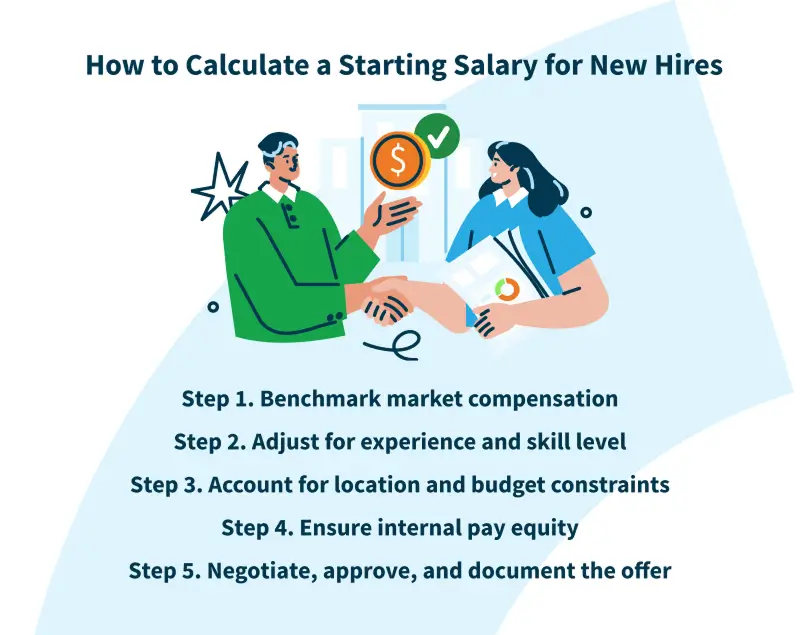
Research market rates for the role. Use tools like Salary.com to find averages. Use market data to identify competitive pay levels. Market Pricing provides reliable benchmarks to anchor starting pay decisions.
Factor in candidate experience and skills. Add premiums for advanced qualifications.
Consider location and company budget. Adjust for high-cost areas without breaking limits.
Check for equity with current staff. Compare to avoid gaps in similar roles.
Negotiate and finalize the offer. Document reasons for the amount.
Here are some examples of calculations for starting pay
A new grad applies for a marketing job in Chicago. Market data shows $50,000 average. With no experience, start at $48,000. Add $2,000 for a degree, totaling $50,000.
An engineer with three years applies in San Francisco. Average is $90,000. Adjust 20% for location to $108,000. Subtract $3,000 for budget, final offer $105,000.
Here are some FAQs for better understanding:
Inflation raises living costs, pushing firms to adjust starting salaries to stay competitive. In 2026, stable budgets at 3.4% reflect contained inflation, but some add cost-of-living boosts. This keeps offers appealing without big jumps. HR pros watch trends to plan.
Remote work can lower starting salaries in some cases due to no location premium. Many firms offer the same pay to attract wider talent pools. It also saves office costs, allowing flexibility in offers.
Use data to find medians and set ranges. Focus on key roles for higher pay. Negotiate perks instead of cash to stay under limits.

The latest research, expert advice, and compensation best practices all in one place.
Blog
Bringing trusted compensation intelligence and seamless planning to even more ADP users.

Blog
Learn how to train managers for effective pay conversations and build trust.

Blog
Total rewards package flexibility lets employees choose what matters - pay, perks, and benefits tailored to their needs.