Blog
Get Pay Right on ADP Workforce Now® Next Gen™
Bringing trusted compensation intelligence and seamless planning to even more ADP users.
Written by Salary.com Staff
August 28, 2026

Building high-performing teams is no longer a "nice-to-have" in today's organizations. As the HR leader, you are responsible for building these teams to drive the growth of the organization as a whole.
Thousands of compliant templates. Save hours of work.
In this article, we will discuss what makes a high-performing team, examples of such teams in the business world, the traits of performing teams, and the steps that HR can take to build performing teams within the organization.
A high-performing team consists of individuals with complementary skills who all have the same vision for the team and its projects, and a commitment to achieving those goals themselves.
Top-performing teams are characterized by psychological safety, roles alignment, and a growth mindset for the entire team dynamic. Each team member feels valued and owns the outcome of the team, which gives the organization a distinct competitive advantage.
| Element | What it looks like in practice |
|---|---|
| Shared purpose | Every member understands the "why" behind team objectives and stays on the same page. |
| Complementary skills | A diverse mix of technical skills and interpersonal abilities covers all critical functions. |
| Mutual accountability | Members hold each other responsible for outcomes, not just individual tasks. |
| Open communication | Two way feedback flows freely, and team members feel safe to admit mistakes. |
| Continuous improvement | The team regularly reflects on performance and looks for ways to stay ahead. |
There are several attributes of top-performing teams that have allowed them to reach extraordinary goals in sports, science, and business:
Google's Project Aristotle studied hundreds of teams over several years to determine why some teams succeeded in their goals while others stumbled towards achieving theirs. The study found that the makeup of the teams was less important than how the teams interacted with one another - psychological safety was the essential element for performing teams.
NASA's Apollo 11 mission thousands of engineering and science teams with specific skills required to achieve their goal.
The New Zealand All Blacks are among the most successful sports franchises in history and have maintained their high levels of performance for several generations of players. They feature a team culture that places team interests above individual egos and require continual self-correction to improve their performances.
Understanding the components of high-performing teams can assist HR leaders in finding areas of improvement within the organization.
According to the findings of Gallup's comprehensive report entitled the State of the Global Workplace, the level of engagement of employees globally is extremely low at only 23%. This represents a financial loss to the global economy of around $8.9 trillion per year. Furthermore, Gallup also found that 70% of the variance in a team's engagement with their workplace and tasks is determined by the quality of the manager of that team.
Clear, aligned goals: Teams that are aligned with the organization's goals understand where to focus and can answer essential questions regarding the goals.
Defined roles and responsibilities: By defining the responsibilities of the team members, there is a minimizing of conflicts and an increase in productivity within the team. Confusion often arises when roles are not made clear.
Psychological safety: Team members feel comfortable admitting to mistakes and presenting new ideas. The leader should encourage this behavior.
Strong leadership: Leaders play a significant role in the team dynamic. They foster trust and model the behavior they want from their team members.
Open communication: Effective communication encourages team members to trust one another and minimizes the chances of misunderstandings. Poor communication negatively impacts the team dynamic.
Mutual respect and trust: Teams that perform at the highest levels thrive on trust and mutual respect from each member. This ensures that each member feels valued within the team.
Continuous learning: A commitment to continuously growing and improving the skills of each team member ensures that the team stays sharp and performs at the highest level.
Constructive conflict resolution: An effective team sees conflict as an opportunity to solve problems and challenge the status quo.
Accountability at every level: Mutual accountability ensures that each team member owns their contribution to the project. Feedback at the team level ensures ownership of each component of the project.
Recognition and celebration: Celebrating the successes of a project and recognizing the contributions of each team member boosts engagement from employees within the team.
Below are five actionable steps that help managers and HR professionals create the conditions for team growth.
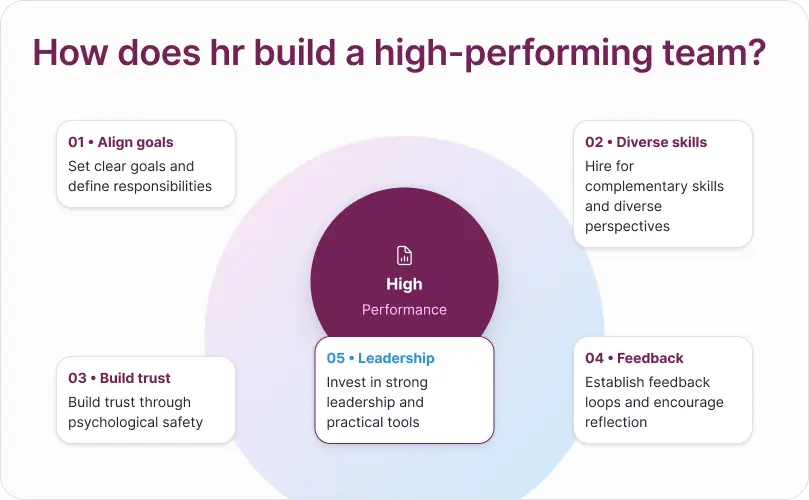
Partner with department heads to establish team goals tied to organizational priorities. Use performance management systems to document role expectations, define responsibilities, and track progress during quarterly reviews.
Clear responsibilities are easier to establish when job expectations are well defined. HR teams can use JobArchitect® to create and manage job descriptions, helping managers and employees understand their roles and how they contribute to team goals.
Design job descriptions that assess candidates for both technical skills and interpersonal strengths. Work with hiring managers to map existing team competencies and identify gaps that new hires can fill.
HR can strengthen team composition by identifying the skills already available within a team and the capabilities it still needs. Salary.com's Skills and Competencies data can support talent assessment and development by helping organizations understand the skills associated with different roles.
Embed psychological safety into policies, training programs, and leadership development. Offer manager training on how to invite input, admit mistakes openly, and create space for two way feedback through anonymous employee engagement surveys.
Design feedback routines that go beyond annual reviews. Introduce 360 degree feedback tools and structured one on one check ins so managers and direct reports can discuss what is working and develop a growth mindset.
Build manager training programs focused on coaching skills and constructive conflict resolution. Equip managers with people analytics and performance dashboards to spot trends in employee engagement and team level performance metrics.
Practical tools can also help HR create the conditions for high performance. CompAnalyst® helps organizations benchmark jobs, build salary structures, model pay scenarios, and evaluate internal pay practices, giving HR data to support more informed compensation decisions.
Here are the common questions about the topic:
Success is quantifiable using a variety of metrics, including both the accomplishment of KPIs and other performance metrics, as well as qualitative indicators of the team's success, such as retention rates, engagement scores, internal promotion rates, and the number of effective retrospectives conducted by the team members.
Regular teams fulfill the tasks that are given to them. Top-performing teams, however, find ways to outperform the expectations of the team by each member taking accountability for the others' contributions and finding ways to solve problems proactively rather than reacting to the status quo.
Goalposts shifting, conflict within the team, encountering toxic top performers within the team, or the leadership failing to recognize the efforts of the team can all ruin a high-performing team.
Auto-matching tools for a clear, fair organization.
With top-performing teams in a remote or hybrid environment, there must be a deliberate choice to avoid acting spontaneously within the team. Teams can establish rules for communication outside of working hours, hold virtual meetings to discuss challenges in solving specific problems, and focus on the outcomes of team members' contributions rather than the amount of hours they work for the organization.

The latest research, expert advice, and compensation best practices all in one place.
Blog
Bringing trusted compensation intelligence and seamless planning to even more ADP users.

Blog
Learn how to train managers for effective pay conversations and build trust.

Blog
Total rewards package flexibility lets employees choose what matters - pay, perks, and benefits tailored to their needs.