Blog
Get Pay Right on ADP Workforce Now® Next Gen™
Bringing trusted compensation intelligence and seamless planning to even more ADP users.
Written by Salary.com Staff
June 26, 2026

Employee financial stress remains a challenge for many companies as the standard pay structure for employees does not necessarily reward their growing abilities. Companies can alleviate this financial stress for their employees by implementing a skill-based pay structure.
Under this system, employees are rewarded according to the skills that they master, allowing them to earn more and experience financial security.
This is a guide that will help you build a skill-based pay system for your organization. It explains the concepts, frameworks, and steps to implementing such a system.
A competency-based pay system rewards employees based on their specific skills. Instead of rewarding employees according to their job title, this system rewards them according to the specific skills they possess.
This model encourages people to keep learning and developing their careers. Employees will receive pay increases when they prove they have learned new relevant skills.
Also, competency-based pay promotes adaptability in dynamic environments. Employees can earn more money without having to seek a promotion.
CompAnalyst® helps organizations compare pay practices against market conditions to ensure compensation remains competitive.
Skill-based pay differs from job-based pay by linking compensation to an employee's demonstrated skills and competencies rather than their specific job title or position.
| Aspect | Job-based pay | Competency -based pay |
|---|---|---|
| Basis of pay | Salary is set mainly according to the job title and its standard responsibilities. | Compensation is based on the verified skills and abilities the employee actually brings and uses. |
| Flexibility | Pay growth is usually limited to promotions, tenure, or across-the-board raises. | Pay can increase as employees gain new relevant skills, even while staying in the same role. |
| Employee motivation | Can sometimes lead to reduced drive once a position is secured. | Motivates continuous development and directly rewards initiative and learning. |
| Equity focus | May create inconsistencies between people in similar titles. | Promotes fairness by connecting compensation to measurable capabilities and contributions. |
Several established frameworks help organizations design and manage skill-based pay with clarity and consistency.
Competency models help to define the skills and behaviors that are necessary to succeed in a specific role.
A taxonomy of skills allows for the creation of different skill levels within a role.
Job leveling systems provide structures for jobs based on skills.
Integrating these skills models into performance management ensures that the skills model is easy to track and practical for the organization.
These models are based on practices in pay structures that are used by the leading organizations in the country.
A competency framework outlines the essential skills, knowledge, and behaviors required for success across different roles in an organization. It serves as a reliable blueprint for making skill-based pay decisions.
Core competencies are applicable across the entire company, such as teamwork or problem solving. These ensure a strong cultural fit.
Role-specific competencies relate to the candidate's technical skills and the requirements specific to certain job families.
Proficiency is divided into several stages, from beginner to expert. This creates a clear path for employees to earn pay increases.
Several different assessment tools will be used to evaluate the candidates' proficiency in the required skills. These will be updated regularly.
Job architecture creates the structural foundation for organizing roles, levels, and career paths in a consistent manner. It supports skill-based pay by clearly linking jobs to required skills.
Job family's group related roles that share similar skill sets.
Leveling criteria use skills and responsibilities to determine what qualifies someone for the next level.
Career pathways allow employees to see how to advance in their careers by obtaining specific skills.
Market alignment ensures that the role skills are priced competitively with the market. This is done through regular reviews of the job family.
Ensuring fairness in skill-based pay requires transparent processes and objective measurement tools. This approach builds employee trust and minimizes potential conflicts.
Clear criteria for skill assessments reduce subjective judgments. Proper documentation supports every pay decision.
Regular audits examine results for any unintended biases across groups. Timely adjustments help maintain equity.
Employee involvement through open communication and feedback sessions increases acceptance. Transparency remains essential.
Training managers promote consistent application of rules and processes. This improves overall perceived fairness.
Pay equity in skill-based pay systems means offering equal compensation for comparable skills and contributions, regardless of personal characteristics such as gender or background. It requires proactive management.
Skill-based comparisons evaluate the skills of employees to show pay gaps that can be remedied.
Regular analysis collects and reviews data to find pay disparities and fix them using modern compensation tools.
A pay transparency initiative allows employees to understand how pay is determined based on skill levels.
The company follows the regulations and standards of the law to ensure equal pay for all employees.
Market pricing in compensation means researching external salary data to establish competitive pay ranges for skills and roles. It keeps skill-based systems realistic and attractive.
Data from trusted sources that survey and benchmark the job market for in-demand skills
Skills are valued according to the demand for those skills in the job market
Salary ranges are periodically reviewed to ensure accuracy with the job market; most companies review at least once per year
Salaries are internally balanced to ensure that no skill is overpaid or underpaid relative to company salaries for other positions
CompAnalyst® helps compensation professionals benchmark jobs and skills against current market rates.
Implementing a skill-based pay system requires careful planning to achieve success with minimal disruption.
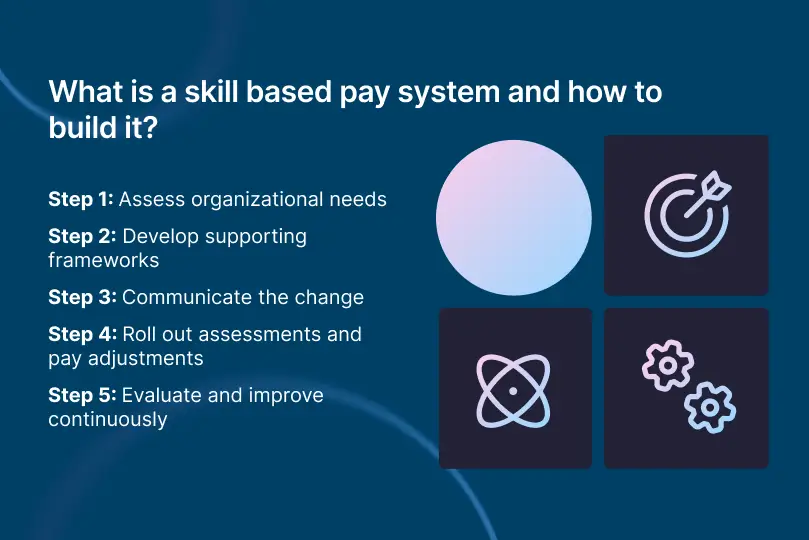
Step 1: Assess organizational needs
Identify the skills that best align with your business goals. Gather input from business leaders and employees. Analyze skill gaps within the company. This step will create a solid foundation for your business skills development strategy.
Step 2: Develop supporting frameworks
Build competency models, skills taxonomy, and updated job architecture. Define proficiency levels and fair assessment methods. Work with compensation experts to establish pay bands. Test out these elements with a small group of employees to gather feedback.
CompAnalyst® helps organizations create salary ranges that align with skills and market data.
Step 3: Communicate the change
Share with all employees and managers. State the benefits and how they can advance their pay. Offer training on available resources to develop their skills. Answer questions and concerns from managers to secure their buy-in.
Step 4: Roll out assessments and pay adjustments
Begin conducting skill evaluations using the same processes. Link skills to pay changes. Monitor the results and make changes quickly to fix any issues. Integrate the system smoothly into existing performance tools.
Step 5: Evaluate and improve continuously
Review the metrics for success. Ensure the framework can adapt to new skills and markets. Continuously seek feedback to make improvements. For long-term success, constantly refine the framework.
Here are some FAQs for better understanding.
Skill-based pay systems increase employee motivation and encourage them to develop new skills. Such pay structures allow companies to respond faster to changing demands of their businesses.
A report from the SHRM indicated growing interest in skills-based pay systems to improve business and employee productivity. It can also relieve employees of financial stress.
Yes, skill-based pay typically improves employee retention as well. This is because employees are rewarded for their growth with the program's financial incentives.
In a recent analysis of the WorldatWork organization, it was found that skills-based pay helped companies retain their employees during periods of change. Employees desire opportunities for growth within their current company.
Common challenges of implementing skill-based pay include increased work assessments and employee resistance. Compensations must be measured objectively, which takes time and resources.
Studies conducted in 2025-2026 indicated the complexities of maintaining a fair and up to date system. However, planning, training managers, and communicating with employees can overcome difficulties in implementing this system.

The latest research, expert advice, and compensation best practices all in one place.
Blog
Bringing trusted compensation intelligence and seamless planning to even more ADP users.

Blog
Learn how to train managers for effective pay conversations and build trust.

Blog
Total rewards package flexibility lets employees choose what matters - pay, perks, and benefits tailored to their needs.