Blog
Get Pay Right on ADP Workforce Now® Next Gen™
Bringing trusted compensation intelligence and seamless planning to even more ADP users.
Written by Salary.com Staff
August 29, 2025

Now that 45% of new job seekers are looking for a more flexible payment methods in their first job, utilizing systems that compensate their employees competitively according to the market data is becoming the new norm.
Auto-audit pay gaps. Eliminate bias before it strikes.
This means that payroll management is also slowly on the rise. That’s why for companies, quickly addressing accrued payroll – or the small liabilities that are addressed on a company’s payroll expenses – can help make companies run as smoothly as possible.
But what is it, and how does it work? Read on and learn more about how to calculate accrued payroll, what it does to a company, along with some examples that can help employers as well.
Accrued payroll is defined as payroll-related debts that companies owe to their employees that are still yet to be paid. This includes everything from payroll taxes, employee wages, PTOs – essentially every expense that employees are yet to pay their employees can be counted as accrued salary.
The formula will look like this:
Employee’s gross pay + FICA tax = employee accrued salary.
It is important to note that both employers and employees need to pay their share of FICA tax, hence why it’s multiplied by 2.
It should also be noted that this still does not include overtime bonuses, PTO requests, and any other bonuses that can directly affect an employee’s accrued payroll.
Although it’s possible to simplify and streamline this process further with the right payroll software, learning how to calculate it manually is useful as it can help employers properly identify how employees are paid. Accrual accounting can also help companies know how much money will be coming their way as well.
Essentially, it works by providing employers with a payroll deficit that provides them with a picture of how much they owe their employees. This practice ensures better cashflow for companies and can help them with their financial planning and provides a more accurate forecast financial planning for the company for any given pay period.
Companies can also do the opposite process - otherwise known as acquiring reverse accrued payroll entries. In this process, the employers record accrued payroll at the end of the pay cycle, and they then reverse it at the beginning of the next pay period.
Listed below are some examples of accrued payroll that companies can use to properly evaluate their overall cashflow.
Salary and wage
One of the simplest examples, salary and wage that are yet to be paid to employees takes up the vast majority of accrued salary. It’s important to remember that salary and wages are initially considered as liabilities and is only considered to be an expense after payday.
Gross and net pay fall under this category since it can help companies properly how much they owe the federal government tax and contributions-wise.
PTO
Although not all U.S. companies offer PTOs for their employees, it should still be accounted for when it comes to accrued payrolls. Even if the employee doesn’t take them, it should still be counted as most employees are more than likely to take them.
Companies who offer it for their employees should value it for their accrued payrolls as most companies allow their employees to cash out unused PTOs after leaving the company.
Leaves
Similar to PTOs, leaves should also be accounted for when it comes to accrued payroll. Companies should take into account every leave and sick day that an employee has or has not taken yet, while taking the employee’s contribution to the company into consideration.
Overtime pays
When it comes to overtime pay, it will only start to take effect if the overtime hours have already been earned in the accounting period without still being paid to the employee during the pay period.
Employee benefits
Several benefits, like FICA taxes, medical insurance, and social security taxes should also be considered as accrued payroll. However, some benefits like employee stock ownership and pension plans can also be counted as well since it is also included in an employee’s paycheck.
Although there can be several deviations to acquire an employee’s total accrued payroll, a simple formula can be used to calculate payroll accrual.
For this instance, let us assume that we’re calculating a custodian’s accrued salary for the month of February 2025. According to Salary.com’s Real-Time Job Posting Salary Data Report, custodians in the United States make $18 an hour, which equates to a biweekly salary of $1,400.
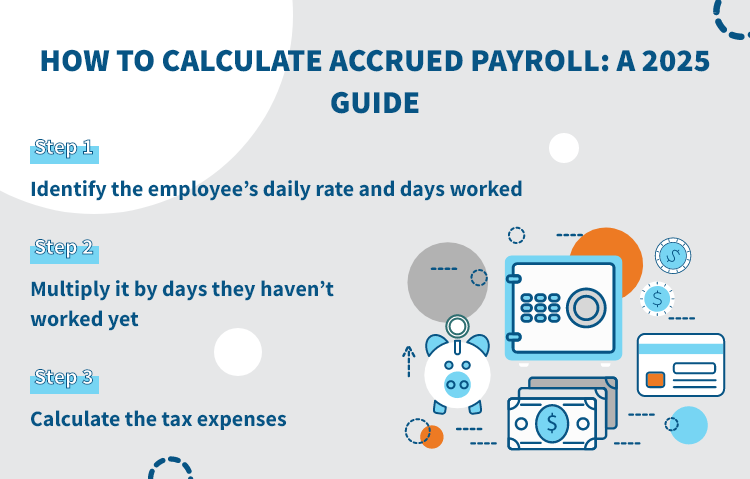
For this example, let us assume that the custodian makes the median $18 per hour, and they’ve worked for an entire week. This equates to 40 out of the 80 hours before the biweekly accounting period.
Since there are still 5 days/40 hours that they haven’t worked yet for the time being, add that to the formula to finalize the employee’s gross pay for their biweekly salary.
In this scenario, let us also assume that the custodian pays for Medicare tax on top of the existing Social Security taxes.
Thus, the figure below can teach employers the steps to calculate accrued payrolls using a standard formula.
However, keep in mind that for this formula, we are assuming that the employee's hourly wage is $18 an hour, worked 40 hours per week, gets paid bi weekly, and FICA (Federal Insurance Contributions Act) tax for them.
Remember also that in this scenario, the employer payroll taxes have been calculated and accounted for. Hence, a custodian’s accrued payroll will look similar to the figure below:
$1,400 (gross biweekly pay) x 1.45% (Medicare tax) = $20.3
$1,400 x 6.2% (Social Security Tax) = $86.6
$20.3 + $86.6 = $106.9, multiplied by 2 equals $213.8. Add this to the employee’s gross bimonthly income of $1,400, which means that the average custodian in the United States has an accrued biweekly payroll of $1,613.8.
One-click compliance reports for state pay equity laws.
Keep in mind that several deviations might happen to the formula depending on the employee and the benefits package that their employer provides them with. For instance, employees on the upper management may receive benefits like the aforementioned employee stock ownership or 401(k) plans.
Utilizing compensation planning softwares can help companies streamline the process further and provide them with clarity with their accrued payroll journal entries in the long run. This also comes with the positive effect of providing them with some help with the clarity that they need to make sound decisions in the long run as well.

The latest research, expert advice, and compensation best practices all in one place.
Blog
Bringing trusted compensation intelligence and seamless planning to even more ADP users.

Blog
Learn how to train managers for effective pay conversations and build trust.

Blog
Total rewards package flexibility lets employees choose what matters - pay, perks, and benefits tailored to their needs.