Blog
Get Pay Right on ADP Workforce Now® Next Gen™
Bringing trusted compensation intelligence and seamless planning to even more ADP users.
Written by Salary.com Staff
April 03, 2026

Getting salary increases right matters. If you set them too low, you risk losing your top performers to competitors. If you set them too high, you put unnecessary pressure on your company budget. And that’s where the average raise percentage helps you find a middle ground by providing a structured starting point for your pay decisions.
In this article, we explain what this raise percentage means for your business and how it differs from individual raises. We also provide a clear, step-by-step guide on how to calculate these increases accurately to keep your organization’s pay structure on track.
Average raise percentage is the standardized salary increase across a company, expressed as a percentage of an employee’s current base pay. HR and finance teams use this metric to ensure fair pay, match market rates, and maintain internal equity.
The table below shows the key characteristics of the average increase percentage:
| Characteristic | Description |
|---|---|
| Organization-level calculation | Averages pay raises across all departments, business units, or the whole company. |
| Merit budget-driven | Based on the total pool of funds allocated for employee pay increases. |
| Governance constrained | Follows formal policies and approvals to stay consistent and avoid overspending. |
| Fixed cost impact | Every percentage raise adds to ongoing payroll costs that grow each year. |
Here’s the most recent data:
Most U.S. organizations plan to budget an average salary increase of 3.6% in 2026. (Salary.com National Budget Survey)
2.8% cost-of-living adjustment (COLA) increase in 2026. (U.S. Social Security Administration)
Organizations that fail to benchmark their raise percentages risk either overspending on compensation or losing key talent to competitors offering more competitive increases. That’s why most companies utilize solutions like Salary.com’s CompAnalyst Software that offer comprehensive market benchmarking and pay equity analysis tools to turn these budgets into equitable pay decisions.
Understanding this distinction is critical for effective compensation management.
Average raise percentage reflects the company's overall budget for salary increases and is often standardized. This is the organization-level metric that guides your total compensation spending. As mentioned above, most U.S. organizations project an average raise of 3.6% in 2026.
Individual raises, on the other hand, can differ significantly based on factors like personal performance, role, tenure, or promotions, and may range from 5-10% for top performers.
This means that while your company might budget an average of 3.6%, individual employees will receive raises distributed around that average based on merit matrices and performance ratings. In short, some employees will receive more than the average, others less, but the total will align with your calculated average raise percentage.
This average percentage gives your HR and finance teams a clear benchmark for total salary adjustments. Here’s how your organization can calculate it:
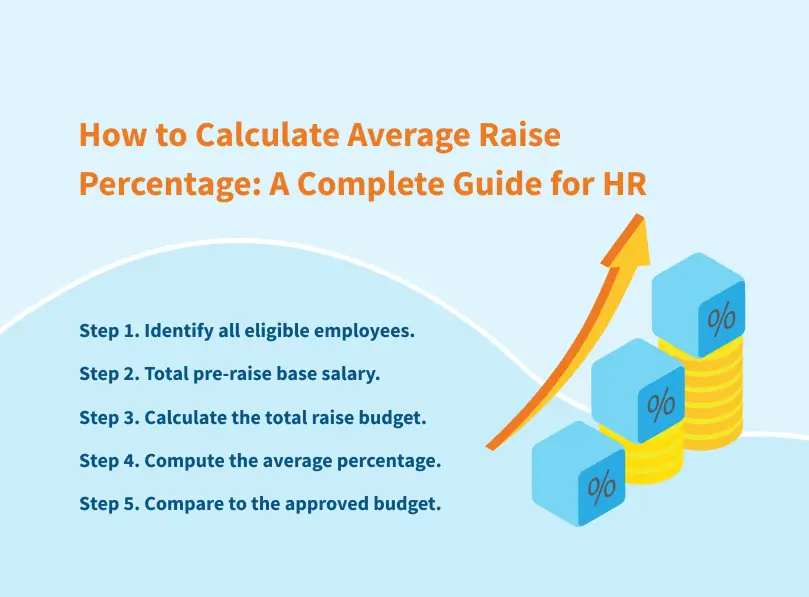
Make a list of all the employees who are eligible for merit increases in this cycle.
Calculate the total current base salaries of all eligible employees.
Sum up all the budgeted money for raises. This amount should come from your approved merit increase budget.
Divide the total raise budget by the pre-raise base salary, then multiply by 100.
Average raise percentage = (Total Amount of Raises / Total Base Salary Before Raises) × 100
For example: ($350,000 / $10,000,000) × 100 = 3.5%
Check that the calculated percentage matches the approved merit budget and aligns with your organization's compensation strategy.
Now that you know how to calculate the average raise percentage, it's important to understand where that budget comes from and how organizations determine it.
The role of merit increase is to:
give annual raises based on how well employees perform,
help companies reward top performers,
stay competitive in the labor market, and
manage payroll costs effectively.
Finance and HR leaders work together using a clear and structured process that usually starts 3 to 6 months before the annual raise cycle.
First, they review the company's financial performance, including sales growth, profit levels, and cash flow projections.
Next, HR analyzes salary data from trusted sources such as Salary.com’s CompAnalyst Software to understand competitors' plans to spend.
Finally, HR and finance aim to closely match market salary averages. This keeps them competitive in attracting talent without overspending.
After your team determines the right average percentage, you would want to make sure that it is implemented fairly in your organization.
Here are common factors that generally affect pay increases:
Budget: This refers to the amount your organization will be able to spend based on your revenue.
Performance: Employees who meet or exceed their goals, increase their role or responsibility, or help generate business growth.
Tenure: Salary increases after reaching major service milestones such as 5 years and 10 years of service to reward loyalty to the service.
Cost of living: Increases in pay, tied to the consumer price index (CPI), to ensure that employees don’t lose purchasing power. As noted, the US Social Security Administration lists a COLA in 2026 at 2.8%.
Skills and qualifications: New degrees or certifications, professional development that merits a raise.
Regulatory requirement: Complying with federal, state or local wage mandates, such as minimum wage changes and pay equality regulations.
Most organizations utilize a "merit matrix" that links raise percentages to performance scores.
| Compa-ratio | Performance Rating 1 | Performance Rating 2 | Performance Rating 3 | Performance Rating 4 |
|---|---|---|---|---|
| Below 0.80 | 3% | 4% | 5% | 6% |
| 0.80 to 1.20 | 2% | 3% | 4% | 5% |
| Above 1.20 | 1% | 2% | 3% | 4% |
This distribution approach ensures your calculated average turns into fair, performance-based individual increases. To simplify merit matrix planning, many organizations today use tools like Salary.com’s Compensation Software, allowing them to replace spreadsheets with automated workflows for greater accuracy and efficiency.
Here are frequently asked questions related to the topic:
Companies typically use 3-5% annually for cost-of-living adjustments or merit increases. But this can vary by industry, region, and company budget.
Recent data from WorldatWork shows that most U.S. organizations project an average raise of 3.6% in 2026.
As mentioned above, the average raise percentage reflects the company’s overall budget for salary increases and is often standardized across the organization. Individual raises, on the other hand, can differ based on factors like personal performance, role, tenure, or promotions.
No. Inflation does not automatically raise the average percentage for employee raises. Companies often adjust pay to offset some inflation through cost-of-living adjustments, but these decisions depend on factors like profitability, economic trends, and business strategy instead of CPI alone.

The latest research, expert advice, and compensation best practices all in one place.
Blog
Bringing trusted compensation intelligence and seamless planning to even more ADP users.

Blog
Learn how to train managers for effective pay conversations and build trust.

Blog
Total rewards package flexibility lets employees choose what matters - pay, perks, and benefits tailored to their needs.