Blog
Get Pay Right on ADP Workforce Now® Next Gen™
Bringing trusted compensation intelligence and seamless planning to even more ADP users.
Written by Salary.com Staff
June 05, 2026

Understanding the CEO to worker pay ratio helps HR and compensation experts maintain pay equity according to the legal requirements of the country. This pay ratio helps companies make informed decisions on pay and strategy in the workplace today.
The CEO to worker pay ratio indicates how much more money the company’s CEO makes compared to the average worker in that company. This pay ratio matters for a variety of reasons, including as a way to gauge if the company is fair in its pay structures.
A high pay ratio often indicates that there are discussions regarding the fairness of the company’s pay structure. Additionally, many HR departments use this pay ratio to formulate a pay system that remains competitive in the industry yet remains fair for everyone in the organization.
A recent study of the pay ratios between CEOs and workers has indicated that the ratios have increased significantly over the decades. In 2024 alone, CEOs earned, on average, 281 times more money than a typical worker in their companies.
There are a variety of reasons why the pay ratio is influential within the organizations, including:
It influences the organization’s ability to attract and retain talent
It allows for a better communication strategy between the company and its stakeholders
It indicates where there may be opportunities to increase pay equity
Total CEO compensation refers to the total amount of money that the company’s CEO earns in a year. This includes salary, any bonuses awarded to the CEO, stock awards, stock option grants, changes to the CEO’s pension plan, and any other perks that may be provided to the CEO as part of their position in the company.
Data-EXE provide HR leaders with reliable benchmarks for CEO pay, helping organizations evaluate whether executive compensation aligns with market practices and internal pay structures.
Median employee compensation is the compensation that the middle worker in the company earns in a year. This salary uses the same definition as the total compensation for the CEO in the company. This is calculated using the same methods used to calculate median salaries for the employee pool within the company.
The pay ratio for the CEO and the median employee can fluctuate significantly due to the compensation plans that are given to the company’s executive team. If the company’s stock increases in value, the compensation that the CEO earns increases with the stock value.
The compensation committees for each company use the pay ratio between the CEO and the median employee to help them determine whether the CEO compensation aligns with the company values and the shareholders’ expectations.
Additionally, the pay ratio allows the company to respond to questions from shareholders during proxy season. By monitoring the pay ratio, the company ensures that it maintains its current state and remains healthy in the long term.
Determining the pay ratio between the CEO and median employee in a company is a simple calculation that uses publicly available information. All companies that meet specific criteria must report this calculation to the federal government. The formula can be directly applied by HR departments within the company to determine this statistic for their organizations.
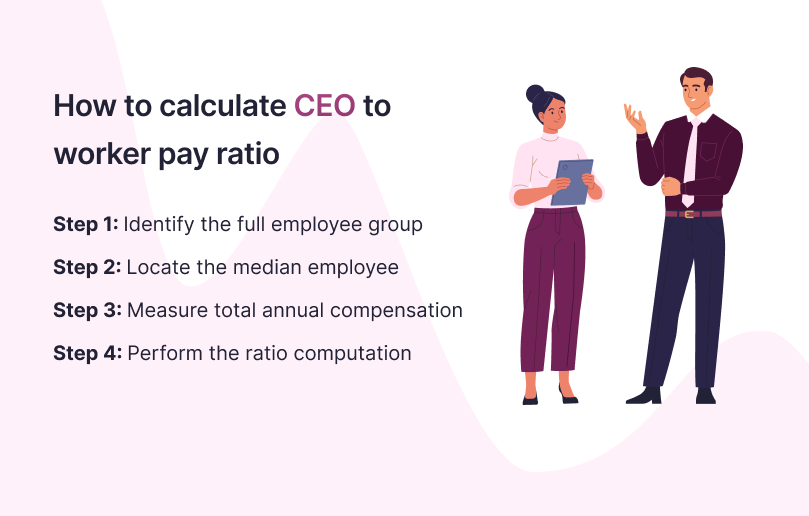
All employees that work for the company, including part-time, seasonal, temporary, and international workers, must be accounted for. Any contractors who work with the company do not have to be included in this calculation.
A variety of methods can be used to determine the median employee within the company. For example, the company could sample the pay of each employee group. Alternatively, one median employee can be used for up to three years in a row within the company.
The same criteria for calculating total compensation for the CEO must be used for the median employee. The total compensation for all employees within the company can be used to calculate the median salary for those employees.
Platforms-CA help HR teams accurately measure total compensation by providing reliable salary benchmarks, total rewards data, and compensation analytics needed to support these calculations.
The total compensation for the CEO can be divided by the total compensation for the median employee to calculate the pay ratio between the two groups of employees.
Formula: CEO to Worker Pay Ratio = CEO Total Compensation ÷ Median Employee Total Compensation
Example: If the CEO earns $14,050,000 and the median employee earns $50,000, the ratio is 281:1.
HR departments must be aware of the various compliance rules regarding the pay ratio calculation to guarantee that they do not face any penalties for noncompliance with the federal government. These compliance rules will help the HR departments to prepare and report this statistic correctly for each year’s payroll.
Follow the same compensation methodology each year
Ensure that all calculations are documented
Prepare for potential questions from company shareholders
The CEO Pay Ratio Disclosure Rule requires all companies to report this statistic within the reports that include information regarding the pay of the company’s executives.
Section 953(b) of the Dodd Frank Act directed the creation of this disclosure requirement. It aims to shed light on pay gaps at the highest levels.
Item 402(u) spells out exactly how to calculate and present the ratio. It gives flexibility in median employee selection while demanding accuracy in compensation figures.
Proxy statements must include information regarding the median employee pay, the pay of the CEO, the pay ratio, and a description of how the pay ratio was calculated within the company.
There are various factors that influence the pay ratio for each company. An understanding of these factors will allow HR departments to provide better recommendations to the executives within the company.
Total direct compensation for the CEO
Long term incentive plans for the CEO
Stock based compensation for the CEO
Compensation benchmarking and market pricing of the CEO’s positions
Total direct compensation for the CEO includes salary, bonus, and short term incentive plans. This compensation directly impacts the pay ratio for that company’s CEO.
Long term incentive plans for the company’s CEO typically include shares of the company’s stock that will be earned over a period of years. If the company performs well during those years, the CEO earns more money.
Stock based compensation for the CEO is awarded based on the market price of the company’s stock. If the stock increases in price each year, the CEO will earn more money each year.
Benchmarking the CEO’s pay against other companies in the same industry will ensure that the CEO earns a competitive pay rate. Additionally, market pricing for each job ensures that employees earn competitive salaries.
CompAnalyst® help HR teams benchmark executive and employee salaries against real market data, giving organizations better insight into how their pay ratio compares with industry standards.
Here is how HR could utilize such data to develop an improved compensation strategy:
Use median employee data to spot pay gaps between departments or demographics.
Contextualize benchmarking comparisons with peers — to show whether company investment in talent is at the very top or more broadly distributed.
Tap into the public nature of this data to develop “total rewards” communications — explaining median calculations and career paths to higher pay brackets.
Pay equity reviews compare similar roles across genders, races, and levels. They help close gaps that might otherwise widen the overall ratio.
Analytics tools reveal trends in pay distribution. HR can spot departments where employee pay lags and recommend targeted adjustments.
Benchmarking against industry peers keeps executive pay competitive without over inflating the ratio. It ensures rewards match performance and market norms.
A clear job architecture defines levels and pay bands consistently. It creates transparent career paths that reduce unintended pay disparities.
Here are the common questions about the topic:
No single number fits every company, but many experts view ratios below 100 to 1 as more balanced for long term success. Industry, company size, and location all play a role in what feels appropriate.
In 2024 the average stood at roughly 281 to 1 across large US firms. Some sectors report even higher figures depending on business models.
It gives HR a data backed way to advocate for equitable practices. Leaders use it to strengthen culture and meet growing demands for transparency.
Stock market movements, new incentive grants, and workforce shifts all cause natural variation. Companies may also refine calculation methods within allowed rules.

The latest research, expert advice, and compensation best practices all in one place.
Blog
Bringing trusted compensation intelligence and seamless planning to even more ADP users.

Blog
Learn how to train managers for effective pay conversations and build trust.

Blog
Total rewards package flexibility lets employees choose what matters - pay, perks, and benefits tailored to their needs.