Blog
Get Pay Right on ADP Workforce Now® Next Gen™
Bringing trusted compensation intelligence and seamless planning to even more ADP users.
Written by Salary.com Staff
September 18, 2026
Recruitment and talent acquisition are undoubtedly one of the most crucial aspects of a company's continuous growth. But how much does it really cost to hire an employee?
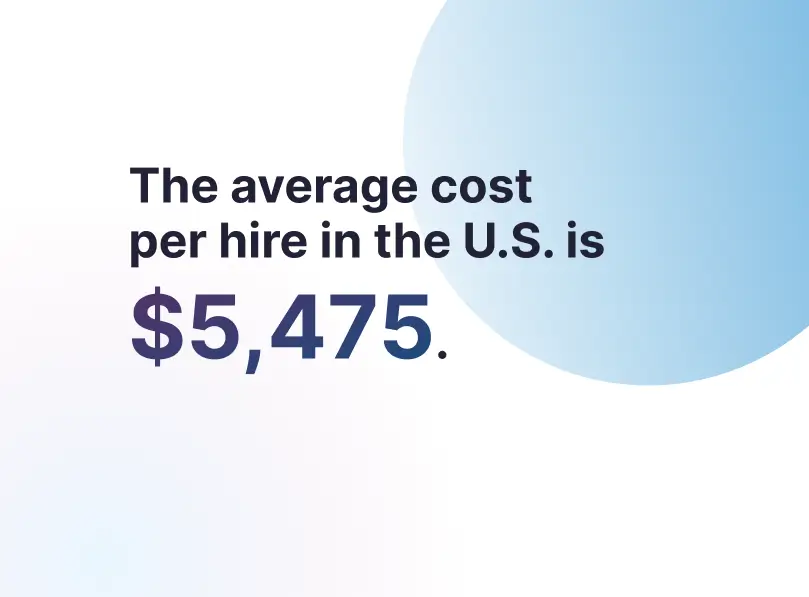
A recent report suggests that the average cost per hire in the U.S. is $5,475. However, many employers estimate that hiring a new employee costs three to four times the position's annual salary. This means it could cost $150,000 to $200,000 to fill a role that pays $50,000 per year.
As an employer, you have to be aware of these numbers as they greatly impact your company's finances. In this article, we'll discuss everything you need to know about the cost per hire. What does it mean? Why is it important? And how do you calculate it? Let's find out!
Cost per hire (CPH), also known as the fee for hire, is an HR recruiting metric representing the total amount it costs a company to hire new employees. This figure includes all the expenses needed to execute the recruitment process, such as:
Talent sourcing
Recruitment advertising costs
Onboarding programs
Referral bonus programs
Cost of recruiting technology
For example, if you hire 500 new employees every year and your average CPH is $3,000, then you may spend an average of $1,500,000 on hiring costs that year. You may evaluate the CPH according to your entire company's hiring metrics or just an individual department.
The cost of hire is an important metric in every organization's workforce planning. Together with other reliable data, Salary.com's consultants can help you make better decisions on job structures, recruitment budget, and hiring to achieve your organization's long-term objectives.
Profitability is the top priority in your goals as a business owner. Therefore, you should always understand how to allocate your resources better within profitable areas in the business.
Cost per hire helps you achieve this by enhancing the organization's cost visibility so you can understand where the profit goes all the time. It gives a clear perspective on how an organization's recruitment efforts perform, allowing them to improve their efficiency, optimize their budgets, and make data-driven decisions about their hiring strategies.
The fee per hire also helps you gauge the competitiveness of your company's new hire pay practices, whether they're above or below current market prices. Salary.com's consultants can help you analyze your candidate pool and make smart pay decisions to win the talent war.
Businesses usually calculate CPH based on specific periods such as monthly, quarterly, or annually. According to a study conducted by the American National Standards Institute (ANSI) and the Society of Human Resources Management (SHRM), the cost per hire formula is:
Cost Per Hire = (Internal Recruiting Costs + External Recruiting Costs) / Total Number of Hires
Every component of this formula is crucial to determining the exact amount of the cost to hire new employees. However, you have to keep in mind that each company follows its own recruitment process. Therefore, some components may or may not apply to each organization.
As mentioned above, some components of the CPH formula may not apply to all companies. You must assess your organization's recruitment to determine which components apply.
Internal recruiting costs
These are primarily composed of the internal organizational costs incurred by a company related to its hiring process, including the recruitment team salary, training and development budgets, referral programs, and more. Below are some examples of internal recruiting costs:
Hiring manager costs
Recruitment staff costs
Training and development costs
Administrative costs
Organizational costs
Compliance costs
External recruiting costs
These are basically the costs associated with external or third-party services your company avails to facilitate the recruitment process. There are cases when some of the internal recruiting costs mentioned above are outsourced to external companies.
Background checks
Third-party agency
Marketing costs
Screening expenses
Technological expenses
Job board fees
Relocation expenses
Signing bonus
Referral bonus programs
Total number of hires
The total number of hires represents employees who were successfully hired by your company during a specific time period. This number may include internal or external employees, temporary staff, freelancers, or contractual professionals.
On the other hand, employees who were transferred due to mergers or company acquisitions together are usually not included in the total number of hires. Simply said, it all depends on the outcome you want to achieve in calculating the fee per hire.
Remember that these components of cost per hire are significant HR metrics that track the effectiveness of your company's hiring processes. Carefully assess your current recruitment process to accurately pinpoint which external and internal costs to consider.
The following are key steps in the process of calculating CPH, along with actual computations and examples:
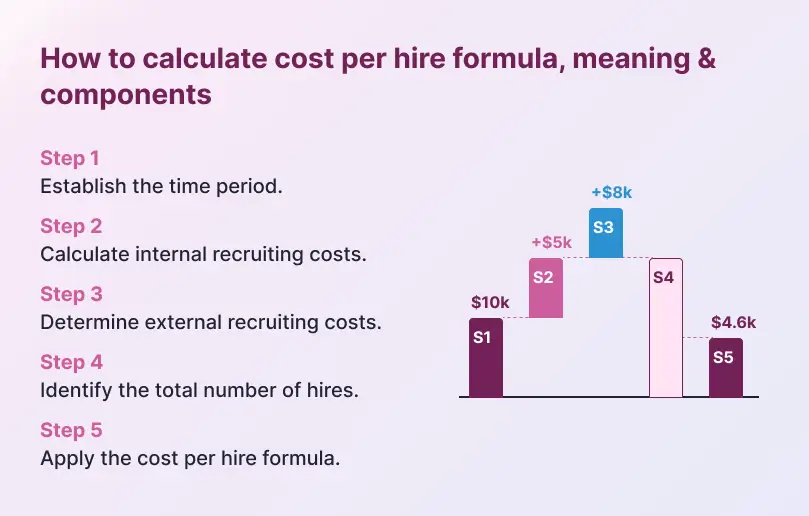
What time period do you need for calculating the fee per hire? Why and how are you planning to use this data in your recruitment process? Salary.com's consultants can help you decide the most feasible time period to use and create reliable, long-term financial forecasts.
Tally all of the internal recruiting costs incurred by your company during the specified time period. Let's use the table below as an example:
| Internal Recruiting Costs | Amount in USD |
|---|---|
| Recruitment team costs | $5,000 |
| Administrative costs | $2,000 |
| Compliance costs | $500 |
| Hiring manager expenses | $2,000 |
| Office expenses (rent, equipment, utilities) | $3,500 |
| Total internal cost | $13,000 |
Carefully determine every external recruiting cost billed by your company, including outsourced tasks, third-party company services, and HR technology subscriptions. For example:
| External Recruiting Costs | Amount in USD |
|---|---|
| Marketing costs | $6,000 |
| Job fair expenses | $4,000 |
| Background checks | $2,000 |
| Screening costs | $1,500 |
| Third-party agency fees | $3,500 |
| Technological expenses | $5,000 |
| Total external cost | $23,000 |
Review the actual total number of hires by your company during the specified time period. Take note to also include those employees who were hired during that time period but have since left the company (including internal and external hires).
In this case, let's assume that you're calculating the CPH data for the quarterly time period of January to March:
Total number of hires = 8
Finally, you can now plug these components (total number of hires, internal and external costs) into the CPH formula:
Cost per hire = (Internal Recruiting Costs + External Recruiting Costs) / Total Number of Hires
| Recruitment Cost | Amount |
|---|---|
| Internal recruitment cost | $13,000 |
| External recruitment cost | $23,000 |
| Total number of hires | 8 |
CPH = ($13,000 + $23,000) / 8
Cost per hire = $4,500
According to a study, the average cost per hire in the U.S. is $5,475. Therefore, a cost per hire of $4,500 is below the reported average and may indicate that your company has an efficient hiring process.
However, this could depend on several different factors, such as the type of jobs, quality of hires, and referral bonus programs. Salary.com's consultants can help your company benchmark its hiring performance in comparison to the market trends and improve key areas for better results and a return of investment.

The latest research, expert advice, and compensation best practices all in one place.
Blog
Bringing trusted compensation intelligence and seamless planning to even more ADP users.

Blog
Learn how to train managers for effective pay conversations and build trust.

Blog
Total rewards package flexibility lets employees choose what matters - pay, perks, and benefits tailored to their needs.