Blog
Get Pay Right on ADP Workforce Now® Next Gen™
Bringing trusted compensation intelligence and seamless planning to even more ADP users.
Written by Salary.com Staff
May 15, 2026

Earnings per share can drop when employee turnover costs climb within any company. These costs have the potential to significantly impact a company’s profits. The personnel department must remain attentive to these figures to ensure that the company remains financially healthy and can operate efficiently for everyone in the company.
We'll show you the basics of calculating these expenses as well as the steps you can take to control them. Also, there are some tips that will help you to avoid common mistakes and answers to some common questions.
Employee turnover costs include all the money that a company spends when an employee leaves and a new one takes their place. These costs are sustained each time an employee leaves a company, whether they chose to or the company laid them off.
The indirect costs are also a big part of the cost of replacement. The work will slow down while they look for and wait for the new replacement to arrive. The knowledge of the company leaves with the employee that departs, and the new employees will take time to come up to speed.
Thus, these costs can quickly add up for the organization if not watched closely by the management team.
For global organizations, Global Market Data allows companies to compare compensation across countries, ensuring turnover cost estimates are accurate internationally.
Calculating turnover costs matter because it shows the real dollars lost when good people walk away and helps leaders make smarter choices.
It reveals how much each departure costs, so HR can compare that number to the price of a pay raise or better benefits.
Accurate numbers let compensation teams prove the value of retention programs to senior leaders who focus on the bottom line.
Tracking these expenses year after year spots trends early and gives time to fix problems before they grow.
Clear cost data supports better budgeting and helps protect earnings per share by cutting unnecessary spending.
Turnover costs fall into two main groups that together show the full expense of losing staff.
Direct costs include cash spent on recruiting ads, agency fees, background checks, and signing bonuses for new hires.
Separation costs cover exit interviews, severance pay, unused vacation payouts, and any legal steps tied to the departure.
Training and onboarding costs add up with new employee orientation, job training sessions, and time spent by managers to teach the role.
Indirect costs cover lost productivity while the job stays empty plus the extra work other team members pick up during the gap.
Calculating employee turnover costs follows a clear five-step process that any HR team can use with basic numbers from payroll and finance records.
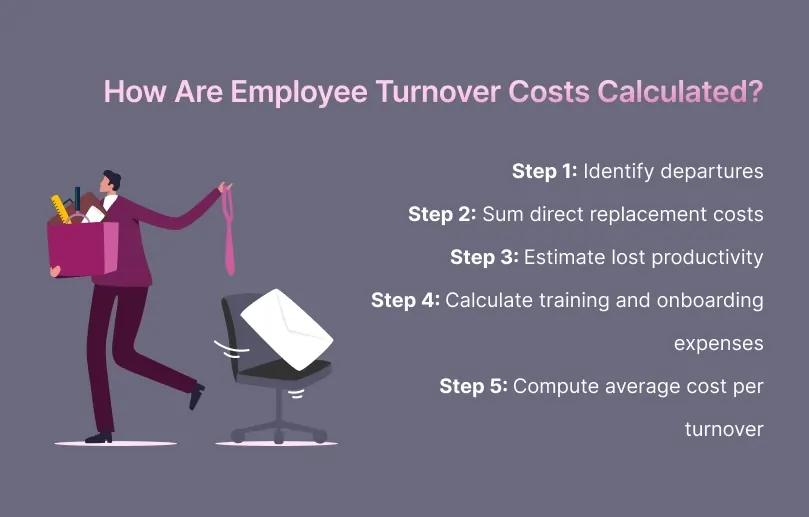
List all employees who left during the chosen period, record their reasons for leaving, note their salaries, and track how long each position remained vacant, as this information will serve as the foundation for your calculations.
Add up all direct replacement costs—job postings, recruiter fees, interviews, bonuses, background checks, and tests—for each employee, then total them and keep records for verification.
Estimate productivity loss by multiplying the employee’s salary by the number of days the role was vacant, then add any costs from overtime or temporary workers used to cover the work.
Calculate training and onboarding costs by including programs, mentor time, materials, and the portion of the new hire’s salary during the weeks it takes them to reach full productivity, then add this to the total to ensure all expenses are captured.
Divide the total turnover costs by the number of employees who left to find the average cost per employee, then compare this with industry benchmarks and your company’s historical data to identify trends and illustrate progress to management.
Reliable compensation data from Salary.com Data ensures that each step in the calculation is backed by accurate financial inputs.
Managing turnover costs well means building programs that keep people happy and reduce the need to hire repeatedly.
Set up stay interviews to learn what employees like and fix small issues before they turn into resignations.
Offer competitive total rewards packages that go beyond base pay and include flexible work options.
Use exit surveys to gather honest feedback and turn those answers into real changes for the team.
Share cost data with managers, so they see how retention directly helps their department budget.
Retention programs cut turnover costs by giving employees clear reasons to stay and grow inside the company.
Launch mentorship pairings that help new hires feel supported and speed up their learning curve.
Provide career path planning so staff see future opportunities and stay motivated year after year.
Roll out recognition awards and small bonuses tied to length of service to celebrate loyalty.
Check in regularly through pulse surveys to catch dissatisfaction early and adjust benefits fast.
Monitoring turnover trends keep costs predictable and lets HR spot patterns before they become expensive.
Run monthly reports on whoever leaves by department, role, and length of service to find hot spots.
Compare your numbers to industry benchmarks, so you know if your rate sits too high or looks normal.
Use simple charts to show leadership how turnover links to missed deadlines or lower output.
Set alerts for sudden jumps in exits so the team can act quickly and limit damage.
Aligning HR and compensation strategies makes sure pay and benefits work together to lower turnover costs.
Tie raises bonuses to clear performance goals, so top talent feels rewarded.
Review total rewards every year to keep them competitive with what similar companies offer.
Combine compensation data with engagement scores to prove which perks actually keep people.
Train managers on how to talk about pay, so conversations build trust instead of frustration.
Budgeting and forecasting turnover costs help HR plan and avoid surprise hits to the budget.
Build an annual estimate based on last year’s average cost times expected headcount changes.
Set aside a reserve fund for replacements, so sudden exits do not strain other projects.
Update forecasts each quarter using fresh turnover numbers to stay realistic and flexible.
Share the forecast with finance so earnings per share of projections stay accurate and complete.
Accurate forecasts can be built using CompAnalyst Market Data ensuring cost estimates reflect real market conditions.
Common mistakes in handling turnover costs can hide the true expense and lead to bigger problems later.
Avoid ignoring indirect costs like lost productivity because they often make up the largest share.
Do not rely on guesses for numbers instead of gathering real receipts and time logs for every step.
Steer clear of calculating only once a year since monthly checks catch issues faster.
Make sure managers get training on the full cost formula, so they support retention efforts fully.
Source: Salary.com blog on the real cost of employee turnover.
Here are some FAQs for better understanding.
The average cost of employee turnover reached about $45,236 per worker in recent 2025-2026 reports, up from previous years due to higher recruiting and productivity losses. This figure can range from 50% to 200% of an employee’s annual salary depending on the role and industry. HR teams use these numbers to build realistic budgets and show the return on strong retention efforts.
Turnover costs and recruitment costs are related but cover very different parts of the hiring process.
| Aspect | Turnover costs | Recruitment costs |
|---|---|---|
| Time period covered | Starts when an employee leaves and ends when the new hire reaches full productivity | Ends once the candidate accepts the job offer |
| Scope | Includes separation, lost productivity, training, and team disruption | Focuses only on sourcing, advertising, screening, and hiring expenses |
| Impact on business | Affects daily output, team morale, and knowledge loss | Limited to the expense of finding and bringing someone new on board |
| Measurement | Requires data from payroll records, manager time logs, and productivity reports | Mainly tracked through job board fees, agency bills, and interview expenses |
| Typical size | Usually much larger because it captures hidden indirect costs | Generally smaller and more predictable |
The costs of employee turnover are generally tax deductible as business expenses. These costs can be claimed on the company’s tax return as if they were any other cost of the business. Maintaining clear and accurate records will ensure that your accountant can properly claim any tax deductions for you.

The latest research, expert advice, and compensation best practices all in one place.
Blog
Bringing trusted compensation intelligence and seamless planning to even more ADP users.

Blog
Learn how to train managers for effective pay conversations and build trust.

Blog
Total rewards package flexibility lets employees choose what matters - pay, perks, and benefits tailored to their needs.