

Blog
Get Pay Right on ADP Workforce Now® Next Gen™
Bringing trusted compensation intelligence and seamless planning to even more ADP users.
Written by Salary.com Staff
September 18, 2026
Companies often offer fringe benefits to attract new talent and boost job satisfaction. As an HR professional, it's important to know how to calculate fringe benefits to create competitive compensation packages that fit employee needs and budget limits.
This article discusses how to calculate fringe benefits for employees, their different types, tax rules, the current average fringe benefit rate, and the importance of accurate calculations.
Fringe benefits are the extra perks and amenities an employer provides in addition to an employee's regular salary or wage. According to the Internal Revenue Service (IRS), they are paid for services performed.
These benefits can be given to full-time and part-time employees, as well as independent contractors, partners, directors, and shareholders. Some of the common fringe benefits include:
Health insurance
Retirement plans
Educational assistance
Dependent care assistance
Transportation benefits
Employee discounts
Wellness programs
Medicare tax
Security tax
To calculate the fringe benefit for salaried employees, use this formula: (employee's total fringe benefits / annual salary) x 100.
For hourly employees, the formula is: (total annual benefit cost / estimated annual work hours) x 100.
Salary.com consultants help create benefit packages that offer a competitive advantage while keeping costs down. They review your compensation programs and recommend changes to meet your hiring and retention goals.
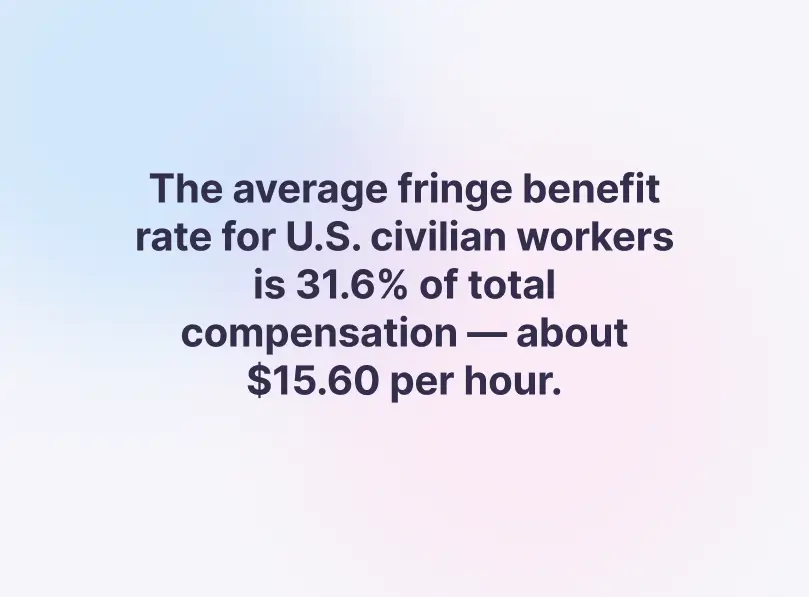
As of this writing, the average fringe benefit rate for civilian workers in the U.S. is about 31.6% ($15.60 per hour) of total employee compensation. This includes benefits like paid leave, insurance, retirement savings, and legally required benefits.
For private industry workers, the average fringe benefit rate is 30.1% ($14.01 per hour) of total compensation. For state and local government workers, the average fringe benefit rate is 38.5% ($25.59 per hour) of total compensation.
Stay up to date on employee pay with Salary.com's Consulting services. Compensation experts will compare your performance to the market, find gaps, and suggest improvements.
It is important to consider your employees' needs and preferences when offering fringe benefits. Here are some types of fringe benefits that are often used to attract, retain, and motivate employees:
Taxable fringe benefits
These benefits are included in an employee's taxable income. Their value is subject to income tax, Social Security tax, and Medicare tax. Examples include:
Company cars
Educational assistance
Housing allowances
Nontaxable fringe benefits
These benefits are perks employees receive that are not taxed. These benefits improve the employee's compensation without raising their taxable income. Examples include:
Life insurance
Retirement plans
Health insurance
De minimis (minimal) benefits
De minimis benefits are a type of nontaxable fringe benefit that are too small or low-cost to track easily. Because they are minimal, they are not included in an employee's gross income or subject to payroll taxes.
Discounts for employees on company products or services
Small gifts or awards
Employee discounts on company products or services
Meals
Ensuring the fringe benefit calculation is accurate is important because it can impact several factors, including:
Ensuring financial compliance: Accurate calculations help your organization follow tax laws, preventing fines and legal problems. Correct fringe benefit calculations reduce the risk of audits and penalties from tax authorities.
Streamlining employee benefits administration: Correct calculations make it easier to manage and distribute employee benefits. This efficiency reduces the workload for HR and ensures employees receive their benefits on time, boosting satisfaction.
Maintaining fair compensation: Accurate fringe benefit rate calculation helps ensure that all employees are paid fairly. Understanding total compensation allows companies to promote fairness and attract talent.
Supporting business planning: Knowing the costs of fringe benefits helps in creating budgets and financial plans. This data allows organizations to allocate resources wisely and plan for future growth.
Improve your benefits program with the help of Salary.com's consultants. Experts will review your setup and turn it into a competitive advantage, considering your budget, industry, current benefits, and employee feedback.
So, how is fringe benefit calculated? Calculating fringe benefits requires a few steps to ensure accuracy and compliance. Note: These steps apply to salaried employees.
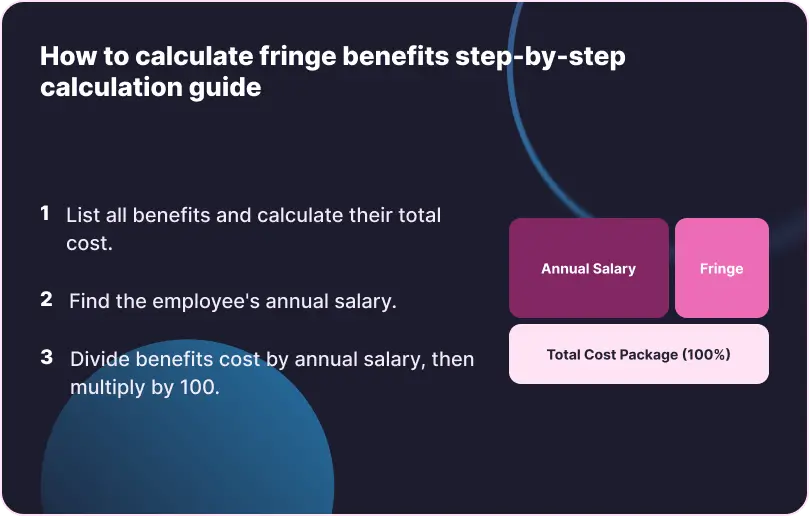
Compile a comprehensive list of all benefits provided to the employee. Once all the benefits have been identified, calculate the total cost for each benefit.
For example, if an employer pays $5,000 for health insurance, $2,000 for retirement contributions, and $1,500 for paid time off, the total cost of fringe benefits would be the sum of these amounts: $5,000 + $2,000 + $1,500 = $8,500.
Find the employee's annual salary, which is the total amount they earn before deductions or taxes. This can be a fixed amount or include extras like commissions or overtime.
For example, if the salary is $50,000 a year, this will be used in the next calculations.
Speaking of employee's compensation, Salary.com consultants help you create fair and effective base pay programs by assessing the market competitiveness and internal fairness of your current pay practices.
To find the fringe benefit percentage of the employee's salary, divide the total benefits cost by the annual salary and multiply by 100. Example calculation: ($8,500/$50,000) x 100 = 17%. This shows that fringe benefits make up 17% of the employee's annual salary.
How about if you're planning to calculate fringe benefits for an hourly employee? Here's how to do it:
Determine the total cost of the employee's fringe benefits: Add up all benefits for the employee, such as health insurance, retirement contributions, and paid time off.
Determine the annual wages of the hourly employee: Multiply the employee's hourly wage by the total hours worked in a year. For example, if the hourly wage is $20 and the employee works 40 hours a week for 52 weeks: Annual wage = 20 x 40 x 52 = 41,600
Calculate the fringe benefit rate: Divide the total cost of benefits by the total hours worked in a year. For example, if benefits cost $8,500 and the employee works 2,080 hours: Fringe benefit rate = 8,500/2,080 = $4.08. This means the employee receives about $4.08 in benefits for every hour worked.
To help you understand fringe benefit calculations, here are two scenarios:
Scenario 1: Casper, salaried employee
Casper earns an annual salary of $60,000. He also receives fringe benefits that add to his compensation, including $5,000 for health insurance, $3,000 for retirement contributions, and $2,000 for paid time off. The total cost of Casper’s fringe benefits is $10,000.
To see how this affects his compensation, we find that his fringe benefits make up about 16.67% of his annual salary. This is calculated as follows: (10,000/60,000) x 100 = 16.67%
Scenario 2: Whisper, hourly employee
Whisper earns $15 per hour and usually works 40 hours a week, which gives her an annual salary of $31,200 (15 per hour x 40 hours x 52 weeks = 31,200) In addition to her hourly wage, she receives fringe benefits totaling $4,000, including $2,500 for health insurance and $1,500 for paid time off. These benefits account for about 12.82% of her total compensation (4,000/31,200) x 100 = 12.82%.
Most fringe benefits are taxable and must be added to the recipient's pay, unless the law excludes them. Examples of taxable fringe benefits include company cars, cash payments, and gym memberships.
However, some benefits, like health benefits, employee discounts, educational assistance, and achievement awards, may be tax-free. These exemptions depend on the type of benefit and specific circumstances.
Employers must calculate the fair market value (FMV) of benefits and report taxable ones on employees' W-2 forms. Certain benefits, like educational assistance, moving expenses, and retirement planning, follow special tax rules.
Now that you know how to calculate fringe benefits, we hope you are ready to assess the total value of employee compensation packages in your organization. If needed, seek help from experts, especially compensation experts, to gain a better understanding of and improve your benefits strategy.

The latest research, expert advice, and compensation best practices all in one place.
Blog
Bringing trusted compensation intelligence and seamless planning to even more ADP users.

Blog
Learn how to train managers for effective pay conversations and build trust.

Blog
Total rewards package flexibility lets employees choose what matters - pay, perks, and benefits tailored to their needs.
