Blog
Get Pay Right on ADP Workforce Now® Next Gen™
Bringing trusted compensation intelligence and seamless planning to even more ADP users.
Written by Salary.com Staff
April 30, 2025

In high-risk roles—whether in military, government service, or specialized federal assignments—certain jobs go far beyond the usual call of duty. From parachute jumping to flying duty, or handling toxic fuels, these assignments come with real danger. To recognize that, hazardous duty pay offers extra compensation. But how is this pay calculated? Who’s eligible to receive it? And what are the tax implications?
This guide breaks down everything you need to know about hazardous duty, including how duty pay is structured, how hazardous duty incentive pay (HDIP) works, and how to calculate your earnings if you’re facing physical hardship as part of your job.
Hazard pay is a form of additional compensation provided to individuals performing tasks that involve risk, danger, or physical hardship. It is designed to reward individuals who routinely face threats to their safety while performing their responsibilities.
Unlike regular basic pay, this extra amount reflects the dangerous environments or conditions that go beyond standard expectations.
For example, military personnel assigned to flying duty, duty involving parachute jumping, or duty involving exposure to hazardous materials receive this pay as an incentive.
The formula to calculate hazard duty pay is: (Base pay) + (hazard pay differential) = employee's total hazard pay.
To ensure your job classification system reflects this accurately, Salary.com offers job evaluation services that help standardize duties tied to hazard levels.
The term “hazardous duty” includes a wide range of assignments or conditions. It refers to responsibilities where safety cannot be adequately alleviated, even when standard safety precautions are followed. This includes, but is not limited to:
Work on a flight deck of an aircraft carrier
Operating ski equipped aircraft in arctic missions
Engaging with live dangerous viruses in laboratory work
Participation in mass destruction civil support operations
Regular involvement in assignments with toxic fuels, flammable agents, or biological risks
Duties can also involve frequent and regular participation in flight duties, high-speed ejection seat testing, or human acceleration experiments. The nature of duty performed must involve real and consistent danger.
The rate of hazardous duty pay depends on the type and duration of the duty performed. For the U.S. military, the Department of Defense outlines a structure called hazardous duty incentive pay (HDIP), which allocates specific monthly payments based on the risk level.
Typically, duties involving physical hardship such as parachute jumping, demolition, or working around explosives may earn between $150 and $225 per month. For flying duty, both aircrew members and non aircrew members may receive between $110 and $250 depending on the complexity and frequency of the missions. These amounts are paid in addition to a member’s basic pay.
For federal civilian employees, duty pay is often calculated as a percentage of the hourly wage. This percentage varies based on the level of hazard and is added to their regular paycheck only for the hours during which the hazardous task is performed. This form of additional pay is regulated by federal policy.
Salary.com provides competitive pay assessment consulting to ensure your incentive structure supports fairness and transparency for all hazardous duty roles.
To qualify, the individual must be on competent orders to perform hazardous duties. Eligibility is generally restricted to those whose assignments place them in direct contact with dangerous conditions as part of their primary duty.
Federal employees become eligible when their assigned tasks involve ongoing risks that cannot be eliminated by normal protective procedures. This includes roles in research, law enforcement, or disaster response that place them in perilous situations. Compensation for these employees falls under the special pay or incentive pay structure set by the Office of Personnel Management.
First responders, particularly those in federal service or special assignments, may qualify for duty pay if their role entails significant hazard. Entering burning buildings, handling explosives, or intervening in violent confrontations regularly can make these personnel eligible for extra compensation.
Military service members receive hazardous duty incentive pay for missions or postings that meet the risk criteria. These include duty involving explosive materials, toxic exposure, or low pressure chamber duty. HDIP is commonly used for personnel in flight pay, demolitions, or specialized combat training roles. Participation must be ongoing and part of the individual’s operational requirements.
Eligibility is rooted in job responsibilities, physical exposure, and formal orders for military or government employees. Salary.com’s total rewards strategy consulting helps employers craft comprehensive pay and benefits programs that reward employees fairly and appropriately.
To accurately calculate hazardous duty pay, determine the duty type, eligibility, and applicable rates:
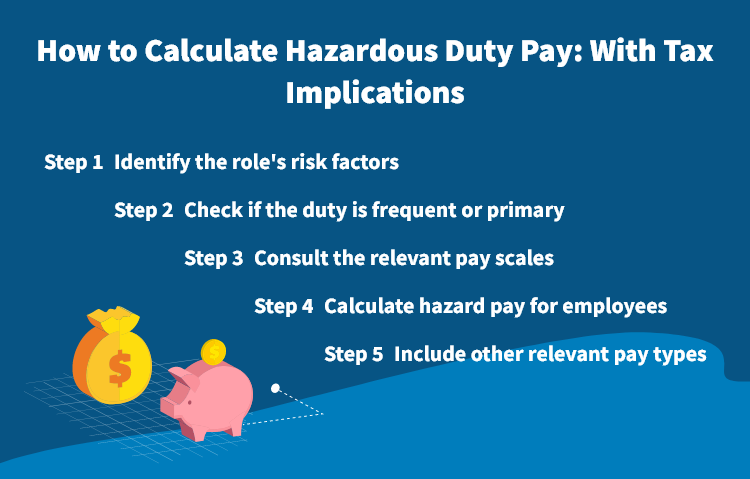
Identify whether the role includes duty involving toxic substances, physical threat, or is performed under extreme physical discomfort. Jobs that fall into these categories typically qualify for additional compensation.
Check if the duty meets the threshold of frequent and regular participation or involves a primary duty. Frequent exposure to hazardous conditions is qualified for additional pay.
For both military and civilian employees, it's important to consult the appropriate pay scales or compensation guidelines to determine the correct hazard pay. For military personnel, this is typically the DoD pay scale for HDIP, which categorizes roles such as aircrew duties, parachute jumping, or hazardous materials handling.
For example, if an employee earns $45/hour and works in a high-risk environment with a 25% hazard differential, the calculation would be: $45 x 0.25 = $11.25 in hazard pay for each hour worked in hazardous conditions.
Include any other incentive pay or special pay relevant to the position. This could include flight pay, environmental pay, or imminent danger pay for both military and civilian employees.
To fully understand how to calculate hazard pay, here’s a sample scenario.
Let’s say a service member is on active duty and performs duty involving parachute jumping under competent orders. This primary duty is performed regularly as part of their assignment with an airborne unit.
Base monthly pay (E-5 rank, 4 years of service): $3,058.20
Hazardous duty incentive pay (HDIP) for parachute jumping: $150/month
Other incentives (e.g., flight pay, if applicable): $0
Calculation:
Total monthly compensation = basic pay + HDIP
$3,058.20 (basic pay) + $150 (parachute HDIP) = $3,208.20/month
Now, if this service member was temporarily reassigned and only completed parachute jumps for 15 days out of a 30-day month, the duty pay would be prorated.
Prorated HDIP for 15 Days:
$150 ÷ 30 = $5 per day
$5 × 15 = $75 HDIP
Total Pay with partial month HDIP = $3,058.20 + $75 = $3,133.20
Here’s another scenario:
A federal scientist performs laboratory work handling live dangerous viruses. Their regular hourly rate is $45. The Office of Personnel Management designates this type of work for 25% hazard differential pay during hours the risk is present.
If the scientist spends 30 hours that month in direct hazardous exposure:
$45 × 0.25 = $11.25 (hazard premium per hour)
$11.25 × 30 hours = $337.50 in hazardous duty pay
So, the total hazardous compensation for that month would be $337.50 added to their basic pay.
For employers designing pay structures involving special duties or physical hardship, Salary.com offers compensation and benefits program design services to help implement accurate, compliant, and competitive pay models tailored to your workforce needs.
To apply for hazardous duty pay, military members need competent orders confirming their assignment to a qualifying hazardous duty. Federal employees must submit documentation through HR detailing the duty involving risk or hardship. Once approved, the pay is added to their regular compensation.
Applications generally begin with a supervisor’s verification and documentation that the individual is performing qualifying duties. For military service members, orders must specify their participation in duty involving risk. Civilian applications are routed through HR departments with supporting evidence and logs detailing the duty pay hours.
Documentation should include the nature of the task, duration, and any protective measures in place. Additional details like maritime visit, use of toxic fuels, or interaction with non crew members may also be included to establish context.
Normally, hazard pay is considered taxable. However, if the service member is assigned to a designated combat zone, it can be excluded under the imminent danger pay tax provision. This rule exempts qualifying pay types, including duty incentive pay HDIP, from federal taxation.
In contrast, civilian employees do not typically receive tax exemptions unless they’re embedded in official overseas missions or conflict zones. Consult a tax professional to ensure correct reporting.

The latest research, expert advice, and compensation best practices all in one place.
Blog
Bringing trusted compensation intelligence and seamless planning to even more ADP users.

Blog
Learn how to train managers for effective pay conversations and build trust.

Blog
Total rewards package flexibility lets employees choose what matters - pay, perks, and benefits tailored to their needs.