Blog
Get Pay Right on ADP Workforce Now® Next Gen™
Bringing trusted compensation intelligence and seamless planning to even more ADP users.
Written by Salary.com Staff
June 27, 2025

Nowadays, many employers in several industries require their staff to be available outside regular working hours, ready to respond to urgent needs or emergencies. This practice, known as on-call duty, raises important questions about compensation, employee rights, and legal compliance, most especially in California, where labor laws are robust.
According to the Bureau of Labor Statistics (BLS), there were a total of 2.8 million on-call workers as of 2023. The sheer size of workers is a significant reason why understanding on-call pay, FLSA travel time, and related regulations is crucial for both employers and employees.
In this comprehensive guide, we will walk you through everything you need to know about calculating on-call salaries for hourly employees. How does it work? Who qualifies for it? And how do you calculate it, considering a special focus on California law and federal standards? Let’s find out!
On-call pay refers to the compensation provided to employees who are required to be available to work outside their regular working hours. This typically means the employee must be reachable and ready to perform job duties at short notice, even if they are not actively working during the entire on-call period.
Industries that require round-the-clock availability, such as healthcare, public safety, construction, and emergency services, typically provide on-call pay for their employees, prompting the salary planning strategies of such organizations to adjust accordingly.
On-call pay applies when an employee is required to remain available—either at the employer’s premises, at home, or within a certain geographical area—to respond quickly to work demands. The specifics of how on-call salary works may depend on several factors:
Location: Is the employee required to stay at the employer’s premises, or can they remain at home?
Restrictions: Are there any types of excessive geographical restrictions, such as the FLSA travel time, or even the employer’s rules that limit the employee’s freedom?
Frequency of calls: Are frequent calls or tasks expected during the on-call period?
Ability to engage in personal matters: Can the employee use their free time for personal matters, or is their freedom unduly restricted?
The more restrictive the on-call conditions are, the more likely the time spent will be considered “hours worked” according to the Fair Labor Standards Act (FLSA) and California law, making it compensable.
It’s important to emphasize that, unfortunately, not every on-call employee is entitled to additional pay, and it's on a case-by-case basis. The determination depends on a lot of factors, such as the nature of the on-call arrangement, nonexempt employees, company policies, and especially the applicable on-call pay laws:
Fair Labor Standards Act (FLSA)
This is the most common and applicable federal law for on-call salaries. The Fair Labor Standards Act (FLSA) requires employers to pay employees at least the minimum wage for all “hours worked,” including certain on-call hours. Certain provisions include:
If an employee is “engaged to wait” (i.e., their time is predominantly for the employer’s benefit and they cannot use it freely for personal activities), that working time is considered compensable.
If an employee is “waiting to be engaged” (i.e., they can use their time freely and only need to respond occasionally), that waiting time may not be compensable.
California Law
California’s labor standards are often more protective than federal law. The state considers not just the employer’s rules but also the employee’s ability to engage in personal activities during on-call time.
California courts have ruled that if the employer’s restrictions are unduly restrictive, such as requiring employees to remain within a short distance, respond within a few minutes, or prohibit personal activities, the on-call time is considered hours worked and must be compensated.
Overtime pay applies if the total actual hours worked, including on-call hours, exceed 8 in a day or 40 in a week. Using the Compensation Planning Software allows you to easily handle even the most complex incentive programs and develop a strong rewards system.
Calculating on-call salary requires a systematic approach to ensure compliance with both federal and state laws. Here’s a step-by-step guide you can follow:
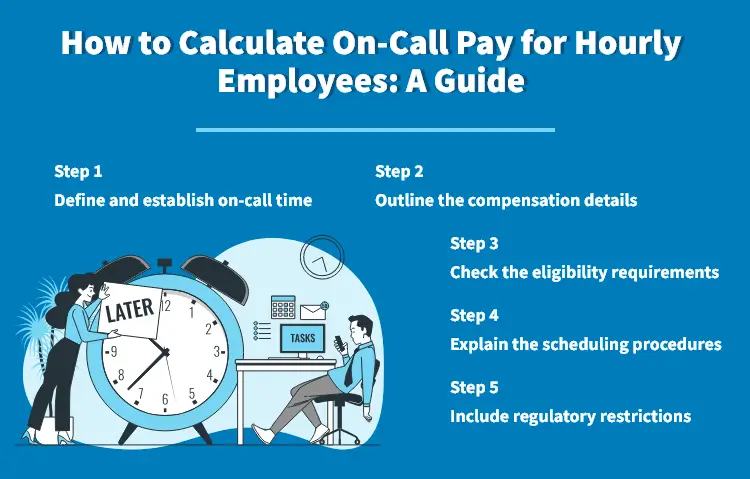
Make sure to clarify on-call expectations. Try to clearly define what determines on-call time for your organization—Is the employee required to remain at the employer’s premises, at home, or within a certain distance?
Next, set the pay rates. Decide whether to pay the regular hourly rate, a reduced rate, or a flat fee for on-call hours. Remember, actual hours worked (when the employee is called in) must be paid at least minimum wage, and overtime pay applies as required.
You may also include the FLSA travel time, which applies if an employee's location is far from the employer's location. Therefore, he is required to travel during an on-call shift. This travel time may also be compensable under FLSA travel time rules.
Finally, determine the compensable hours. Assess whether the on-call time is considered “hours worked” under the FLSA and California law. If the employee’s freedom is significantly restricted, all on-call hours may be compensable.
Review the job roles within your organization. Certain industries and job roles may have specific rules or exemptions, so review the FLSA regulations and California wage orders for your industry.
Moreover, make sure to identify non-exempt employees because only they (those eligible for overtime under the FLSA) are entitled to an on-call salary.
Compensation Planning Software can help you streamline your company’s pay practices and cover even the most complex rewards systems, like on-call pay. It offers a tailored approach that will perfectly fit your unique needs and preferences.
Ensure you communicate schedules clearly. Provide employees with advance notice of on-call shifts, including start and end times, response expectations, and any required check-ins. In addition to that, you can consider giving employees more time or allowing personal matters.
Finally, stay up to date by regularly reviewing federal and state laws, as well as court decisions, to ensure your on-call salary policies remain compliant. Most importantly, document everything—keep detailed records of on-call hours, actual work performed, and compensation provided.
Let’s look at some practical examples to clarify how on-call salary is calculated under different scenarios:
A hospital requires a nurse to remain in the on-call room at the hospital for a 12-hour overnight shift. The nurse may rest or read but must respond to calls within 2 minutes.
Analysis: The nurse’s freedom is significantly restricted since he must remain at the employer’s premises and respond quickly. Therefore, all 12 hours spent on-call are considered “hours worked” under the FLSA and California law.
Solution: If the nurse is paid $30/hour:
Total on-call pay = 12 hours x $30 = $360
Take note: If the nurse works more than 8 hours a day, overtime pay applies.
An IT technician must be available by phone from home between 6 p.m. and 6 a.m., respond within 10 minutes, and remain within 5 miles of the office.
Analysis: The technician’s ability to engage in personal activities is restricted since he cannot travel beyond 5 miles and must respond quickly. California law likely considers this time compensable.
Solution: If the technician is paid $25/hour:
Total on-call pay =12 hours x $25 = $300
Take note: Overtime pay may apply if total hours exceed daily/weekly limits.
A utility worker, earning $20/hour, is called in during an on-call shift and must travel 30 minutes each way to the work site.
Analysis: Under FLSA travel time regulations, travel time required by the employer is compensable.
Solution: If the worker spends 1 hour traveling and 2 hours working:
Total compensable hours = 3 hours
Total on-call pay = 3 hours x $2 = $60
Understanding and correctly calculating on-call salary is essential for compliance with both the Fair Labor Standards Act (FLSA) and California’s more stringent labor laws. By following these guidelines and using real-world examples, you can ensure fair compensation for on-call employees, avoid legal pitfalls, and foster a more transparent and compliant workplace.

The latest research, expert advice, and compensation best practices all in one place.
Blog
Bringing trusted compensation intelligence and seamless planning to even more ADP users.

Blog
Learn how to train managers for effective pay conversations and build trust.

Blog
Total rewards package flexibility lets employees choose what matters - pay, perks, and benefits tailored to their needs.