Blog
Get Pay Right on ADP Workforce Now® Next Gen™
Bringing trusted compensation intelligence and seamless planning to even more ADP users.
Written by Salary.com Staff
June 26, 2026

Total direct compensation represents the core monetary rewards an organization puts forth for employees according to their performance and contributions. As an HR professional, understanding and effectively managing this critical element will aid in attracting top talent and effectively realizing business results all while maintaining sound pay practices throughout the workforce.
The following article covers the topic of total direct compensation including definition, calculation methods, design elements, and strategies specifically tailored to US-based HR leaders and professionals.
Total direct compensation (TDC) considers the elements of cash and cash-equivalent rewards that employees directly see and receive in relation to their role and results. Components like health insurance and retirement programs are left out.
For HR departments, TDC breaks down the various elements of direct compensation that employees earn as a result of their role. This metric also allows them to see how competitive the role is in relation to the labor market.
TDC considers both types of variables when defining the total pay that should be offered to candidates to ensure it is competitive in the market. Companies can separate the base salaries that all employees will receive from performance incentives.
For sales roles, there will be more of an emphasis on the commissions that they earn over time. At higher levels of management, long-term incentives for employees will be offered. All of these components should be accounted for in the job offer and compensation plan for the role. These compensation plans will be calibrated regularly within the company.
The following components may be included in the total direct compensation for employees:
Base salary or hourly wages
Short-term incentives, such as bonuses
Variable pay, such as sales commissions
Target value of long-term incentives
Other cash allowances
Execution of these components requires a system that ensures accuracy and consistency. CompXL® manages merit increases, bonuses, commissions, and equity awards in one system. Use CompXL® to manage incentive payouts correctly.
TDC features the target value of long-term incentives and equity offerings. Total cash compensation instead reviews actual base pay levels and short-term bonuses alongside realized commissions without future equity grants.
This aspect is critical in understanding roles and pay offers. Candidates typically evaluate TDC for growth potential while payroll considers "cash" elements for budgeting considerations. Understanding total direct vs. total cash prevents misalignment in compensation planning.
| Aspect | Total Direct | Total Cash |
|---|---|---|
| Includes Base Pay | Yes | Yes |
| Short term Incentives | Yes (target or actual) | Yes (actual payouts) |
| Long term Incentives/Equity | Yes (target value) | Usually No |
| Focus | Full performance aligned pay opportunity | Immediate cash received |
| Use Case | Planning and benchmarking | Actual earnings analysis |
This table yields benefits regarding accurately communicating total opportunity during recruitment processes and performance reviews.
To calculate total direct compensation (TDC) of an employee accurately, all forms of targeted rewards must be accounted for.
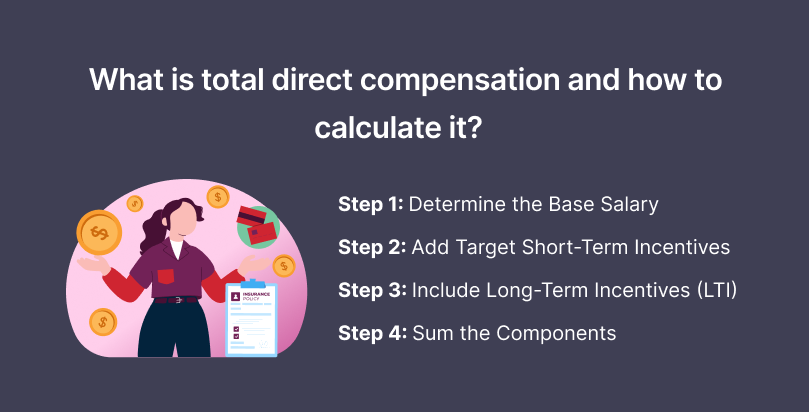
2.1 Step 1: Determine the Base Salary
For salaried employees, the salary will be the employee's annual rate. For hourly employees, the hourly rate will be multiplied by the number of hours they are expected to work annually (typically 2,080 hours for full-time roles).
To ensure the base salary used in this step reflects real market conditions rather than internal estimates, HR teams rely on compensation benchmarking tools such as CompAnalyst Market Data. It provides extensive salary insights across job titles, industries, and regions, helping organizations validate that base pay levels are aligned with current market standards before including them in TDC calculations.
2.2 Step 2: Add Target Short-Term Incentives
These are typically bonuses or sales commissions that employees may earn within the performance year.
2.3 Step 3: Include Long-Term Incentives (LTI)
These are awards of stock options, restricted stock units (RSUs), or performance shares granted or allocated for the performance period, typically valued at their grant-date fair value.
2.4 Step 4: Sum the components
Add all the calculated values together to determine the employee's TDC.
Formula: TDC = Base Salary + Target Short-Term Incentives + Target Long-Term Incentives
CompAnalyst® helps HR teams combine base pay, incentives, and long-term compensation into a structured TDC model supported by market benchmarking and compensation planning tools. Use CompAnalyst® when finalizing TDC calculations for accuracy and consistency.
The process should include all aspects of creating a well-balanced compensation offering including considerations for competitiveness but also affordability. Every HR leader should develop a philosophy for total pay that reflects company culture and needs. This then provides a solid foundation for departmental decisions.
Best practices for design include:
Aligning pay elements and mix with role and business objectives
Incorporating performance metrics that impact key results
Ensuring clear and transparent communication practices
Regularly benchmarking against reliable market data sources
Providing flexibility mechanisms to respond to economic changes
The resulting structure can help maximize both employee retention and motivate all levels of staff members.
Market pricing considerations map internal roles against external salary data. The sources should be reputable and relevant to the industry, company size, and role location. Jobs should be accurately matched using detailed position descriptions rather than job titles alone.
Salary ranges should feature minimum, middle, and maximum values. The company's positioning within this range, such as at the 50th or 75th percentile, should reflect talent strategies. Such market benchmarks should be updated at least annually.
The pay mix should naturally differ according to the role type. Entry level positions may feature higher base salary elements for stability while executives or sales roles offer more variable pay. Targets for incentives may be set as percentages of base pay: 10-20% for managers, 50%+ for executives.
Clear guidelines and approval processes should guide such pay structures. Each element should be documented to promote internal equity reviews.
Long term incentives can appropriately be valued at grant date fair values, such as using Black Scholes models for options or current stock prices for restricted stock units. Vesting and performance schedules also factor here. For planning efforts, target values and market data are best used.
Realistic communication of potential value considers both benefits and risk elements. This helps employees understand the full opportunity within TDC packages.
According to WTW research of S&P 1500 CEOs, the target TDC growth rate declined slightly in 2024 to 5.3%.
A fair management process builds trust with employees and minimizes turnover risks. Processes for compensation reviews, adjustments, and audits should be implemented. Regular performance analyses help prevent gaps in any given workforce.
Key management steps include:
Conducting annual compensation reviews
Monitoring actual vs. target payouts
Addressing compression or outliers quickly
Ensuring management team understands proper application of pay elements
Maintaining detailed documentation records
Targets established during planning should be compared against TDC payouts at the end of the year. Such comparisons help reveal year-end performance elements or external factors. This becomes valuable for tailoring future compensation targets.
Sharing insights with leadership teams ensures pay is even more effectively linked to organizational results. Tools such as dashboards help track such elements across groups of employees.
Pay equity analyses can occur according to protected characteristics and comparable positions such as gender or race-based data for similar positions. Internal equity focuses upon providing fair differences based upon experience, performance, or skills. Both can best be assessed through statistical analysis or regression tools for deeper insights.
Any findings that merit adjustment should be acted upon. All processes should be well documented to ensure legal and equity-based confidence within the organization.
Here are the common questions about the topic:
A good total package aligns well with market benchmarks for the role and company. The total pay element offers competitive base plus incentive structures. The specific "good" level may differ, but targets within the 50th and 75th percentile ranges are common for key talent.
No, the annual salary element is only the base figure. TDC also features target bonuses and long-term incentive elements.
The TDC model presents the fullest possible view of rewards potential critical for performance alignment and benchmarking. The approach helps attract talent aiming for growth opportunities beyond fixed salary offers.
Base salary, target incentives, and equity grants as well as actual yearly elements where relevant. Contextual notes on how each part ties to performance or market considerations will yield the most clear and personalized pay statements.
Structures and benchmarks can be reviewed annually. Higher attrition roles or markets may warrant more frequent checks. Individual employee reviews typically happen within performance or promotion cycles.

The latest research, expert advice, and compensation best practices all in one place.
Blog
Bringing trusted compensation intelligence and seamless planning to even more ADP users.

Blog
Learn how to train managers for effective pay conversations and build trust.

Blog
Total rewards package flexibility lets employees choose what matters - pay, perks, and benefits tailored to their needs.