Blog
Get Pay Right on ADP Workforce Now® Next Gen™
Bringing trusted compensation intelligence and seamless planning to even more ADP users.
Written by Salary.com Staff
August 21, 2026

Every pay decision impacts executives, finance leaders, managers, and employees. The project management team that fails to understand how much influence each group has sees programs stall. Such an analysis is critically important because it helps HR professionals identify stakeholders, analyze them, and involve them before embarking upon any initiative.
This guide provides information about the fundamentals, with examples of a stakeholder analysis process and includes a free stakeholder analysis template.
Stakeholder analysis is the process of identifying every person and group that either influences or is affected by a given initiative. In project management and compensation, this means mapping out who the potential stakeholders are and understanding the concerns, interests, and business interests of each prior to introducing any changes.
| Component | Description |
|---|---|
| Stakeholder identification | Listing all individuals and groups affected by the initiative |
| Stakeholder assessment | Evaluating each stakeholder's power, interest, and attitude |
| Prioritization | Ranking stakeholder groups by required engagement level |
| Strategy development | Creating tailored communication strategies per stakeholder |
HR professionals use this process to reduce risk and address stakeholder concerns. A recent report found that 51% of organizations struggle to balance constrained budgets with rising stakeholder expectations. Not all stakeholders carry the same weight, so knowing who shapes the project plan and who communicates changes to project team members helps improve project outcomes.
Both internal stakeholders and external stakeholders play a role. Primary stakeholders are directly involved, while secondary stakeholders are indirectly affected but still important stakeholders to consider.
Executive leadership (CEO, CFO, CHRO): The project sponsor group that approves budgets and sets direction.
Finance team: Validate affordability and model cost scenarios to support project goals.
People managers: Deliver compensation decisions and need rationale to manage stakeholder satisfaction.
Employees and ERGs: Community groups whose perceptions drive retention and stakeholder participation.
Legal, compliance, and regulatory bodies: Ensure regulatory compliance with federal and state requirements.
Board or compensation committee: Other key stakeholders with a vested interest in executive pay and economic development.
Consider an HR team overhauling its pay structure to address equity gaps. Before designing new pay bands, they map every project stakeholder across the project lifecycle. This initial analysis ensures no important stakeholders are overlooked.
| Stakeholder | Interest | Power | Strategy |
|---|---|---|---|
| CFO | High | High | Co-design budget scenarios, provide regular updates |
| CHRO | High | High | Align on philosophy, secure executive sponsorship |
| Department heads | High | Medium | Involve in job leveling and market data review |
| People managers | Medium | Low | Train on communicating pay changes |
| Employees | High | Low | Share transparent communication and FAQ documents |
| Legal counsel | Medium | Medium | Consult on pay equity and transparency compliance |
During compensation projects, executives and finance teams often want evidence that proposed salaries are competitive. Market Pricing helps HR professionals compare internal positions against current market compensation data, allowing them to present objective salary benchmarks that support informed stakeholder discussions and compensation recommendations.
For total rewards, the analysis broadens beyond base pay. Benefits administrators, wellness vendors, government agencies, and payroll teams all join the map. Categorize them as definitive stakeholders, influencers, or recipients. As projects evolve, new stakeholders may emerge, so the project manager should revisit the map at each project phase.
The power interest grid is one of the most common stakeholder analysis tools. It plots various stakeholders on two dimensions: authority and personal stake. Using the salience model as a complement, stakeholders fall into four quadrants:
High power, high interest (manage closely): Executive sponsors and the project team. Include them in key decisions.
High power, low interest (keep satisfied): Board members and community leaders needing periodic updates only.
Low power, high interest (keep informed): Employees, community members, and patient advocacy groups needing transparent communication.
Low power, low interest (monitor): External vendors and local communities. Light updates suffice.
Follow these four steps to build a structured process that aligns every stakeholder with your compensation goals from start to finish.
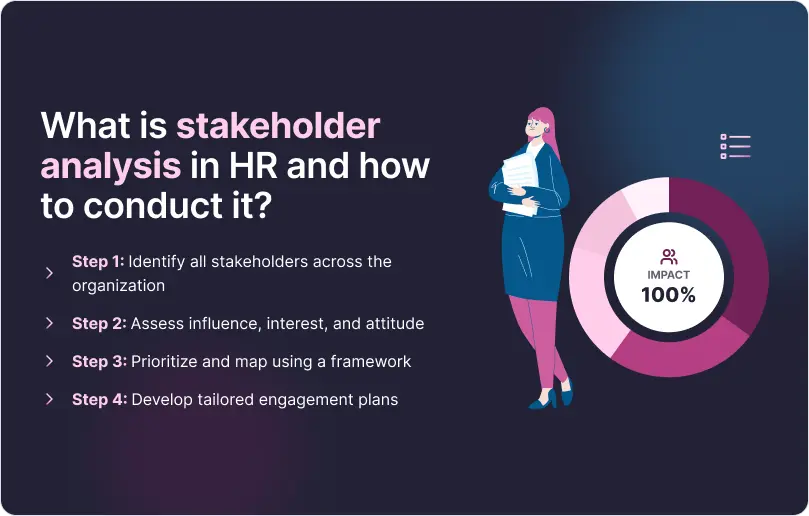
Brainstorm every person and group connected to the initiative using org charts and project charters. A thorough stakeholder identification step captures other key stakeholders like IT teams and recruiters, anyone with a vested interest in the project scope, whether directly involved or indirectly affected.
Identifying the right stakeholders begins with understanding organizational roles and responsibilities. JobArchitect® helps HR teams create standardized job descriptions, organize job families, and maintain consistent role definitions across the organization.
Evaluate three dimensions per stakeholder. Influence measures authority to approve or block. Interest measures how much the outcome affects them. Attitude captures whether they support, oppose, or stay neutral. Once the project manager understood each position, document stakeholder input and begin building stakeholder relationships.
When evaluating stakeholder concerns, reliable compensation data helps build trust and support among executives and finance leaders. CompAnalyst® gives HR teams access to comprehensive market salary data, pay benchmarking, compensation analytics, and modeling tools.
Use the power interest grid to group stakeholders into tiers. Focus deep stakeholder engagement on the high power, high interest quadrant and develop lighter plans for managing stakeholders in lower quadrants. This step is central to conducting stakeholder analysis that drives project success.
Each group needs a specific strategy. Executives might get monthly briefings with budget data, while managers receive training on pay conversations. Research shows 59% of organizations now train managers in these conversations, up from around 50%. Strong stakeholder management across multiple projects starts with tailored plans.
Below is a free stakeholder analysis template you can customize for any compensation initiative. It tracks stakeholder dynamics and the project's progress in one place.
| Stakeholder | Category | Power | Interest | Attitude | Engagement strategy | Frequency | Owner |
|---|---|---|---|---|---|---|---|
| Jane Smith, CFO | Decision maker | High | High | Supportive | Co-design budget scenarios, present cost models | Biweekly | VP of Total Rewards |
| Mark Lee, CHRO | Decision maker | High | High | Supportive | Align on comp philosophy, secure sponsorship | Weekly | Comp Director |
| Regional VPs | Influencer | Medium | High | Neutral | Include in job leveling reviews, gather stakeholder input | Monthly | HR Business Partner |
| People managers | Influencer | Low | Medium | Neutral | Train on pay conversation scripts and FAQs | At rollout | HR Communications |
| All employees | Recipient | Low | High | Mixed | Transparent email updates, FAQ page, town halls | At milestones | HR Communications |
| General counsel | Influencer | Medium | Medium | Supportive | Review pay equity compliance, flag legal risks | Monthly | Comp Director |
Here is a quick breakdown of each column:
Stakeholder: The individual or group name and their title.
Category: Whether they are a decision maker, influencer, or recipient.
Power: Their level of authority over the initiative (high, medium, or low).
Interest: How much the outcome affects them personally or professionally.
Attitude: Whether they are currently supportive, neutral, or resistant.
Engagement strategy: Actions you will take to build or maintain support.
Frequency: How often you will communicate (weekly, monthly, at milestones).
Owner: The project team member managing that relationship.
Use a RACI framework (Responsible, Accountable, Consulted, Informed) alongside your template. The CHRO might be accountable for comp philosophy, finance consulted on budgets, and managers informed once final. Mapping decision rights for different stakeholders eliminates ambiguity across project phases.
Here are the common questions about the topic:
Analysis is the full process of identifying, assessing, and strategizing around stakeholders. Mapping is one step where you plot them on a grid. Mapping is the tool; analysis is the methodology.
Identify all stakeholders, assess their influence and interest, prioritize using a framework like the power interest grid, and develop tailored engagement plans.
Keep it visual. Use the power interest grid as your anchor, supported by a summary table of stakeholders and engagement plans. Focus your narrative on risk reduction and project success.
Excel or Google Sheets work for most teams. Platforms like Smartsheet offer built in tracking, and salary.com provides compensation data that supports the analysis. Many HR teams pair RACI charts with the power interest grid
Revisit at every major milestone: budget approval, design finalization, and rollout. As stakeholder dynamics shift with organizational changes, review quarterly for long running initiatives and treat it as a living document.

The latest research, expert advice, and compensation best practices all in one place.
Blog
Bringing trusted compensation intelligence and seamless planning to even more ADP users.

Blog
Learn how to train managers for effective pay conversations and build trust.

Blog
Total rewards package flexibility lets employees choose what matters - pay, perks, and benefits tailored to their needs.