Blog
Get Pay Right on ADP Workforce Now® Next Gen™
Bringing trusted compensation intelligence and seamless planning to even more ADP users.
Written by Salary.com Staff
October 09, 2026

A strong resume can get a candidate noticed, but it cannot tell you how they'll perform on the job. Can they solve problems under pressure, lead a team through challenges, or handle conflict with confidence?
Our Skills Library helps with skills-based pay by quickly grouping similar jobs with the same skills.
Competency assessments help HR teams answer these questions by measuring the skills and behaviors that matter for the role. They give hiring teams a clearer picture of what candidates can actually do beyond their job titles, degrees, and years of experience.
In this article, we'll take a closer look at what competency assessments are, the examples and methods you can use, and how HR can conduct them effectively.
Competency assessments measure the skills, knowledge, and behaviors employees need to succeed in a role. This type of assessment looks beyond basic skills tests. It considers technical knowledge, soft skills, and job-specific behaviors in real work situations.
To see why this matters, it helps to understand the difference between a skills assessment and a competency assessment. Although often used interchangeably, they measure different things:
Skills assessments measure specific abilities, like writing code or creating spreadsheet formulas.
Competency assessments evaluate how skills are applied in context. They also consider communication skills, teamwork, and problem-solving in changing job situations.
But the challenge most HR teams run into is knowing which competencies actually matter for a given role and keeping that definition consistent across the organization.
A platform like Skills Library gives HR teams a database of jobs, skills, and competencies to start with. This makes defining the right competencies easier, without starting from scratch or using outdated job descriptions.
A competency assessment that's well-designed does more than just support hiring decisions. HR teams get a clear and consistent way to evaluate people, identify gaps, and make better decisions about their workforce.
Helps reduce hiring bias
Candidates are evaluated based on the same competencies, not gut feelings or impressions from their resume. And that creates a more consistent and fair process.
Improves hiring decisions
Competency assessments show whether a candidate has the skills and behaviors needed for a role, instead of focusing only on job titles or past experience.
This approach is becoming more common now. SHRM found that 73% of organizations that removed degree requirements for some roles hired at least one candidate they would have previously rejected as unqualified.
Add skills and competency data from our Skills Library to attract the right candidates.
Supports internal mobility
With clear competency requirements, employees understand what they need to develop to move into new or higher-level roles. Managers can identify strong internal candidates for open positions too.
Improves performance reviews
Reviews are more objective when managers can evaluate employees against clear, observable competencies instead of general impressions.
Helps close skills gaps
Competency assessments show which specific skills employees have and where they need development, helping HR create more targeted training plans.
This is especially relevant because 30% of workers say they need additional education or training to get ahead in their job or career.
Helps improve workplace safety
In hands-on or safety-sensitive roles, competency assessments confirm that employees can perform tasks correctly, not just that they've completed a course or hold a certification.
Supports succession planning
Competency data helps HR identify employees ready for larger roles and those who need more development.
No single approach works for competency assessments. HR teams often use a mix of methods based on the role and the core competencies they want to measure.
360-degree feedback
Collects feedback from managers, peers, direct reports, and sometimes clients. This gives a broader view of how an employee works with others.
Self-assessments
Employees assess their skills and behaviors against set competencies. HR and managers can use the results to identify development needs and compare self-perception with actual performance.
Behavioral interviews
Candidates or employees describe situations where they used a specific competency, like resolving conflicts or meeting deadlines. This helps show how they've handled similar situations in the past.
Skills tests and simulations
Ask candidates or employees to complete tasks similar to those they would perform on the job. For example, a software developer might write code, while a customer service representative might handle a mock customer call. This shows what someone can actually do.
Manager evaluations
Managers assess employees on role-specific competencies. These evaluations are often part of regular performance reviews.
Assessment centers
Employees or candidates complete exercises, group activities, and simulations. This method is often used for leadership roles or important hiring and promotion decisions.
Observation-based checks
A manager or evaluator observes someone performing a task and compares it to standards. This is common in industries such as construction and manufacturing, where safety and proper procedures are especially important.
Running a competency assessment well takes some planning. Here are simple steps to run one effectively:
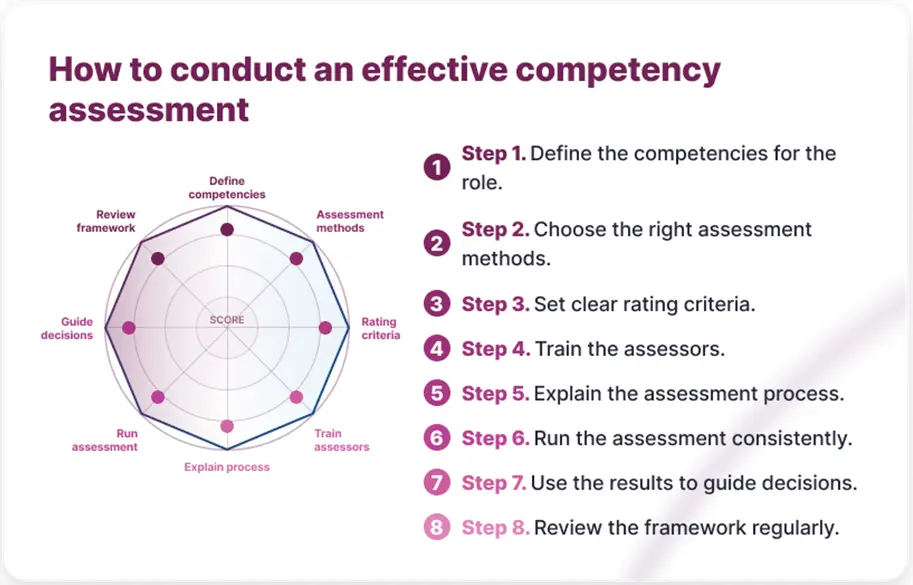
Identify the skills and behaviors that lead to success in the role with hiring managers. Focus on what employees need to do, not just what looks good.
Define competencies as observable behaviors. For example, "communicates well" is hard to measure, but "clearly summarizes findings in team meetings" is much easier.
Salary.com's Skills Library can help you identify relevant skills and keep job descriptions and competencies aligned across the organization.
Choose methods that match your measurement goals. For example, a technical role may need a skills assessment, while a leadership role may benefit from 360-degree feedback and behavioral interviews.
Decide on a scoring method for each competency before the assessment. Everyone should use the same criteria to keep results fair and consistent.
Make sure managers and interviewers understand the competency framework and know how to use it. This reduces personal bias and ensures consistent standards.
Tell employees or candidates why they're being assessed, how the results will be used, and who will have access to them. Clear communication can build trust in the process.
Assess competency consistently by providing the same instructions, tools, and time. A consistent process makes it easier to compare results across employees and teams.
Assessment results should inform action. HR can use them to create development plans, support promotion decisions, or review pay.
Combining competency data with market pay data through a platform like CompAnalyst® can also help HR keep pay aligned with the skills employees show.
Roles and business needs change, so competency frameworks should be reviewed regularly. If the results no longer match how employees perform their jobs, it may be time to update the competencies or retrain assessors.
Here are frequently asked questions related to the topic:
It depends on the method. A self-assessment or manager evaluation might take less than an hour, while an assessment center can span a full day or more.
Ideally, HR, hiring managers, and sometimes senior leaders or subject-matter experts should all weigh in, since each brings a different view of what success in a role looks like.
Yes. Many organizations use them for performance reviews, promotion decisions, succession planning, and identifying training needs across their current workforce.

The latest research, expert advice, and compensation best practices all in one place.
Blog
Bringing trusted compensation intelligence and seamless planning to even more ADP users.

Blog
Learn how to train managers for effective pay conversations and build trust.

Blog
Total rewards package flexibility lets employees choose what matters - pay, perks, and benefits tailored to their needs.