Blog
Get Pay Right on ADP Workforce Now® Next Gen™
Bringing trusted compensation intelligence and seamless planning to even more ADP users.
Written by Salary.com Staff
June 05, 2026

Earnings per share remain a vital metric for analyzing a company’s financial performance, pay equity analysis is the cornerstone of HR and compensation departments.
Performing a pay equity analysis helps spot and fix discrepancies in employee pay to ensure everyone doing similar work is paid the same.
This guide aims to provide you with an understanding of pay equity analysis and how to implement it in your company effectively.
Pay equity analysis compares how much employees earn with others doing similar work. It analyzes whether there are unfair differences in pay based on factors like gender and race. The goal is to ensure that all employees are paid fairly based on the value of their jobs.
It’s not just about equal pay for the same job. It’s about ensuring that individuals are paid according to the skills and responsibilities of the job. Data and statistics will be pulled to expose the injustice of the market for specific jobs. This will create a more just workplace for all individuals involved.
For global consistency, CompAnalyst® Global Data enables benchmarking across different countries. It was included because multinational organizations must ensure pay equity across regions.
Conducting pay equity audit brings several clear advantages that strengthen your organization from the inside out.
It can boost the morale and engagement of your employees as they feel valued in their positions within the company.
It will aid in your ability to attract and retain quality employees as you show care for their pay and equity within the company.
It will lower the risks associated with your company by avoiding pay gaps between employees.
It will improve the productivity and innovation of your company as employees will focus on their work instead of the way in which they are treated within the company.
Pay equity audit and pay transparency work hand in hand to build trust in your compensation practices.
It provides you with solid data to show your employees how you determine salaries for employees.
It allows for open conversations between managers and employees regarding salary.
It helps your business stay in compliance with new laws regarding pay transparency.
It gives you the opportunity to show your dedication to providing fair pay to all of your employees.
The pay equity audit follows a clear set of steps that any HR team can manage with the right focus and data.
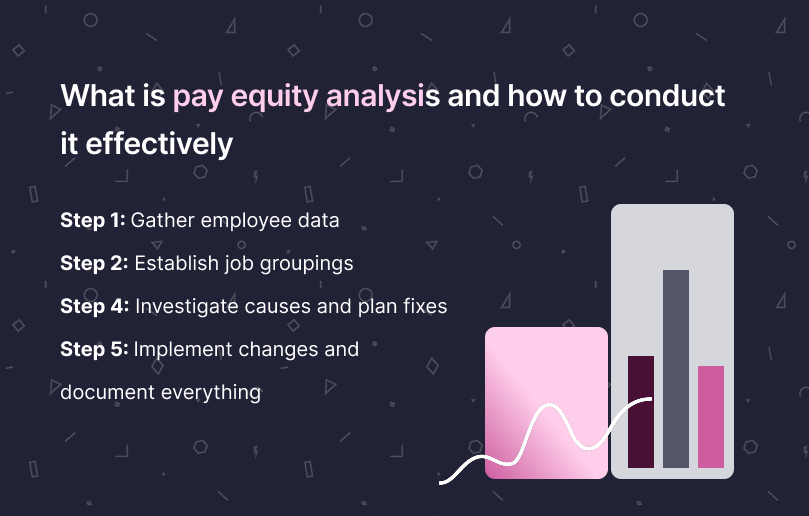
Collect information on each employee in the company. Gather information about their job title, salary, bonuses, experience, education, and demographics. Make sure that the information is private and accurate. Knowing about each employee will give you an understanding of the current pay structure in the company.
CompAnalyst® streamlines the collection and analysis of compensation data, making it easier to work with accurate and reliable information, as strong data accuracy and analysis are essential for this step.
Group jobs with similar skills, effort, and responsibility into pay grades or bands. Create clear criteria for making comparisons between jobs. Avoid using job titles alone as they may not reflect the true duties of the job. This step forms the base for identifying pay gaps.
Compare pay inside each group and run simple stats or regression checks to find differences. Look at averages, medians, and unexplained gaps after your account for experience or performance. Flag any patterns tied to protected categories. This step shows where action is needed.
Review the gaps to see if they come from legitimate reasons or from bias in hiring, promotions, or reviews. Talk with managers if needed and build a budget-friendly plan to close unjustified gaps. Include back pay or policy changes where it makes sense. This step turns findings into real improvements.
CompAnalyst® Pay Equity Suite identifies and resolves pay inequities, directly supporting effective remediation planning and execution.
Make the pay adjustments, update your policies, and tell employees about the process in simple terms. Keep records for compliance and future reviews. This step locks in the gains and sets you up for ongoing success.
Pay equity audit fits smoothly into your overall compensation strategy when you treat it as a regular part of decision making.
It allows you to update your salary bands to reflect both internal and external market rates for your positions.
It can help with job evaluations to ensure that your jobs are correctly valued as your business grows.
It allows for better budgeting for your company as it can plan salary adjustments in advance.
It ensures that salary structures align with your company values.
Adjusting salary bands with market pay data keeps your structure fair and competitive after a pay equity review.
Use market survey results to determine realistic ranges for pay for each position.
Raise the low end of the pay range for underpaid groups to ensure that new hires and current employees are compensated accordingly.
Use simple pay structures to test the budget impact of adjusting pay rates.
Update your pay range data every year to account for changes in the job market and workforce.
Incorporating pay equity findings into job evaluation makes sure roles get valued the right way from the start.
Add equity questions to your job scoring process so factors like skill and responsibility stay free of bias.
Re-evaluate jobs that show gaps and adjust points or grades to match actual work demands.
Train evaluators use consistent criteria, so future reviews stay fair and easy to defend.
Link evaluation results directly to pay bands, so changes flow naturally into your compensation system.
Monitoring pay equity over time keeps your practices strong as the company and workforce evolve.
Set up quarterly or yearly reviews to catch new gaps before they become big problems.
Use simple dashboards to track progress and share updates with leadership in plain numbers.
Adjust policies when you spot patterns from hiring, promotions, or performance reviews.
Celebrate wins publicly to show employees that fairness stays a top priority year after year.
Tracking progress with HR analytics and reports gives you clear proof that your efforts are working.
Build easy reports that show pay gaps by group and highlight improvements after each adjustment cycle.
Use regression tools inside your HR system to measure how much unexplained differences have shrunk.
Share summary dashboards with managers so they see the link between equity and team performance.
Set small targets each year and review them in your compensation planning meetings.
Maintaining internal equity as the workforce changes stops new gaps from forming during growth or turnover.
Review pay for every new hire and promotion against current staff in the same job group.
Train hiring managers to use set salary ranges and avoid personal negotiations that create unfair differences.
Run a quick equity check whenever someone leaves or a big reorganization happens.
Keep job descriptions up to date so groupings stay accurate as roles evolve.
Here are some FAQs for better understanding.
Pay equity audit and a market salary survey both deal with pay but serve different purposes for compensation teams.
| Aspect | Pay Equity Analysis | Market Salary Survey |
|---|---|---|
| Focus | Checks fairness inside your own company for similar jobs | Compares your pay to what other companies offer in the market |
| Data used | Your internal employee records, demographics, and performance | Outside survey data from many organizations and industries |
| Goal | Spots and fixes unjustified gaps based on protected factors | Helps set competitive salary ranges and stay attractive to talent |
| Frequency | Done regularly as part of ongoing compliance and culture work | Usually updated once or twice a year when budgets are planned |
| Outcome | Leads to internal pay adjustments and policy changes | Guides external benchmarking and overall budget decisions |
Pay gaps that are justified for appropriate reasons other than bias can be proven with evidence. Factors like seniority, merit, education, and place of work can be used to show a gap in pay for appropriate reasons.
Always document the reason for the pay gap and ensure that it is applied to all employees in the same way for legality of such a determination.
Common HR mistakes include basing decisions on averages and medians without considering other factors that could impact pay for each role. This can make pay gaps either seem present when they are not or fail to find existing gaps in pay.
Another common mistake is adjusting only one component of an employee’s pay without considering the impact on overall compensation. Always use regression analysis and root cause analysis to ensure that any pay adjustments made to employees are accurate.

The latest research, expert advice, and compensation best practices all in one place.
Blog
Bringing trusted compensation intelligence and seamless planning to even more ADP users.

Blog
Learn how to train managers for effective pay conversations and build trust.

Blog
Total rewards package flexibility lets employees choose what matters - pay, perks, and benefits tailored to their needs.