Blog
Get Pay Right on ADP Workforce Now® Next Gen™
Bringing trusted compensation intelligence and seamless planning to even more ADP users.
Written by Salary.com Staff
May 15, 2026

As an HR professional, you understand that pay is one of the most crucial aspects of employee relations and organizational dynamics. A pay equity review ensures that employees receive equal pay for the same work.
According to an analysis performed by the Economic Policy Institute, the gender pay gap has grown slightly in 2025, with women earning 18.6 percent less than men.
A Pay Equity (PE) review involves systematically examining an organization's pay structures to determine if certain groups of employees are receiving pay that is different from what is expected based on the work they do.
It involves examining the compensation of different groups of employees and determining the cause of any significant differences in pay. The outcome of such a review can help to improve employee relations, as employees feel that the organization values them equally.
Conducting such a review allows organizations to do the following:
Encourage employees to feel included within the organization
Improve employee retention by clearly showing how the organization values its people
Comply with pay transparency laws in various states.
Organizations often use tools like Pay Equity Suite, which performs pay equity analysis using statistical models, identifies unexplained pay gaps automatically, provides compliance reporting for pay transparency laws, creates dashboards to visualize pay gaps, and supports remediation planning and pay adjustments.
The pay gap analysis is the main element involved in a review. The purpose of this analysis is to determine the difference in pay between different groups of employees after accounting for similar jobs these employees perform.
Professionals will calculate raw averages and then adjust them to determine the controlled pay gap.
| Aspect | Description | Example Benefit |
|---|---|---|
| Uncontrolled gap | Raw pay difference by group | Quick initial scan |
| Controlled gap | Adjusted for experience and role | Identifies true inequities |
The compensation governance process determines how compensation decisions are made throughout the organization. This process ensures that reviews are defensible.
Effective governance involves creating a written philosophy and governance process and training managers. A recent report from the AAUW in 2025 suggests that poor governance processes contribute to widening pay gaps.
To conduct an effective review, organizations must first gather the relevant data. This data consists of information regarding employee compensation, the jobs they do, and the characteristics of the employees. The data is the foundation upon which any analysis will be conducted; without it, conducting the review will be impossible.
Organizations frequently support this process using CompAnalyst, an end-to-end compensation management platform that provides job pricing, market data, and pay analysis tools and helps HR teams manage compensation programs efficiently.
The HRIS contains the most critical data for conducting pay equity. Most HRIS platforms allow organizations to export a range of data, such as compensation, role, tenure, and performance data.
Ensure the data is accurate before beginning the data analysis process.
Base salary and variable pay elements
Employee demographics and protected characteristics
Tenure, education, and performance data and history
Compensable factors are elements that explain differences in pay between employees. These can include factors such as level of skill, effort, responsibility, and working conditions. These factors are recognized by the Equal Pay Act.
Creating an accurate job architecture will allow an organization to effectively determine pay equity between groups of employees. It will ensure that all pay comparisons are valid. A good job architecture forms the basis of all reviews.
Using statistical analysis, HR professionals and managers can determine the root of pay discrepancies and create defensible explanations. The statistical analysis will also strengthen any documentation that is produced as a result of the review. The following steps provide a framework for using statistical analysis to determine pay equity.
Multiple linear regression allows HR managers to determine the factors influencing pay equity and how strong those factors are. The equation that can be used is as follows:
Pay=β0 +β1 (Experience)+β2 (Level)+⋯+βn (Gender)+ϵ
β0 : The intercept (starting pay).
β1 ,β2 : The "weight" or impact each factor has on pay.
ϵ: The error term (unexplained variance).
A significant negative coefficient for gender suggests an issue, but this is only applicable to larger groups of employees.
A cohort analysis involves dividing employees into groups based on the time they were hired. This allows HR departments to determine if pay equity is a problem at the time of hiring. This approach can be more helpful when dealing with smaller groups of employees.
Data normalization ensures that pay equity comparisons are accurate and fair. It allows for differences in pay based on location and other elements to be accounted for. Normalized data and statistical analyses can be generated directly from your HRIS using automated tools.
The process for conducting a pay equity can be divided into several distinct stages. Each stage is crucial to the successful completion of the review. See section 5.0.
The data collection framework will determine which data is needed for the review and where to find it. This framework ensures that data from the HRIS is collected. This framework will ensure that the data is as accurate and complete as possible.
The job matching process groups jobs that employees do. The matching is based on the job architecture and compensable factors described in the review. This process will allow the review to determine which jobs are being compared to what extent.
The gap identification process involves performing statistical tests on job groups to determine if there are significant differences in pay. Any significant unexplained variances in pay are flagged. Creating visual dashboards that summarize these findings enables leadership to easily understand the outcome.
Root cause analysis aims to determine the reason that pay disparities were created. This analysis involves reviewing the hiring and promotion processes and interviewing team members involved in setting pay structures. The outcome of this process allows for effective remedial action to be taken to resolve any identified root causes.
Remediation planning determines what steps will be taken to fix the problems found during the review. This can include adjusting the pay for certain groups of employees. This process should also include a documentation protocol.
Follow these steps to effectively conduct a Pay Equity (PE) review. If you are working with a large organization, you might want to start with a small number of employees.
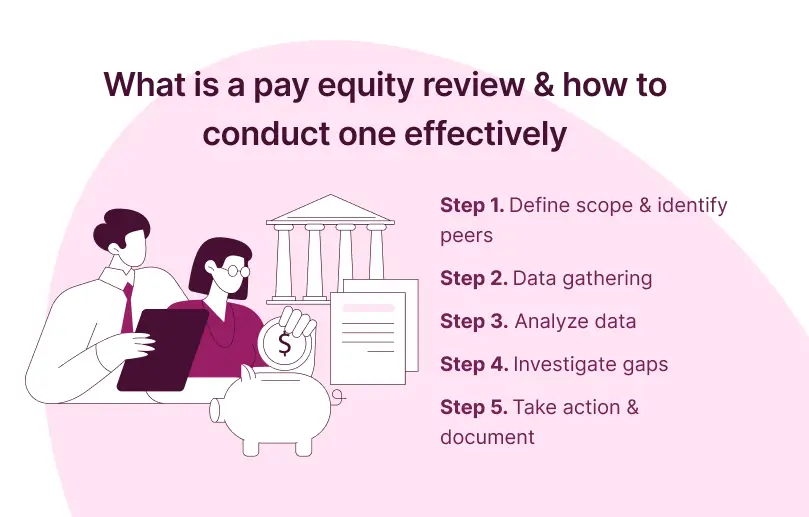
Identify which employees will be reviewed and how you will group them into peer groups based on the work they perform.
Collect data on employees from different sources. This can include compensation, base salary, bonuses, tenure, experience, performance reviews, and education.
Compensation benchmarking tools like CompAnalyst can support this step by providing market pricing data that helps validate whether internal pay is aligned with external market rates.
Use data analysis and statistical software to compare and analyze the pay of the different groups of employees. This can reveal significant differences.
Investigate the reasons for any significant differences in pay between peer groups.
Adjust the compensation for the employees as necessary and document the actions you have taken. Given the growing number of states with pay transparency laws, proper documentation is essential.
Here are the common questions about the Pay Equity (PE) review:
Compensation teams or dedicated analysts typically lead to the effort. They partner with people analytics and legal for support. Larger organizations often bring in external experts for objectivity. Clear ownership keeps the project on track.
The Equal Pay Act of 1963 requires equal pay for substantially equal work. It shapes how you define comparable roles and justify differences. Reviews help demonstrate compliance and reduce lawsuit risks.
Analysts build models, run statistical tests, and interpret results. They prepare reports and recommend remediation steps. Their expertise turns raw data into actionable insights for HR leaders.
People analytics teams handle complex data pulls and advanced modeling. They create dashboards that visualize gaps and trends. Their work ensures statistical validity and ongoing monitoring capabilities.
Strong documentation creates a defensible record of decisions and actions. It supports future audits and shows good faith efforts. Consistent records protect the organization while building internal trust.

The latest research, expert advice, and compensation best practices all in one place.
Blog
Bringing trusted compensation intelligence and seamless planning to even more ADP users.

Blog
Learn how to train managers for effective pay conversations and build trust.

Blog
Total rewards package flexibility lets employees choose what matters - pay, perks, and benefits tailored to their needs.