Blog
Get Pay Right on ADP Workforce Now® Next Gen™
Bringing trusted compensation intelligence and seamless planning to even more ADP users.
Written by Salary.com Staff
June 07, 2024

A skills matrix is a visual tool that charts the needed and current level of skills and competencies to identify skills gaps. This tool helps team leaders and line managers make better decisions and allocate resources more effectively by offering an overall view of their team’s skills.
However, implementing skills matrices into an already existing organization effectively can be challenging. A thorough skills assessment, consistent updating, and utilizing Salary.com's Consulting Services can help ensure all the skills and competencies are accurately mapped.
Our Skills Library helps with skills-based pay by quickly grouping similar jobs with the same skills.
A skill matrix records the required and available skills and competencies within a team, department, or entire organization. Creating skills matrices allows HR and L&D managers to stay on top of the organization’s skill set and understand each employee's capabilities, ensuring that all the skills are accounted for.
The skills matrix template usually takes the form of a table that includes roles, employees’ names, and a list of essential skills, with each skill assigned a score to assess individual employees’ competencies accurately.
For example, consider a software development team trying to launch a new mobile application. With a skills matrix in place, the team leader can identify that employee A possesses advanced coding skills necessary for app development, while employee B excels in UI/UX design. The matrix also pointed out that the team lacks expertise in backend development. Using this insight, the team leader arranges targeted training for team members to fill this skills gap.
Organizations can use Skills Library to gain access to software and data collection of skills and competency frameworks that enable HR teams to hire, evaluate, and develop top talent.
Skills matrices are vital tools for data-driven organizations, particularly for HR departments and project management leaders. These matrices enable easy tracking of employees' skills, qualifications, and competencies across the entire organization, ensuring teams are well-equipped for crucial projects and business objectives.
Identifying required skill sets based on project needs allows teams to be organized effectively and ensure that tasks are completed by the most skilled employees. This improves team performance and contributes to the company's overall efficiency.
For HR departments, skill matrices are an important part of talent management and workforce planning. It aids in identifying the needed skill set for hiring processes, scheduling employee vacations to maintain necessary staffing levels, and facilitating targeted training to fill any skill gaps within the organization.
A skills assessment evaluates employees' desired skills to assist in identifying skills gaps and guiding targeted training to enhance team performance. On the other hand, a competency matrix includes not only skills but also knowledge and attitude that provides a comprehensive view for management to strategize talent management and workforce planning more effectively.
The key difference between the two lies in their scope and application, with the competency matrix offering a broader assessment while the skills matrix focuses primarily on evaluating specific skills. However, both are essential tools for maximizing team performance and filling core competencies.
Add skills and competency data from our Skills Library to attract the right candidates.
As mentioned earlier, creating a skills matrix is important for effective talent management and achieving business objectives. However, overlooking certain aspects of the process can lead to inefficiencies. Here are some common mistakes to avoid when creating your skills matrix:
Overlooking soft skills
While technical skills are essential, soft skills such as communication, teamwork, and problem-solving are equally important for productive teams and overall team performance. Make sure your skills matrix includes a balanced assessment of both soft and hard skills.
Lack of regular updates
A skills matrix should be a dynamic tool that evolves with your workforce. Failing to update it regularly can result in inaccurate assessments of employees' capabilities and skills gaps. Schedule regular reviews to ensure that the skills mapping reflects the current skill sets of your employees and any changes in business needs.
Using a one-size-fits-all approach
Every team and job role within an organization is unique, and a one-size-fits-all approach to creating skills evaluation may not be effective. Tailor your skills mapping to the specific needs of each team and job role by considering the particular skills and competencies required.
Job Skills Model provides a solution for organizations looking to adopt a skills framework to guide their job architecture, career pathing, and skill-based hiring initiatives.
Overcomplicating the matrix
Keep it simple. While it is tempting to include every possible skill and competency, an overly complex skills matrix can become unwieldy and difficult to use. Focus on the essential skills required for each job role or project. Use a straightforward grading system to assess skill levels and avoid using jargon or overly technical language.
Not utilizing available tools
Many organizations make the mistake of creating a skills matrix from scratch without utilizing available tools or templates. Using a skills matrix template or software can streamline the process and ensure consistency in assessing and grading skills across the organization.
With Job Competency Model, organizations can acquire up-to-date skills and competency data for hiring, assessing, and developing top talent to fill the skills gap.
Now that you understand how skills matrices ensure your team is equipped with the necessary skills, follow these five simple steps to create an effective skills matrix for your organization:
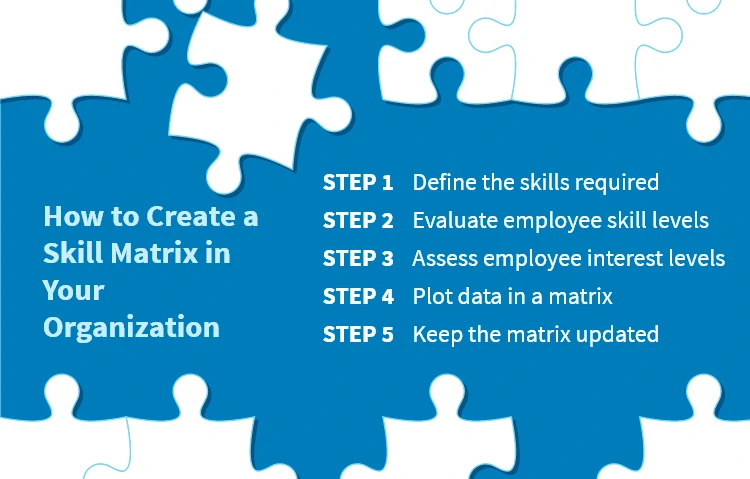
Identify the skills needed for your project. Consult with team leaders, managers, and employees who have relevant experience to compile a list of essential skills. Focus on the relevant skills required for the project to avoid a lengthy list of unnecessary skills.
Assess each employee's competency in the identified and potential missing skills. Utilize a simple grading system, such as a scale of 0-3, to rank their proficiency. Consider using 360° feedback to gather comprehensive insights from employees, colleagues, managers, and senior leaders, ensuring a more accurate evaluation of skills.
Organizations can utilize Competency Library which provides talent management, learning and development, and HR with a common language and set of expectations for success.
Consider each team member's interest in utilizing specific skills. Even if employees possess certain skills, their interest in deploying them can vary. For instance, an employee with a background in customer service may have the skills but little interest in using them in their current IT role.
Organize the gathered information into a skills matrix table. Display each employee's skill proficiency and interest level for each skill. This matrix allows for a quick overview of the team's collective capabilities and identifies any skills gaps that need addressing.
Regularly review and update the skills matrix to ensure its relevance. Continuously monitoring and updating the matrix enables you to track progress, evaluate the impact of learning initiatives, anticipate future skill requirements, and targeted training efforts.

The image above is a sample skills matrix for Product Management that details the proficiency and interest levels of various team members in key capabilities such as project planning, risk management, communication management, and quality assurance. Each employee's skills are rated on a scale from 0 to 4 for proficiency and 0 to 1 for interest to identify skills gaps and map out the necessary skills for each role.
For instance, if an important project requires advanced skills in project planning, the matrix helps team leaders quickly identify which team members possess the desired skills and interests to ensure the right employees are assigned to complete the project.
Creating skills matrices allows HR and L&D managers to stay on top of the organization’s skill set and understand each employee's capabilities. By following this step-by-step guide and utilizing Salary.com's Skill Library, you can effectively manage your team's capabilities, address skills gaps, and achieve organizational success.

The latest research, expert advice, and compensation best practices all in one place.
Blog
Bringing trusted compensation intelligence and seamless planning to even more ADP users.

Blog
Learn how to train managers for effective pay conversations and build trust.

Blog
Total rewards package flexibility lets employees choose what matters - pay, perks, and benefits tailored to their needs.