Blog
Get Pay Right on ADP Workforce Now® Next Gen™
Bringing trusted compensation intelligence and seamless planning to even more ADP users.
Written by Salary.com Staff
April 30, 2026

Building a rewards strategy shouldn't feel like a high-stakes guessing game for you or your leadership team. It requires a thoughtful, data-driven approach to ensure your top talent feels genuinely recognized for their yearly contributions.
Read on as we explore the mechanics of an annual incentive plan, including its core components and how to design one for your organization. We will also walk through the specific steps to calculate payouts and answer your most common technical questions.
An annual incentive plan is a structured component of variable pay designed to reward your employees for meeting specific, short-term goals. It serves as a formal short-term incentive (STI) that bridges the gap between daily tasks and your organization's broader financial success.
Unlike a discretionary bonus, this incentive plan operates on a formulaic basis to ensure objective and transparent payouts. You typically tie these rewards to defined performance measures and financial performance metrics like EBITDA, revenue, or operating income.
To clarify how this fits your strategy, let's look at the primary objectives below. This table highlights the specific benefits these programs offer your leadership teams.
| Objective | Benefit to Your Team |
|---|---|
| Clarity | Employees know exactly how their work impacts their yearly bonus. |
| Alignment | Individual efforts are channeled toward your most critical financial KPIs. |
| Retention | High performers are rewarded proportionally for their contributions. |
Understanding what is annual incentive plan logic helps you move away from subjective rewards toward a data-driven strategy. However, manually tracking these complex formulas and performance tiers can quickly become a significant logistical burden for your HR department.
To eliminate manual errors and ensure your rewards are always accurate, you need a solution that handles the heavy lifting for you. Streamline your entire compensation cycle with Salary.com's Compensation Planning Software and simplify complex incentive modeling.
Understanding the core components of your program is foundational to designing a framework that truly motivates your workforce. Without these architectural building blocks, your rewards strategy may fail to drive the specific financial outcomes your leadership expects.
You must first determine which roles qualify for participation based on their ability to influence your company’s key results. Eligibility is typically reserved for positions with higher accountability, ensuring that your incentive plan remains a targeted tool for driving performance.
The target bonus opportunity is defined as a specific percentage of an employee's base salary that they can earn for meeting expectations. You should differentiate these percentages by job level and scope to reflect the varying market value and impact of each role.
Your plan requires three distinct performance markers to define the range of potential payout outcomes for your team.
Threshold performance: This is the minimum "floor" or trigger required for any payout to occur.
Target performance: This represents the expected level of success where 100% of the bonus is earned.
Maximum performance: This acts as a payout ceiling to reward exceptional over-performance while protecting the budget.
Selecting the right performance measures involves choosing metrics that align with your corporate scorecard and specific business unit goals. You then assign a percentage weighting to each metric to signal to your employees which objectives are the highest priority.
The funding formula is the mechanism that generates the total incentive pool based on the company's overall financial health. This financial discipline is vital because it protects your organization from payout exposure during years when revenue may not meet expectations.
Designing a reward framework doesn't have to be an overwhelming technical challenge for your leadership team. When you follow a structured approach, it becomes a powerful way to ensure your pay practices are fair, consistent, and perfectly aligned with your business objectives.
In this section, we will break down the seven-step process to help you engineer a disciplined and effective payout strategy for your organization.
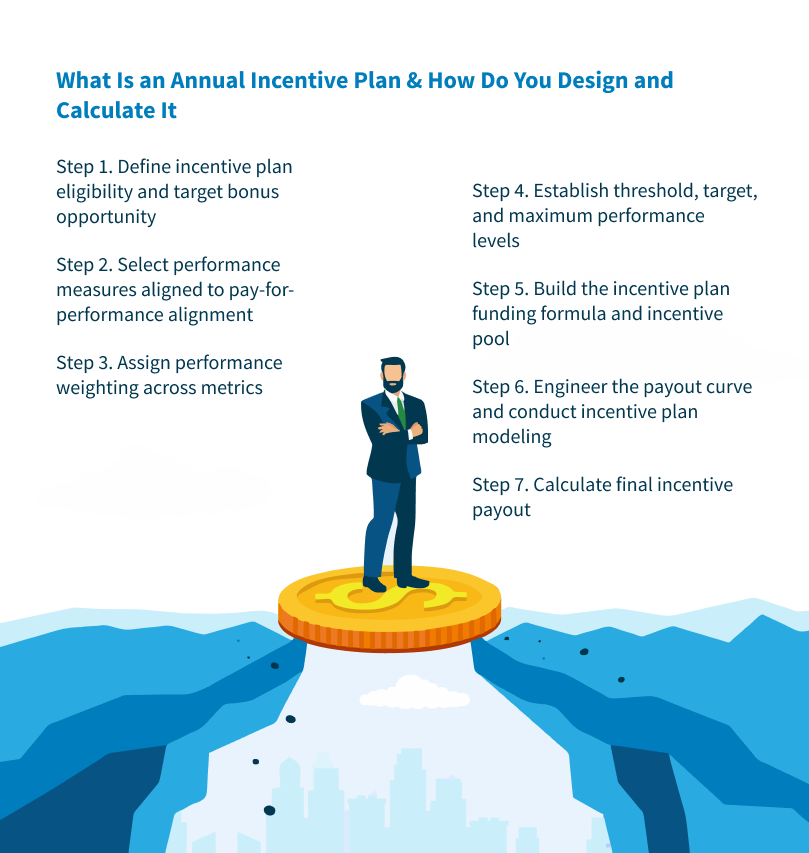
You begin by identifying which roles across your organization will participate in the program based on their strategic impact. For each role, you set a target bonus opportunity, expressed as a percentage of base pay, to ensure that potential rewards reflect an employee's level of accountability.
Next, you choose specific financial performance metrics that define what success looks like for the fiscal year. Common indicators include EBITDA, revenue, operating income, and cash flow, all of which confirm that payouts are directly linked to tangible operational outcomes.
You can easily manage these diverse metrics and maintain perfect alignment using a compensation tool and bring transparency to your incentive strategy.
Weighting allows you to allocate importance across your corporate scorecard and specific business unit metrics. You must validate that these weights reflect your current strategic priorities and your organization's overall risk tolerance for the year.
You need to define calibrated ranges for each measure to provide a clear roadmap for your team. This creates a credible stretch between the minimum threshold and the maximum ceiling, ensuring that exceptional rewards are only granted for truly exceptional results.
The funding formula determines exactly how performance results translate into a tangible incentive pool. It is critical to validate that these outcomes are affordable under target performance levels to protect the enterprise's long-term financial health.
Accurate pool modeling is essential for budget approval and compensation planning software makes it seamless. With its help, you can learn how to model your incentive pool with total precision and confidence.
You then design the payout curve to establish the leverage between threshold and maximum performance levels. By running modeling scenarios, you can estimate the cost of payouts at various success tiers to ensure they align with your actual budget assumptions.
The final step uses a disciplined formula:
Performance Factor x Target Bonus Opportunity = Earned Payout
You must validate this final figure against your established funding limits to confirm that the results reinforce your pay-for-performance commitment.
Here are answers to the most frequent questions people ask to help you maintain a disciplined and competitive annual incentive plan.
Target amounts should scale with a role's level of accountability and direct influence on your financial performance metrics. Generally, more senior leaders have higher "at-risk" percentages because their decisions significantly impact the company's overall success more.
The most effective metrics prioritize value creation, such as EBITDA for profitability or operating income for efficiency. You should choose revenue or cash flow based on whether your current strategic goal is aggressive growth or maintaining liquidity.
You can mitigate volatility through rigorous incentive plan modeling and the use of "trigger" funding formulas. Calibrating your payout curve with conservative thresholds and firm maximum caps prevents unexpected budget spikes during windfall years.
Maintain alignment by performing an annual audit of your metric weightings and performance ranges to reflect changing market conditions. This ensures that your threshold and maximum levels remain a credible stretch for your team every year.

The latest research, expert advice, and compensation best practices all in one place.
Blog
Bringing trusted compensation intelligence and seamless planning to even more ADP users.

Blog
Learn how to train managers for effective pay conversations and build trust.

Blog
Total rewards package flexibility lets employees choose what matters - pay, perks, and benefits tailored to their needs.