Blog
Get Pay Right on ADP Workforce Now® Next Gen™
Bringing trusted compensation intelligence and seamless planning to even more ADP users.
Written by Salary.com Staff
May 15, 2026

Having a well-established system where you recognize and reward excellent contributions of employees lets you align their performance with the set goals in your business. When done right, it is a tool that ensures engagement and productivity.
In this article, let’s talk about the employee reward and recognition system, its key components, benefits and challenges, how to design one in your company, and some best practices to apply.
A recognition and reward system is an approach to acknowledge employees for their performance and contribution to the company. This can be either through structured bonuses, informal praises, or non-monetary awards.
The key objectives of having this system include:
Encouraging desired behaviors from employees to support company goals.
Promoting employee engagement and retention.
Aligning pay with performance where rewards reflect contribution.
Maintaining control over company finances.
Recognition and rewards are not only integrated into one program. They are also made up of important elements that ensure the system drives performance, engagement, and business success.
Here are key components of a reward and recognition program:
| Component | What it means | What it does |
|---|---|---|
| Recognition framework | Establishes the guidelines for employee recognition | Defines what good performance looks like |
| Reward mechanism | Determines what type of rewards is given to employees; monetary or non-monetary | Ensures that employees are rewarded and recognized meaningfully |
| Eligibility criteria | Sets which employees qualify for recognition and rewards | Maintains the system’s fairness and consistency |
| Performance linkage | Ties recognition and rewards to KPIs or OKRs | Gives importance to productivity and measurable outcomes |
| Delivery channels | Defines how recognition is given; platforms, tools, or processes | Makes the program accessible, scalable, and easy to use |
| Reporting and analytics | Monitors results and effectiveness of the program | Highlights what’s working and what requires improvement |
Gain access to eligibility criteria, performance linkage, delivery platforms, and reporting and analytics through Compensation Planning Software. This tool helps you:
Link metrics that define your business success to employee incentives
Integrate performance-based compensation to your payroll system
Customize and control approval paths through automated workflow
Monitor and analyze how employees interact with their total rewards statements
Providing recognition and rewards in your organization has its advantages, including:
Increased productivity
When employees are recognized and rewarded in the workplace, they would want to go the extra mile and stimulate them to perform well in the team.
Progress in career and development
Since employees want to elevate their work to receive recognition and rewards, it encourages development and growth in their career.
Stronger employer brand
An organization that has a system of recognizing and rewarding employees establishes a positive reputation, reflecting good leadership and talent management.
The recognition and rewards program is not only about choosing which incentives to offer. It is also about carefully crafting a step-by-step approach that ensures alignment of your company objectives and employee performance.
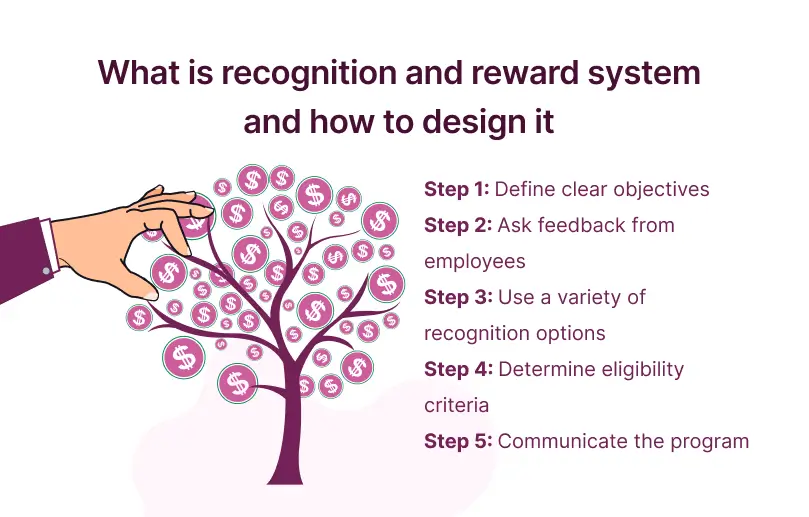
Here is how you can design an effective rewards and recognition system:
Outline specific objectives that your company wants to achieve and how the recognition and rewards program can help achieve them. The program must improve behaviors you want to maintain, such as teamwork, retention, or customer service.
To ensure that the program is meaningful, consult the workforce on what kind of recognition and rewards they want to receive. This can be done through:
Surveys
Focus group discussions
Informal conversations
To boost engagement among your diverse workforce, you must design a mixture of different reward approaches. Here are common types of recognition and rewards you can use:
Monetary: Bonuses, raises, spot awards
Non-monetary: Additional PTO, professional development courses, win celebrations
Experiential: Team outings, concert tickets, all-expense paid trips
Milestone: Work anniversary, project launches, service awards
Social: Team shoutouts, peer-to-peer recognition, public thank you
Establish clear guidelines on who qualifies, how to nominate, and how recognition and rewards are earned. This makes the program objective, consistent, and fair. Here are points you can consider when determining your criteria:
What employee behaviors are rewarded?
How will these employee behaviors be rewarded?
How often will you recognize and reward employees?
Ensure that everyone is aware of the program by properly communicating the objectives, benefits, and criteria. You can announce the program through:
A meeting
A company event
Newsletter
Company intranet
It is not enough that you have already implemented the reward and recognition program. Your team must also assess if it is effective in achieving company goals and improving talent management.
Here are key metrics to monitor:
| Metric | Examples | Why it matters |
|---|---|---|
| Participation |
Frequency of recognition Coverage of recognition Manager participation rate |
Shows how the program is adopted in the organization |
| Engagement |
Employee net promoter score (eNPS) Recognition-specific feedback |
Measures how the program affects employee experience |
| Retention |
Turnover rate Time to voluntary departure |
Reveals whether the program helps retain talent |
| Performance |
Sales figures Customer satisfaction scores Project completion rates Quality metrics |
Links recognition to business outcomes, reflecting whether the program drives measurable improvements |
| Recognition quality |
Timeliness Specificity Appropriateness Personalization |
Makes sure that recognition is meaningful and effective |
Of course, your recognition and rewards program can face problems, and knowing these hurdles will help you address them proactively:
| Challenge | Impact | How to mitigate |
|---|---|---|
| Misalignment with KPIs | Rewards did not drive desirable behaviors and performance | Monitor and adjust metrics regularly |
| Budget overspending | Financial risk by going over the budget on incentives | Forecast cost and cap incentive pools |
| Low engagement | Poor employee participation lowers the program’s effectiveness | Increase visibility and manager involvement |
| Ineffective ROI tracking | Hard to measure the true impact of the program | Leverage analytics and reporting tools |
To further mitigate the risks that come with your recognition and rewards program, consistent practices and careful planning must be done. Here are things you can do:
Set standardized criteria to lessen bias in who receives rewards and recognition.
Monitor performance and rewards in real time to create timely adjustments.
Analyze ROI regularly to refine strategy and magnify impact.
Streamline the process of recognition and rewards through automated workflow and HR integration, which can be accessed through Compensation Planning Software.
Here are frequently asked questions about employee rewards and recognition:
Recognition is focused on the verbal, written, and symbolic appreciation given to employees who performed and contributed well, while rewards emphasize tangible benefits like money or gifts.
Recognition should be done in real-time and frequently. A survey suggested that the impact of recognition is lessened when it takes too long for employees to receive it.
Organizations can allot 1% to 2% of the payroll budget to employee rewards, depending on the company size and the type of recognition implemented. Some cost-effective recognition programs include:
Peer recognition
Experiential rewards
Points-based awards
Public recognition of achievements

The latest research, expert advice, and compensation best practices all in one place.
Blog
Bringing trusted compensation intelligence and seamless planning to even more ADP users.

Blog
Learn how to train managers for effective pay conversations and build trust.

Blog
Total rewards package flexibility lets employees choose what matters - pay, perks, and benefits tailored to their needs.