Blog
Get Pay Right on ADP Workforce Now® Next Gen™
Bringing trusted compensation intelligence and seamless planning to even more ADP users.
Written by Salary.com Staff
June 12, 2026

A variable pay program is a compensation structure that rewards employees based on their performance or the results that the company achieves. These programs allow HR and compensation professionals to motivate employees and control costs. Many industries depend upon variable pay programs to remain competitive in the labor market.
This guide will help you to understand the various components of implementing a variable pay program, the steps involved in the design of the program, as well as the considerations that must be made by those in the HR department. All this information is derived from reputable sources within the industry.
A variable pay program is one that links part of an employee’s pay to meeting performance goals. Unlike a fixed salary, the pay earned in a variable pay program must be re-earned for each performance period. Examples of variable pay include bonuses, commissions, and profit-sharing programs.
Companies design these programs to encourage higher performance and share success with employees. They help manage labor costs during slower periods while rewarding strong results. Participation often spans many roles, with adjustments for different levels or departments. Clear rules and metrics make the system fair and transparent.
HR teams often rely on CompAnalyst® to compare pay practices against competitors and ensure their incentive programs remain attractive in the labor market. This is important when retaining high-performing employees.
Incentive compensation links pay directly to results, while base salary provides stable, fixed pay for the role regardless of short-term outcomes.
| Aspect | Base salary | Incentive compensation (variable pay) |
|---|---|---|
| Payment structure | Guaranteed and fixed, paid consistently | Performance-contingent and fluctuates |
| Frequency | Monthly or bi-weekly | Often quarterly or annual |
| Purpose | Reflects job value, experience, and market rates | Drives specific behaviors and results |
| Changes | Mainly through merit increases or promotions | Must be re-earned each cycle |
| Employee perception | Provides stability and budgeting certainty | Offers upside potential for exceeding targets |
A strong variable pays program rests on several interconnected elements that tie rewards to performance while supporting business strategy.
Eligibility rules — Define who will participate in the program according to job level or department.
Performance metrics (KPIs) — Determine the metrics to be used to gauge individual or department performance. Examples include revenue, profitability, customer satisfaction, and individual goals.
Pay mix — Determine the percentage of salary that is fixed versus variable.
Payout structures — Determine how compensation will be structured according to performance metrics. Include the formula to calculate the payout.
Funding mechanism — Determine if the compensation will be self-funded.
Organizations can streamline role alignment and compensation planning with CompAnalyst®, which helps HR teams accurately match jobs to market benchmarks for fair incentive opportunities.
Pay mix refers to the proportion of fixed base salary versus target variable pay in an employee's total cash compensation.
| Role type | Typical pay mix (base / variable) | Key characteristics |
|---|---|---|
| Sales roles | 60/40 or 50/50 | Emphasizes performance and results |
| Professional/Support | 80/20 or 90/10 | Provides more stability with some incentive |
| Executive levels | 40/60 or lower | Includes significant variable and long-term pay |
The right ratio depends on market data, role controllability of outcomes, and company culture. Benchmarking helps keep it competitive.
Choose KPIs that are specific, measurable, achievable, relevant, and time bound. Focus on setting metrics that employees can influence. Consider both financial and non-financial metrics for employees. Limit the number of metrics to avoid diluting the focus on each metric - three to five metrics per performance plan are usually sufficient. Weight each metric according to its relative importance to the business during the performance period.
Short-term incentives reward results within one year or less, often through bonuses or performance sharing.
Threshold performance: Minimum level required before any payout occurs. This protects the budget and sets a baseline expectation.
Target payout: Achieved at 100% performance. This represents the intended incentive amount for solid results.
Maximum payout: Cap or accelerator for exceptional performance. Common structures allow 150-200% of targets for top outcomes.
Payout frequency: Quarterly, semi-annual, or annual distributions keep motivation high and provide timely feedback.
Effective design starts with clear business alignment and follows a logical process.
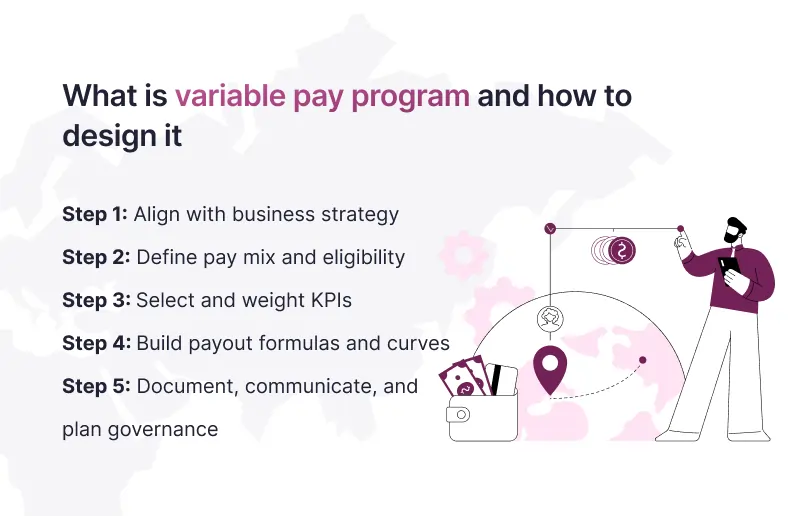
Review company goals for the coming period. Consider the signs of success for each level of organization. Ensure that the leadership team agrees with the goals for the coming period.
Organizations can use CompAnalyst® Market Data to access compensation benchmarks and labor market intelligence to align compensation strategies with business objectives.
Use market benchmarking data to establish base-to-variable ratios by role. Determine which groups of employees will participate in the program and any special rules for the new hires and partial-year employees.
Choose a small set of controllables, measurable metrics. Assign weights that reflect priorities. Test scenarios to confirm the metrics drive desired behaviors.
Design the relationship between performance and payout - the threshold, target, and maximum levels for performance. Model the different outcomes for performance to manage costs and motivate employees. Include accelerators or caps as needed.
Create clear plan documents with examples. Plan for communication and training. Establish review processes for mid-year adjustments and year-end administration.
Successful implementation requires clear processes, communication, and ongoing oversight to maintain trust and effectiveness.
Communication: Share the details and examples of the plan with all participants
Training managers: Ensure that they can discuss the program with employees and convey goals to them
Technology: Use compensation software to calculate and track the metrics for each employee
Regularly reviewing the program: Use the data to ensure that the program is running as it should and making changes as needed to maintain its credibility
A governance policy outlines rules, responsibilities, and controls for performance-based pay. It promotes consistency and fairness.
Oversight committee: Establish a committee comprising HR, finance, and leadership to approve any changes to the program.
Approval processes: Establish approval processes for any changes to the plan or the payouts to employees.
Audit and compliance checks: Regularly audit the payouts to ensure that the conditions of the program have been followed and documented.
Compliance protects the organization and ensures fair treatment. Stay current with relevant laws and regulations.
Equal pay and non-discrimination: Ensure that no adverse impacts are felt by any protected groups.
Wage and hour rules: Ensure that each employee is classified appropriately within the company. Ensure that the variable pay structure does not create violations of wage and hour laws.
Documentation and transparency: Keep accurate records of the earnings and payouts from the program. Communicate any changes to the program to affected employees.
Here are some FAQs for better understanding.
Short-term incentives (STI) focus on performance within one year, while long-term incentives (LTI) reward sustained results over multiple years.
| Aspect | Short-term incentive (STI) | Long-term incentive (LTI) |
|---|---|---|
| Timeframe | One year or less | Typically, 3—5 years |
| Payment form | Usually cash | Often equity or deferred cash |
| Primary focus | Immediate business priorities (revenue, profit) | Long-term value creation and retention |
| Target audience | Broad employee groups | Usually, executives and key talent |
A payout curve defines the mathematical relationship between the level of performance and the incentive paid out. These curves have threshold, target, and maximum points.
The performance incentive payout curves are modeled by organizations to find the perfect balance between employee motivation and costs. Most organizations use linear or stepped curves. In 2026, organizations will be able to model these curves with better data modeling tools to achieve better outcomes.
Benchmarking compensation allows organizations to understand the market for various compensation mixes and variable pay. It allows them to structure their pay scales accordingly.
With benchmark data accessible in real time for 2026, organizations can fine-tune their performance-based pay to remain competitive while aligning with market and economic conditions.
Variable pay programs remain a powerful tool for HR and compensation professionals. Using the information above, compensation and HR professionals can create a performance-based pay that achieves alignment, motivation, and business results for their employees and organizations. Use the information above as a foundation for your organization’s variable pay program and adapt it to your unique needs.

The latest research, expert advice, and compensation best practices all in one place.
Blog
Bringing trusted compensation intelligence and seamless planning to even more ADP users.

Blog
Learn how to train managers for effective pay conversations and build trust.

Blog
Total rewards package flexibility lets employees choose what matters - pay, perks, and benefits tailored to their needs.