

Blog
Get Pay Right on ADP Workforce Now® Next Gen™
Bringing trusted compensation intelligence and seamless planning to even more ADP users.
Written by Salary.com Staff
October 30, 2026

Talent mapping helps employers and hiring managers build a clear view of skills across their current workforce and the talent market. It supports strategic workforce planning by showing talent gaps and future hiring needs early.
Recent findings from the World Economic Forum Future of Jobs Report confirm that 63 percent of employers name skill gaps as the biggest barrier to business transformation.
Talent mapping enables employers to understand the skills and potential within current and external employees. It provides visibility to those who currently possess the demonstrated skills required for key positions today and in the future. It assists hiring with aligning internal talent to business objectives. Talent mapping also supports succession planning and enables talent gaps to be addressed prior to impeding business growth.
Thousands of compliant templates. Save hours of work.
Unlike job titles, talent maps focus on key skills, emerging skills, and soft skills across the talent landscape. Through talent mapping, employers gain talent intelligence that can be used in the hiring process and in creating a strong talent pipeline. Performed effectively, talent mapping enables organizations to remain prepared for market demands and helps maintain a competitive advantage.
JobArchitect® supports this work by helping HR teams create, manage, and standardize job descriptions while connecting roles to skills and job architecture.
Candidate mapping looks only at external people while talent mapping covers both internal employees and the wider talent market to support long term workforce strategy.
| Feature | Candidate mapping | Talent mapping |
|---|---|---|
| Focus | This method reviews only external candidates and passive candidates to fill open roles quickly with people from outside the company. | This method reviews the current workforce plus external talent pipelines and internal candidates, so the full talent landscape becomes visible. |
| Main goal | The aim is to fill open roles fast with qualified candidates who match the open job titles and immediate needs. | The aim is to align employees' skills with business strategy and future needs, so the company stays ready for growth. |
| Tools used | Teams rely on basic candidate data and job boards to build a simple candidate pool for the hiring process. | Teams use a skills matrix workforce data and talent mapping tools to create a complete view of talent pools and skill gaps. |
| Time frame | Work stays short term and centers on one open job or a small group of roles that need filling now. | Work stays an ongoing process linked to strategic workforce planning and future hiring needs across the business. |
| Outcome | The result is a candidate pool that hiring managers can draw from for current openings. | The result is a full view of talent pools skill gaps and development plans that support succession planning and business goals. |
CompAnalyst® can help connect company jobs with appropriate market data, making it useful when employers compare internal roles with external market information.
Employers choose talent mapping tools that turn workforce data into clear talent maps for a better hiring strategy.
Skills-based platforms that evaluate the skills of both internal and external candidates and highlight gaps between skills and business objectives to enable leaders to take early action.
HR systems that store data about candidates and enable hiring managers to create skill mapping templates to review critical positions and determine the next steps.
Analytics tools that monitor the health of the talent pipeline and connect skill mapping to future talent and market demands resulting in more accurate predictions.
Collaboration tools that allow teams to update the skills matrix and share talent insights with leadership and finance to enable better strategic decision-making.
Skill mapping brings clear value when done right, yet common errors can limit results for employers.
Benefits
Enables early identification of talent gaps and allows the creation of external talent networks to ensure that future talent requirements are met without last minute rushes.
Facilitates the identification of high protentional employees and allows the development of career paths which in turn enhance engagement and retention of high-quality employees.
Skills based skill mapping provides hiring managers with the information required to match internal talent to key positions and can help to reduce hiring time due to a greater level of fit.
Allows workforce planning to be aligned to business success and turns the talent acquisition process into a source of competitive advantage for the organization.
Auto-matching tools for a clear, fair organization.
Common mistakes
Viewing skill mapping as a one-off exercise, rather than a continuous process that adapts to shifts in market conditions and business objectives.
Using only job titles and not considering demonstrated skills, emerging skills or soft skills that are critical to long term success and future leaders.
Not incorporating input from hiring managers resulting in talent maps that do not accurately represent the actual talent, and talent demands needed across teams and current market demands.
Not utilizing internal candidates but only external candidates which hamper employee development and succession planning.
Skill mapping in recruitment follows clear steps that help employers build a strong view of skills and prepare for future needs.
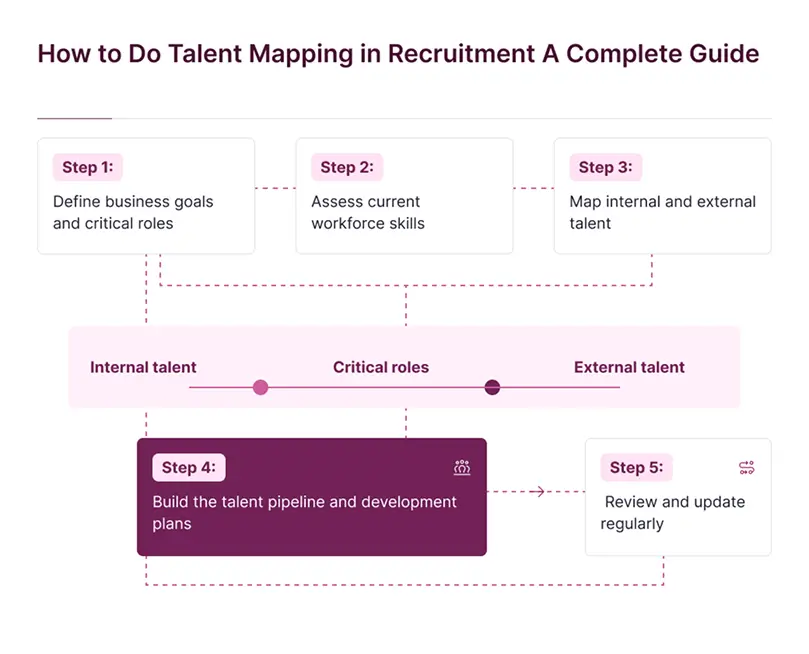
Start by listing the business objectives and the positions that drive them. Talk with hiring managers about future needs and the skills required. This step sets the foundation for every later decision and keeps the work tied to real business strategy.
Review employees' skills through assessments, performance data, and self-reports. Build a skills matrix that shows strengths and talent gaps. Include both technical abilities and soft skills, so the picture stays complete and useful for talent management.
Identify high potential employees and internal candidates who can move into open roles. At the same time, research external talent pools and passive candidates who hold the same skills. This dual view creates a full talent landscape ready for action.
Create talent pools for key areas such as data engineers or other critical roles. Design development plans and career paths for internal talent. Keep candidate data organized so the pipeline stays active and ready for future hiring.
Treat skill mapping as an ongoing process rather than a finished report. Check the maps against changing market demands and business growth. Adjust the hiring strategy and skill mapping strategy as new skill gaps appear.
Here is how a finished talent map might look for a data team using the template in a real company setting.
Connected data engineers to business growth by identifying the needed skills in problem solving, coding, and analysis that align to market needs.
Existing employees are rated highly in demonstrated skills and low in emerging skills (e.g. new tools). This allows for obvious identification of skill gaps that can be addressed.
External candidates are included in the candidate pool with notes on passive candidates that fit the target candidate and candidate persona.
In the Action column, development paths are identified for existing employees and steps for sourcing external candidates to maintain the pipeline strength.
The bottom line explains how the map aids in attracting talent and keeps the talent pipeline in place to meet current and future business needs.
Here are some FAQs for better understanding.
Effective talent management begins by ensuring links to business objectives. All activities should contribute to both short- and long-term success. Management should be actively engaged, and processes should remain consistent throughout the organization to foster trust. Local requirements and culture are also important.
By establishing a strong employer brand, the organization will be able to attract the best talent. These factors will aid HR in transforming skill mapping into tangible outcomes that address talent shortages.
The 9 box model maps existing employees using performance and potential onto a grid. This provides the manager with distinct groups. Employees that possess both high performance and high potential are designated as future leaders.
All other employees receive clear paths for development that fit their level. The tool is used by hiring managers within skill mapping to aid in employee development and succession development among current employees.
Some KPIs used in talent acquisition include time to fill key positions and quality of hire from the pipeline. These are used to measure success across teams. Other KPIs measure the effectiveness of skill mapping in narrowing the skills gap and the effectiveness in expanding the talent pool over time.
For finance, cost per hire and retention of top talent post-hire are tracked. Effective KPIs demonstrate that skill mapping enables the organization to remain aligned with both market needs and business goals.

The latest research, expert advice, and compensation best practices all in one place.
Blog
Bringing trusted compensation intelligence and seamless planning to even more ADP users.

Blog
Learn how to train managers for effective pay conversations and build trust.

Blog
Total rewards package flexibility lets employees choose what matters - pay, perks, and benefits tailored to their needs.
