Blog
Get Pay Right on ADP Workforce Now® Next Gen™
Bringing trusted compensation intelligence and seamless planning to even more ADP users.
Written by Salary.com Staff
April 25, 2025

Diversity is now one of the biggest driving forces for talent acquisition all over the U.S. This directly correlates to 2023 research showing that 3 in 4 job seekers look for companies that offer diversity in their workplace, and 72% of employees are willing to go as far as to leave their jobs if it doesn’t offer much in terms of diversity.
This means that to adjust to modern times, companies should know that hiring a diverse workforce is the way to go. But what should be considered when it comes to workforce diversity, and most importantly, how can it affect companies moving forward?
Read on to learn more about the key steps on hiring a diverse workforce, its benefits for companies, and the challenges that can come along with it as well.
Workforce diversity can be defined as a workplace culture that brings together people of different ethnicities and backgrounds in a single working environment. This means that the workplace would ideally have people of different ethnicities, sexual orientations, religions, ages, physical abilities, and life experiences to be considered diverse.
Though difficult, most companies can have a more inclusive working environment by utilizing job description tools in their hiring practices to hire diverse candidates. This ensures that companies can create time-proof descriptions that can provide companies with a hiring pool that promotes diversity while still being effective at the same time.
Workforce diversity offers companies brand-new perspectives from different backgrounds to solve their current problems, which directly correlates to the 19% higher innovation revenues that most diverse companies had in 2020.
Not only that, but a more diverse recruitment strategy is also good for a company’s brand. Both job seekers and future clientele alike are more likely to go for companies with more diverse employees, which makes hiring a diverse workforce much more enticing for companies.
Listed below are some of the advantages companies can have when it comes to hiring a diverse workforce.
A diverse workplace has been credited with fewer and quicker meetings while still making effective business decisions according to a study, along with achieving 60% better results as well.
Workforce diversity also looks better from a marketing standpoint, as diverse companies are not only more enticing places to work for job seekers but can also help drive more sales. Research has shown that 50% of customers are more likely to purchase from companies that support equality and diversity among their employees, which can then help the companies develop their brand further.
Companies with both gender and ethnically diverse talents have a 25% better chance of having a better financial performance above the national industry median as well, which makes diverse recruiting strategies a better financial decision as well.
When employees feel at ease and can be their authentic selves, they’re 68.3% less likely to leave an organization, resulting in better employee retention in the long run. Not only that, but companies with more ethnically diverse teams have a 33% better chance of outperforming their peers when it comes to profitability.
Workplace diversity comes with its own set of challenges as well. Listed below are some examples of common challenges when it comes to hiring a diverse workforce.
As of 2025, studies have shown that most U.S. companies are completely unprepared when it comes to their DEI practices. This means that in the best-case scenarios, these companies would have to fully rewrite job descriptions to promote a diverse and inclusive workforce. Worst-case scenario, companies would have to scramble to create new job descriptions that match their current needs, which can take a lot of time and manpower to do so in the first place.
Although rewriting job descriptions can be a hassle, using a tool that can create customized job templates that’s relatively easy to manage and utilize can help alleviate the entire process altogether and can make hiring a diverse workforce significantly easier.
According to the U.S. Department of Commerce, the regular working hours throughout the entire country and its territories encompasses 40 hours plus overtime. And though this is the norm for the vast majority of the globe, some European countries are used to 35-hour workweeks – with some countries even having less than that at 30 hours.
Additionally, people from diverse backgrounds have different approaches when it comes to punctuality and professionalism, which some U.S. companies can find difficult to adjust to.
Although having different perspectives is generally a good thing for most businesses, having too many perspectives without any goal in mind can be detrimental for a company in the long run.
Here are some steps that organizations can utilize for a diverse recruitment process.
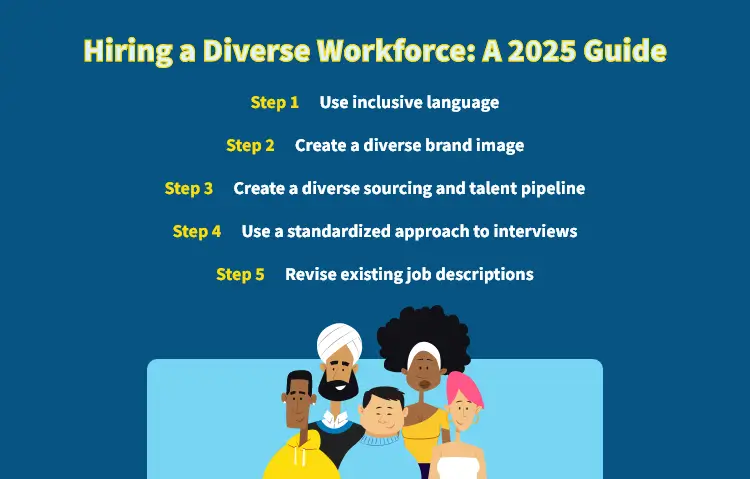
Usage of inclusive language in the workplace not only helps avoid any preconceived notions about people, which can make them uncomfortable but, also helps make an environment where employees are empowered to speak their mind, ensuring workforce diversity in the long run.
Using non-gender specific languages like salesperson, chairperson, and using “they” as an initial pronoun is a good baseline for companies to follow with their inclusivity initiatives. That said, they can drive it even further by fully avoiding ableist language. This means using the terms “strengths and weaknesses” instead of “superpowers and disabilities”, and so on.
Companies willing to diversify their workforce should also incorporate a more diverse brand image to promote their business further. As mentioned above, customers are 50% more likely to buy from inclusive companies – which means that companies should also create a more diverse brand image to match their diversity initiative.
The most effective way to do this is by showcasing how much career growth is possible for anyone within the company. Companies can also post their diversity initiatives, employee satisfaction, and a part of their employee resource groups on their website to further showcase them to both future clients and job seekers alike.
The next step that companies should take to ensure an inclusive workplace culture is to make a diverse sourcing and talent pipeline. Companies have two options: either a.) update their existing job openings and postings by using more inclusive language with little to no cost, or b.) actively use their connections to reach out to underrepresented groups for every role during the hiring process.
Ideally, hiring managers should use the same, bias-free questions can help companies with hiring a diverse workforce. This is because asking the same bias-free questions, in the same order and with the same criteria can reduce bias and help companies choose their future employees better, regardless of their background.
Revising your existing job descriptions to fill more role-specific questions can help companies with hiring a diverse workforce while ensuring that everyone that’s well within their qualification can apply, which ensures that companies can have more diverse employees moving forward.
Though most companies can simply revise their job descriptions to include inclusive language, using an online tool that’s specifically designed to help create an accurate, bias-free job description moving forward can help companies cut costs in the long run.

The latest research, expert advice, and compensation best practices all in one place.
Blog
Bringing trusted compensation intelligence and seamless planning to even more ADP users.

Blog
Learn how to train managers for effective pay conversations and build trust.

Blog
Total rewards package flexibility lets employees choose what matters - pay, perks, and benefits tailored to their needs.