Blog
Get Pay Right on ADP Workforce Now® Next Gen™
Bringing trusted compensation intelligence and seamless planning to even more ADP users.
Written by Salary.com Staff
September 19, 2025
The adoption of artificial intelligence is changing traditional approaches to human resource management. From recruiting top talent to improving employee engagement, AI in talent management is helping HR leaders make smarter, faster, and well-informed decisions. This makes the use of AI for talent management a major influence in today's HR practices.
Fine-tuned LLMs. Your 24/7 intelligent comp analyst.
In this article, we'll explore the role of AI in talent management strategies, why it matters now, and how AI systems enable HR teams to attract, engage, and retain talent.
When we think of the use of AI for talent management, the first thing that comes to mind is automation. But that is not the only thing AI technologies are good at. Their true value lies in their ability to process large amounts of data, predict patterns, and support better decision-making.
Here are some of the crucial roles AI plays in modern HR talent management practices that will help you:
Large-scale data analysis
Analyzes huge datasets to find patterns in the workforce.
Predicts recruitment trends, turnover risks, and skills gaps.
Applies market data to guide workforce planning.
Data-driven, unbiased judgments
Reduces bias in recruiting and promotions by utilizing AI-driven frameworks.
Improves workforce planning by using insights derived from data.
Supports impartial, merit-based assessments.
Automating repeated tasks
Manages pre-screening of candidates, scheduling, and reporting.
Allows HR teams to concentrate on employee engagement and talent strategy.
Increases productivity in a variety of HR tasks.
Personalized development opportunities
Suggests training according to roles, skills, and career goals.
Develops flexible and tailored training programs based on employee growth.
Promotes professional advancement and internal mobility.
As an HR and talent leader, integrating AI-powered tools, like Salary.com's agentic AI platform, into your talent management processes is a smart way to improve decision-making, accelerate employee development, and stay ahead of workforce challenges.
Each phase of your talent management strategy needs thoughtful planning. But these steps can be time-consuming and at times overwhelming, especially when resources are stretched. This is where integrating AI systems into your talent strategy becomes essential.
Below are the key advantages of using AI for talent management:
For talent acquisition & recruitment: Faster, fairer hiring process: AI-driven tools improve recruitment by screening candidates more efficiently, matching skills to job requirements, and reducing bias in evaluations. According to Salary.com’s 2023 Pay Practices & Compensation Strategy Survey, 43% of organizations have adopted the use of AI in their talent acquisition. This includes automating the process of sending offer letters and posting job ads. Through AI talent management, you can shorten time-to-hire, reach a wider pool of talent, and make fairer, data-backed decisions when selecting candidates.
For employee development & engagement: Smarter growth paths: Beyond hiring, AI tools enable personalized employee experiences. They can map out learning opportunities, recommend personalized training, and suggest internal career paths that align with employee goals. This not only supports career development but also boosts engagement and retention, which are key drivers of long-term success in modern talent management.
For workforce planning & decision-making: Data-driven insights: With its ability to process large datasets, AI helps HR teams forecast workforce needs, anticipate turnover, and identify skills gaps before they affect performance. These insights will allow you to make strategic, proactive decisions that align with your organizational goals, ensuring a stronger, more resilient workforce.
Salary.com AI delivers specialized solutions designed to support every stage of the talent management cycle, from hiring to long-term workforce planning. You can have access to an all-in-one platform where you have everything you need to support your talent management strategies.
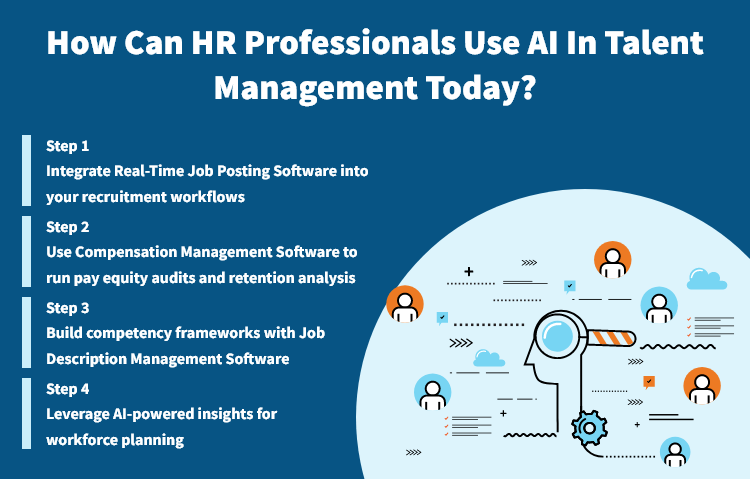
The software’s real-time competitor intelligence draws from millions of job postings across 30+ countries and 15,000 searchable roles, giving you access to up-to-date pay data and skills trends. This allows you to accurately benchmark salaries, so you can design competitive offers that attract the right talent faster.
Global market insights aligned with your compensation strategies reduce hiring delays, helping you stay ahead in a fast-moving talent landscape.
With Salary.com’s comp management software, your HR teams can easily identify pay gaps, reduce turnover risks, and align compensation with performance. Using its real-time market data from 800 million data points and 15,000 unique job titles allows you to ensure fair and competitive pay decisions.
These insights will help you build stronger workforce strategies and smarter talent retention plans.
Job description management software helps your HR teams create clear, consistent job descriptions by defining responsibilities, competencies, and performance goals. With its built-in Skills Library, you can build competency frameworks that support career growth and align roles with measurable outcomes.
This improves performance evaluations, supports internal mobility, and ensures that your pay offers align with actual job value.
Agentic AI models analyze market data and internal job structures to forecast talent needs and identify emerging skill gaps. These insights help you plan talent needs, identify skills needed in the future, and align compensation budgets with future workforce demands. Predictive analytics built into your workflows allow you to respond faster to market shifts, reduce planning delays, and maintain a sustainable talent strategy that supports long-term growth.
With AI built into every step, you can streamline your workflows and make smarter, faster decisions. It’s a future-ready approach to managing existing talent along with future demands with confidence and clarity.
Here are some of the common questions HR professionals ask about the use of AI for talent management:
Some examples of AI applications in HR and talent management include AI-Powered Applicant Tracking Systems (ATS), AI-Driven Employee Surveys, Automated Voice & Chatbots, and Virtual Onboarding Assistant. They support automating resume screening, candidate matching, employee surveys, predictive analytics, and personalized learning programs. These tools cut down repetitive work, help leaders see patterns in workforce data, and guide better decisions for both hiring and employee growth.
There isn’t one single AI tool that fits every company. Some are designed for hiring, while others focus on compensation or performance. The best choice is the one that blends into existing systems and supports the team’s goals, whether that’s faster hiring or more balanced compensation planning. Some tools, like Salary.com’s AI, provide an all-in-one platform where you can manage every stage of your talent lifecycle from recruitment to employee engagement and retention to workforce planning.
AI is not replacing HR professionals but reshaping their role. In fact, according to the US Bureau of Labor Statistics, jobs for HR specialists are expected to grow 6% over the next 10 years. This just proves that human touch remains highly valued in HR processes. And instead of spending hours on repetitive tasks, teams can focus on strategy, employee development, and culture. In this way, AI becomes more of a support system that frees up time for high-value work.
Auto-generated trend reports. Predict market shifts.
The benefits of using AI in talent acquisition include a more efficient sourcing and evaluation process in hiring and streamlined interview logistics, according to IMB. The use of AI speeds up hiring time, improves candidate matching, and reduces bias by focusing on skills and experience. This means better decisions for recruiters and a fairer process for applicants, which helps companies attract the right talent while creating a stronger candidate experience.

The latest research, expert advice, and compensation best practices all in one place.
Blog
Bringing trusted compensation intelligence and seamless planning to even more ADP users.

Blog
Learn how to train managers for effective pay conversations and build trust.

Blog
Total rewards package flexibility lets employees choose what matters - pay, perks, and benefits tailored to their needs.