Blog
Get Pay Right on ADP Workforce Now® Next Gen™
Bringing trusted compensation intelligence and seamless planning to even more ADP users.
Written by Salary.com Staff
August 09, 2024

Organizations must connect with top talent effectively, especially in this competitive job market. Using the right talent marketplace can help them build stronger relationships with potential candidates, run more targeted recruitment campaigns, and develop a more effective hiring strategy.
In this guide, we'll cover everything you need to know about the talent platform, including its benefits, key features, and how it works within your organization. We'll also highlight how Salary.com's Real-time Job Posting Salary Data solution can improve your recruitment strategy efforts with its groundbreaking talent intelligence features.
Live job scraping. Know their pay secrets instantly.
A talent marketplace is a platform where job seekers and current employees connect with employers for career opportunities. It provides job seekers a central hub to discover and apply for external job openings, using technology to match their skills and preferences with available positions.
The platform also supports current employees with internal job opportunities (as an internal talent marketplace), skill development programs, and career growth paths within their organization.
As mentioned, talent marketplaces work by connecting employers and job seekers (often current employees for internal mobility) on a platform for temporary, contract, freelance, or permanent jobs. They use technology to match candidates with suitable roles based on their skills, experience, and preferences, making recruitment more efficient.
Employers can post job listings, search for candidates, and manage hiring processes efficiently, while job seekers and current employees can create profiles, browse available positions, and apply directly through the platform.
Talent platforms are beneficial for organizations because they help find new talent and fill positions efficiently. They also offer additional benefits, including the following:
Faster matching with suitable roles
Talent platforms function like internal job boards, speeding up the advertising and application processes for vacancies, thus improving workforce agility. This reduces search time and increases the efficiency of filling other roles with suitable candidates.
Eliminates the need for lengthy external recruiting processes
Traditional recruiting includes searching external job boards, interviewing numerous candidates, and conducting background checks. A talent marketplace simplifies this by accessing a pre-screened pool of qualified internal candidates, greatly streamlining the process.
Improves skill utilization within the organization
Many employees have hidden talents or skills that are not fully utilized. A talent marketplace enables them to display these abilities and match them with projects that require them, ensuring optimal task assignment and improved outcomes.
Helps reduce turnover and its associated costs
Employees who feel stagnant or overlooked are prone to leaving. A talent marketplace provides growth opportunities and career development, boosting employee engagement and lowering turnover costs.
Helps HR teams identify areas where they have skill gaps
Talent marketplaces can reveal areas where the company lacks expertise by showcasing employee skillsets. This insight enables targeted training programs or strategic hiring to address these gaps effectively.
Stay updated on hiring trends by tracking current job listings with Salary.com’s Real-time Job Posting Salary Data. This helps you see what skills are in demand and how pay is changing.
Promotes diversity and inclusion
As mentioned, talent platforms prioritize the right skills over resumes. This creates opportunities for diverse candidates within the company who may have been overlooked in traditional hiring processes.
Promotes a creative and innovative work environment
When employees from various departments collaborate on projects using the talent platform, it encourages the exchange of ideas and promotes innovation in the workplace.
Encourages employees to manage their own careers
Talent marketplaces empower employees to steer their career paths by actively pursuing projects that match their interests and skills. This can improve job satisfaction and cultivate a sense of ownership.
Know who's hiring, where, and for how much.
How do you choose the right talent platform for your organization? Many struggle because they are unsure of the essential features. Here are some of them:
Employee profiles: Employees should have comprehensive profiles to showcase their skills, experience, certifications, and career aspirations.
Opportunity discovery: The platform should help employees easily find relevant opportunities, like full-time roles, projects, gigs, or training programs.
Matching algorithms: AI-powered algorithms can connect employees with the right opportunities based on their skills, interests, and experience.
Skill-matching capabilities and searchability: It should allow easy searching and filtering of skills to match employee expertise with project needs.
Communication and collaborative tools: Built-in communication tools can help employees and project managers discuss and collaborate easily.
Feedback and performance management: It can be also used for giving and receiving feedback, supporting ongoing performance management.
Analytics and reporting: Data insights can help understand skill gaps, workforce trends, and the talent marketplace's effectiveness.
Security and privacy: The platform should prioritize data security and employee privacy with strong measures to protect sensitive information.
Accessibility: It should be accessible from different devices and support users with disabilities.
After gaining a solid understanding of the must-have features of a talent platform, it's time to engage in experiential learning to choose the right one for your organization.
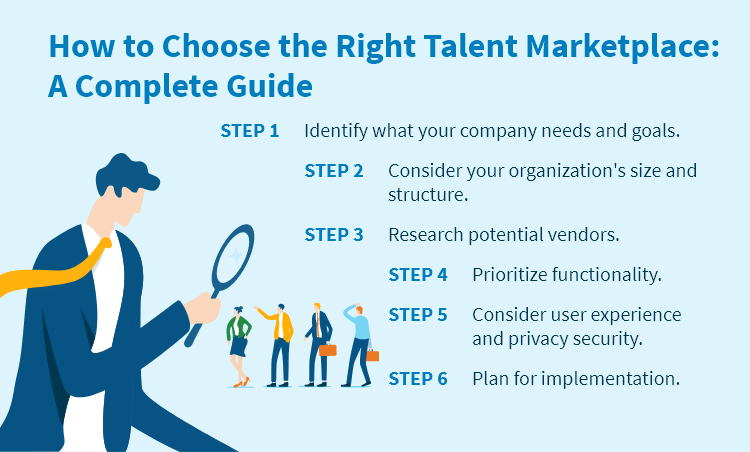
Know what types of employees you need, how many, and any special requirements. Decide if you want the talent marketplace to speed up hiring, find more candidates, or improve your recruitment process.
Need more team members? Use real-time data to predict staffing needs and allocate resources to meet your goals.
Consider how your company’s size and structure affect your choice of talent marketplace. Big companies may need advanced options, while smaller ones might prefer simpler, cheaper ones. Ensure the marketplace works well with your current hiring processes.
Research different talent platform options. Check reviews and testimonials to see how well each one works and what others say about it. Compare their features, prices, and support services. Make sure they match your needs and goals.
Check what each talent marketplace can do. Look at features like job posting, candidate and job search, HR system integration, and reporting tools. Focus on the features that are most important for your hiring needs.
Speaking of job postings, Real-time Job Posting Salary Data is your one-stop shop for finding and searching millions of job postings, exploring 15,000 searchable jobs, and seeing detailed skill sets and profiles.
Check if the talent platform is easy to use for both recruiters and candidates. Make sure it has a simple interface and smooth workflows. Also, ensure it keeps candidate data safe and follows privacy regulations.
Once selected, create a plan for setting up the new talent platform. Include timelines, how you’ll use resources, and how it will work with your current HR systems. Plan to train your team and handle any issues that come up during the switch.
Choosing the right talent marketplace can be subjective, but remember that every company is different, and what works for one may not work for another. Select an opportunity marketplace based on your organization’s needs, goals, and budget. It's best to pair the platform with a tool that provides insights into the job market, like Real-time Job Posting Salary Data.

The latest research, expert advice, and compensation best practices all in one place.
Blog
Bringing trusted compensation intelligence and seamless planning to even more ADP users.

Blog
Learn how to train managers for effective pay conversations and build trust.

Blog
Total rewards package flexibility lets employees choose what matters - pay, perks, and benefits tailored to their needs.