Blog
Get Pay Right on ADP Workforce Now® Next Gen™
Bringing trusted compensation intelligence and seamless planning to even more ADP users.
Written by Salary.com Staff
July 19, 2024

Fair chance hiring is a critical approach in the modern workforce, ensuring that all individuals, regardless of their background, are given an equal opportunity to prove their capabilities and contribute to the workforce.
This article explores the concept, importance, key elements, legal requirements, and best practices for fair chance hiring, providing a comprehensive guide for organizations committed to inclusive employment.
Live job scraping. Know their pay secrets instantly.
Fair chance hiring, also known as "ban the box," is a set of policies designed to reduce employment barriers for individuals with criminal records. The essence of fair chance hiring is to ensure that job applicants are evaluated based on their skills, experience, and qualifications rather than being automatically disqualified due to their criminal history.
In fact, several states have adopted “Ban the Box” laws to help ex-offenders get jobs by limiting questions about criminal records, though employers still conduct background checks. This approach allows individuals who have been involved in the criminal justice system to reintegrate into society, thereby reducing recidivism and promoting community stability.
Here are some reasons why fair chance hiring practices is important:
Promotes equal opportunity: Fair chance employment ensures that all individuals, regardless of their past, have an equal opportunity to secure employment. This is a critical step towards reducing discrimination and promoting diversity in the workplace. Utilizing real-time job market intelligence, employers can identify trends and demands that highlight the importance of inclusive hiring practices.
Improves community safety: Facilitating the reintegration of individuals with criminal records into society, fair chance employment contributes to safer communities. Employed individuals are less likely to engage in criminal activities, promoting overall public safety.
Supports economic growth: When more people are employed, they contribute to the economy through taxes and consumer spending. A fair chance job thus supports broader economic growth and stability.
Promotes diversity and inclusion: Fair chance job promotes a diverse workforce by providing opportunities to a marginalized group, thereby promoting social equity and inclusion within the workplace.
Enhances employer reputation: Companies that adopt fair chance job practices are often seen as socially responsible and can enhance their reputation among customers, investors, and the community.
Fair chance employment involves several key elements to ensure its effectiveness and fairness:
Delay background checks
Conduct background checks only after a conditional offer of employment has been made. This ensures that candidates are evaluated based on their skills and experience first.
Individualized assessments
When a background check reveals a criminal record, conduct an individualized assessment to consider the nature of the offense, the time that has passed, and its relevance to the job.
Transparent policies
Clearly communicate the company’s fair chance policies to all stakeholders, including hiring managers and applicants, to ensure understanding and compliance.
Training and education
Provide training for hiring managers on the importance of fair chance employment and how to conduct interviews and assessments fairly and without bias.
Compliance with laws
Ensure compliance with federal agencies, state, and local laws regarding fair chance hiring. This includes adhering to specific regulations about when and how to inquire about criminal history.
Support and resources
Offer support and resources to new hires with criminal records to help them succeed in their roles, such as mentorship programs, training, and employee assistance programs.
Integrating Real-time Job Posting Salary data features, organizations can enhance their fair chance job practices, ensuring a more inclusive and equitable hiring process.
The implementation of fair chance employment laws varies across jurisdictions, but they generally include similar provisions aimed at promoting fair employment practices. In the United States, several federal, state, and local laws govern fair chance employment practices.
The U.S. Equal Employment Opportunity Commission (EEOC) provides guidelines on fair chance hiring under Title VII of the Civil Rights Act of 1964. These guidelines emphasize the importance of individualized assessments and prohibit blanket bans on hiring individuals with criminal records.
Removal of criminal history questions
Application stage: Employers are prohibited from asking about an applicant's criminal history on the initial job application. This aims to prevent automatic disqualification based on criminal records.
Timing: Fair chance employer may only inquire about criminal history after a conditional offer of employment has been made or at a later stage in the hiring process.
Notice requirements
Notification of rights: Employers must inform applicants of their rights under the Fair Chance Hiring Law.
Adverse action notification: If an adverse employment decision is based on criminal history, the applicant must be notified and provided with the reason for the decision, along with a copy of the background check report if one was conducted.
Confidentiality
Privacy protection: Employers must keep an applicant's criminal history information confidential and secure, limiting access to individuals directly involved in the hiring process.
Prohibited practices
Discrimination: Employers cannot discriminate against applicants solely based on their criminal history unless it is directly relevant to the job.
Retaliation: Employers are prohibited from retaliating against applicants or fair chance talent who exercise their rights under the Fair Chance Hiring Laws.
Know who's hiring, where, and for how much.
Several states and municipalities in the United States have enacted fair chance hiring laws to promote inclusive employment practices. Here are a few examples:
California: The California Fair Chance Act prohibits employers with five or more employees from asking about conviction history before making a conditional offer of employment.
New York City: The Fair Chance Act in New York City requires employers to wait until after a conditional offer of employment before inquiring about an applicant's criminal history. The law also mandates an individualized assessment of the applicant's criminal record.
Seattle: The Fair Chance Employment Ordinance in Seattle prohibits employers from conducting background checks until after an initial screening and ensures that qualified candidates with criminal records are not automatically disqualified from employment.
Illinois: The Illinois Job Opportunities for Qualified Applicants Act requires employers to remove criminal history questions from job applications and conduct background checks only after a conditional offer of employment is made.
Washington, D.C.: The Fair Criminal Record Screening Amendment Act of 2014 limits employers' ability to ask about criminal records until after a conditional offer of employment.
Massachusetts: Massachusetts law restricts employers from asking about criminal history on initial job applications.
Minnesota: The "Ban the Box" law in Minnesota prevents employers from inquiring about criminal histories on initial job applications.
Implementing fair chance job practices involves a series of strategic steps that organizations can follow to ensure an inclusive and non-discriminatory hiring process. Here are six essential steps:
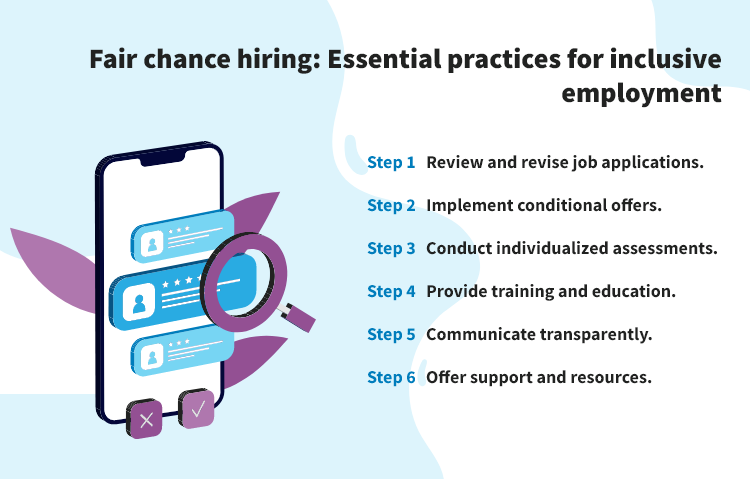
Ensure that job applications do not include questions about criminal history. Filter out irrelevant questions, such as those about criminal history, from job applications. This helps in focusing on the candidate’s qualifications and experience.
Conduct background checks only after making a conditional offer of employment. Leverage Real-time Job Posting Salary data to match candidates with appropriate benchmark jobs based on their skills and experience. This ensures that candidates are considered for their fit to the job before any background checks are conducted.
Evaluate candidates with criminal records on a case-by-case basis, considering the nature of the offense, the time elapsed since the conviction, and its relevance to the job.
Train hiring managers and HR professionals on the importance of fair chance employment and the benefits of a diverse workforce. This helps to reduce bias and promote fair hiring practices.
Clearly communicate the fair chance hiring process to candidates, including when and how background checks will be conducted. Provide candidates with an opportunity to explain their criminal history and any steps they have taken towards rehabilitation.
Provide support and resources to employees with criminal records, such as mentorship programs and access to training and development opportunities. This helps to ensure their success in the workplace.
Integrating the features from Salary.com’s Real-time Job Posting Salary Data can improve the effectiveness of fair chance employment practices within your organization, especially in matching jobs.
Fair chance hiring is essential for promoting inclusive employment and ensuring that all individuals, regardless of their past, can contribute to the workforce. Removing barriers to employment, fair chance employment helps to reduce recidivism, enhance community safety, and expand the talent pool available to private employers. Implementing fair chance employment practices involves revising job applications, training hiring personnel, conducting individualized assessments, and providing support to employees.

The latest research, expert advice, and compensation best practices all in one place.
Blog
Bringing trusted compensation intelligence and seamless planning to even more ADP users.

Blog
Learn how to train managers for effective pay conversations and build trust.

Blog
Total rewards package flexibility lets employees choose what matters - pay, perks, and benefits tailored to their needs.