Blog
Get Pay Right on ADP Workforce Now® Next Gen™
Bringing trusted compensation intelligence and seamless planning to even more ADP users.
Written by Salary.com Staff
June 05, 2026

A pay inequity refers to a situation where employees receive varying salaries, even though their roles and responsibilities are equivalent. This issue can occur across many areas, impacting the employees' perceptions of the company overall. It may also impact the company's earnings per share. Hence, it is a crucial area of focus.
This guide is for you as a leader of human resources or someone who oversees compensation. It will tell you all about paying inequities and provide steps to fix them. Furthermore, there are tools in this guide that will assist in creating a pay system that is fair for all employees and supports your business goals.
Paying inequities means some people will earn less than others doing similar jobs. This is beyond job titles and market pay rates. Certain factors are hidden that affect one group more than another. To ensure fairness and legality of pay structures within the company, management must review pay structures regularly.
Pay disparity negatively impacts employee engagement and poses legal risks for organizations. Such inequities differ from normal pay differences based on an employee's experience and location. Those in the compensation department work hard to ensure pay equity is addressed. Doing so creates a stronger and more productive workplace for organizations.
Organizations operating globally can rely on Global Market Data which provides international compensation benchmarks to ensure equity across different regions.
Several common factors create pay disparity inside companies.
Unconscious bias within the company can cause some individuals to receive lower starting pay than others who perform similar work
Differences in how individuals negotiate for their salary can have a major impact on their earning potential. Women and minorities often end up earning less over time due to negotiation differences.
Providing performance reviews that may not be objective can impact the pays increases for individuals within the company
Providing no pay bands or salary updates for the company can allow for inconsistencies in the salary differences for individuals in similar positions within the company
Pay disparity look at unfair differences in pay for similar work after controlling for job level, skills, and experience while the gender pays gap analyzes the average earnings of all workers.
| Aspect | Pay inequities | Gender pay gap |
|---|---|---|
| Focus | Equal pay for equal or comparable work after factors like role and performance | Overall average pay difference between men and women across the whole workforce |
| Causes | Bias in decisions, negotiation gaps, or poor processes | Mix of job choices, hours worked, career breaks, and some inequities |
| Measurement | Uses regression analysis on matched jobs | Simple comparison of median or mean earnings without controls |
| Fix | Targeted pay adjustments and process changes | Broader efforts on hiring, promotions, and culture |
| Legal tie | Often linked to Equal Pay Act rules | More about systemic trends and opportunity gaps |
Compensation analysis is a structured way to spot unfair pay differences by comparing data across your workforce. Follow these named steps for clear results.
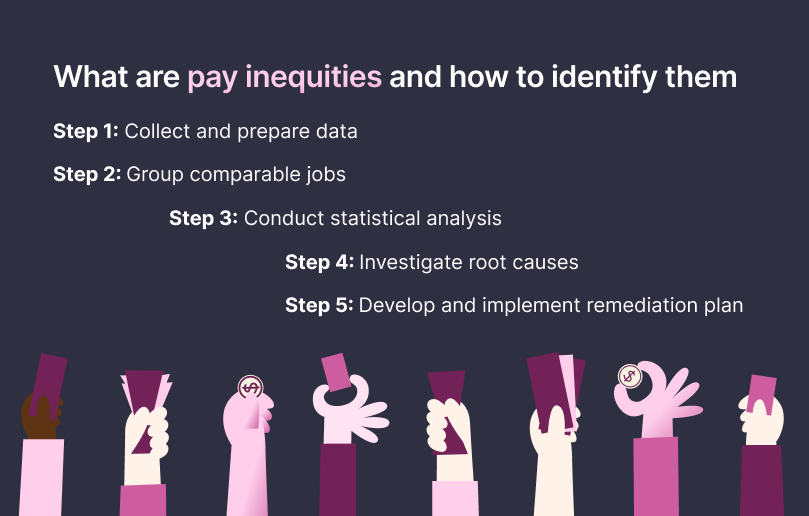
Gather all the data you need about pay, jobs, and employees. Make sure all employee details are complete and up to date. Clean the data to remove any errors. This will give you a clear picture of your company's pay structures and salary trends without guesswork.
Group jobs into similar categories. Use job evaluation tools to create job groups that are appropriate and fair. Avoid using job titles only as this does not reflect the true job categories. This step will ensure that you are comparing apples to apples.
To support job grouping, JobArchitect® helps design consistent job frameworks and career paths, ensuring fair comparisons.
Run statistical analysis such as regression models to determine if there are any pay gaps that cannot be explained. Analyze the protected groups to see if any of those groups exhibit such a gap. Use the software tools to expedite and improve the accuracy of this analysis.
Work with managers and HR to understand the reasons for the gaps. Document everything for compliance reports. Address the largest or most widespread problems first. This review will transform the numbers into insights.
Include a plan for pay adjustments with timelines and budgets. Clearly communicate the plan to establish trust. Track changes over time to ensure the fixes work. Repeat the process every year to ensure fairness in pay.
CompAnalyst® Pay Equity Suite is specifically designed to identify, analyze, and fix pay inequities while ensuring legal compliance.
HR professionals fix pays inequities by using data-driven adjustments and clear processes that build long-term fairness.
Conduct a full pay equity audit and make immediate adjustments where gaps appear after controlling valid factors.
Train managers on bias-free decision making for hiring, promotions, and raises so future pay stays balanced.
Update policies to require consistent pay bands and market checks that prevent new gaps from forming.
Track progress with regular reports shared with leadership to keep everyone accountable.
Good pay structure design creates clear salary bands and ranges that keep pay fair across similar roles.
Establish salary bands for each job level and review those salary bands each year.
Use job evaluation systems to determine job values based on the true demands of the job.
Ensure that salary decisions are separated from performance appraisals.
Include salary compression checks to make sure new employees do not start around the same salary as many of the company's more experienced employees.
Job evaluation helps ensure pay equity by measuring the true value of each role in a consistent way.
Use a point-factor system to evaluate and rank jobs objectively.
Regularly review job evaluations to ensure salaries match current job responsibilities.
Create a team to review salary evaluations to avoid individual bias in the process.
Link job evaluations to salary bands to ensure all jobs are paid competitively.
Pay transparency reduces pay disparity by letting employees see how pay decisions happen and encouraging fair practices.
Publish salary ranges in job postings to give candidates an idea of compensation, and to ensure negotiation is balanced between employer and candidate
Share a philosophy on compensation with all staff
Train leaders on how to discuss salary with employees who ask
Follow up with surveys to assess the impact of salary transparency over time
Organizations prevent paying inequities long-term by making fairness part of everyday compensation strategy and culture.
Schedule annual pay equity audits as a standard business process instead of a one-time project.
Create a written compensation philosophy that ties pay directly to job value, market data, and performance.
Provide bias training for all decision makers and include pay equity metrics in manager scorecards.
Build strong pay transparency policies and review them each year to adapt to new laws and best practices.
Here are some FAQs for better understanding.
Companies should audit pay disparity at least once a year to stay ahead of the law and catch issues early. In 2026, many organizations will be performing these audits due to the fast-moving job market, wherein only about half of all companies perform such audits each year. By performing these audits, companies can maintain trust with their employees and avoid surprises regarding pay equity.
Assess employees based on separation of base pay and performance ratings. Focus on market and equity compensation when conducting reviews. In 2026, compensation professionals will recommend frameworks for merit, promotion, and off-cycle compensation to ensure consistency in the compensation structure. This will help to reduce any bias in the process and ensure that compensation is fair across the board.
Not addressing pay disparity incurs the cost of high turnover, damaged employer brands, and legal claims. In 2026, companies that do not perform regular pay equity studies will find that their workforce and financial performance suffer due to employees leaving the company to seek more equitable workplaces. Act now to protect your company.

The latest research, expert advice, and compensation best practices all in one place.
Blog
Bringing trusted compensation intelligence and seamless planning to even more ADP users.

Blog
Learn how to train managers for effective pay conversations and build trust.

Blog
Total rewards package flexibility lets employees choose what matters - pay, perks, and benefits tailored to their needs.