Blog
Get Pay Right on ADP Workforce Now® Next Gen™
Bringing trusted compensation intelligence and seamless planning to even more ADP users.
Written by Salary.com Staff
August 21, 2026

DEI training allows organizations to build awareness and create an inclusive workplace culture where every individual feels valued. For those in HR and compensation, it allows individuals to recognize biases and create a more equitable workplace for all employees.
From defining key terms to recognizing potential mistakes and understanding current DEI trends, this guide provides insights and statistics to improve the DEI efforts of your organization.
DEI training involves giving employees training on diversity, equity, and inclusion in the workplace.
Diversity means recognizing the many differences between people from various backgrounds. Equity means treating everyone equally and giving people what they need to succeed. And inclusion is when people feel valued in the workplace and are allowed to share their ideas and opinions.
Through DEI training, employees gain an understanding of their biases and how to overcome them. Employees can also learn to work well together within teams of various backgrounds and experiences. Overall, the goal of DEI training is to improve the company culture.
Organizations can strengthen DEI initiatives with CompAnalyst®, which helps HR teams make market-based compensation decisions, improve pay consistency, and support fair and equitable workplace practices.
DEI training plays a vital role in helping organizations create fair and productive workplaces.
It reduces unconscious bias so that people make better decisions in the hiring process.
It fosters innovation as teams with different cultural and demographic backgrounds bring varied ideas to the table.
It creates an equitable workplace that ensures all employees have the same opportunities to advance in their careers.
Employees feel more engaged and valued in the workplace because of effective DEI training.
Organizations can reinforce these efforts with CompAnalyst® Pay Equity Suite, which helps identify potential pay gaps and supports fair, data-driven compensation decisions that align with DEI goals.
Most successful organizations make DEI training available to people at every level.
All employees will benefit from basic awareness training regarding diversity and inclusivity.
Leaders in leadership positions will gain more advanced skills to allow them to work with diverse teams.
HR and compensation will require training to allow them to better handle diversity, equity, and inclusivity in conjunction with compensation.
All new hires will take a few classes early in their employment to educate them on the importance of diversity in the workplace.
Organizations choose from several common types of DEI training based on their size, budget, and goals.
Instructor-led training uses live facilitators to provide interactive learning opportunities for the participants.
Self-paced online training allows people to learn according to their own schedules.
Blended learning offers both live and digital training to provide deeper engagement and better training results for participants.
Instructor-led training involves live sessions guided by experts who interact directly with participants.
Allows for real time discussions on topics like workplace harassment, bias, and inclusive behaviors.
Allows for role plays and group exercises to gain the necessary skills.
Creates a safe psychological environment for employees to openly discuss differences in the workplace.
Utilized by many companies as a means of reinforcing their DEI initiatives and driving change in employee behaviors.
Self-paced online diversity training allows employees to complete modules at their own pace.
Learners can review course content as needed and focus on the sections relevant to their role.
The courses include videos, quizzes, and scenarios that cover the inclusion of courses.
Courses can be easily scaled for large organizations and tracked for completion rates.
There are also free courses available on trusted platforms to supplement the company's training.
Blended learning combines instructor led sessions with self-paced online components.
Flexibility with opportunities for live interaction and questions.
Online awareness of the topic followed by discussion of the topic.
Higher level of engagement with the topic and longer lasting changes in attitudes towards the topic.
Organizations report improvements in skills and commitment to DEI efforts.
Successful DEI training implementation follows a clear process with named steps.
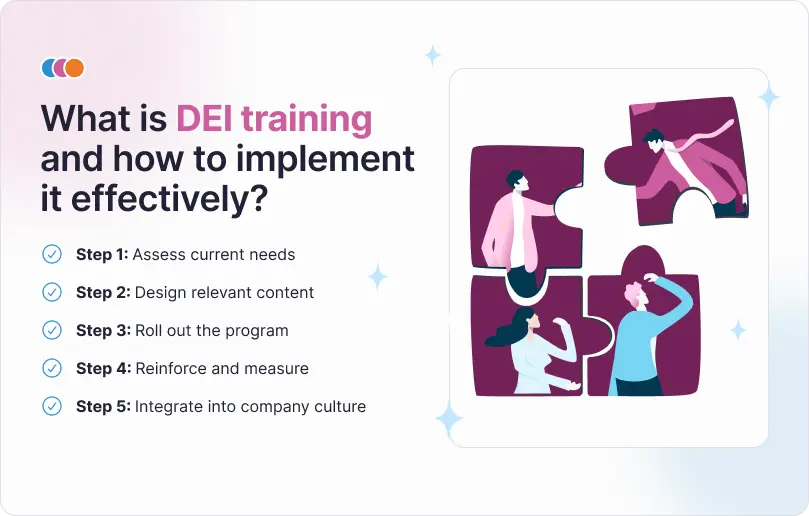
Review the current culture of the company through surveys and conversations with employees. Identify the barriers to diversity and inclusion. Gather feedback from different groups within the company. This step will establish the foundation for the diversity and inclusion program.
Select or create training that aligns with your company goals, such as unconscious bias or cultural competence training. Ensure the training includes strategies that employees can use in their daily work and that relate to their compensation and leadership positions. Make sure the training content reflects the company's values and industry requirements.
Communicate with the purpose and benefits of the initiative to all employees prior to launch. Offer options for employees of different learning styles and schedules. Provide support for employees with questions and ensure high levels of participation. Track the initiative and address any issues that arise as soon as they occur.
Follow the training with discussion groups and mentorship programs. Use metrics like engagement scores and feedback to assess the training's impact. Make changes based on this evaluation to improve future training sessions.
Embed DEI principles into policies, performance reviews, and talent practices. Hold leaders accountable for meeting DEI goals and celebrating their successes. Schedule regular refreshers to ensure commitment to these goals over time.
CompAnalyst® helps HR consistently match jobs to market benchmarks, supporting fair compensation decisions and reducing bias across similar roles.
Real examples show how companies apply DEI training successfully.
Unconscious bias workshops allow employees to recognize and manage automatic attitudes.
Cultural competence training helps employees develop skills working with people of different backgrounds.
Inclusive leadership programs help employees develop skills, creating a psychologically safe environment for diverse teams.
Allyship programs encourage employees to exhibit positive behaviors to eliminate discrimination and promote an inclusive environment.
Avoiding these common mistakes helps make your DEI training more effective.
Viewing training as a one-time event limits its impact.
Focusing only on awareness of issues leaves people unaware of actions to take.
Not measuring diversity and inclusion efforts makes it impossible to prove impact or improve these programs.
Poor communication or forcing people to participate without providing context or communication about diversity and inclusion of efforts can damage the organization's trust in these initiatives.
Here are some FAQs for better understanding.
Many scaled back or completely renamed their DEI programs due to legal pressures and orders from company executives. Some did so due to concerns regarding the cost and effectiveness of their programs. Others focused on merit-based workplaces with a commitment to reducing discrimination in the workplace.
In at will employment states, refusing required training can result in discipline or even termination from employment if the training does not violate the employees' protected rights. The courts have generally supported the rights of employers to require training from employees for legitimate business-related reasons. Employees can request accommodation rather than refusing to attend training altogether.
Various studies show mixed results regarding the gains each group makes. However, by removing the barriers of any group, companies can fairly recognize the talents of their employees. This will ultimately create a stronger company culture that benefits the organization as a whole.

The latest research, expert advice, and compensation best practices all in one place.
Blog
Bringing trusted compensation intelligence and seamless planning to even more ADP users.

Blog
Learn how to train managers for effective pay conversations and build trust.

Blog
Total rewards package flexibility lets employees choose what matters - pay, perks, and benefits tailored to their needs.